Fostering Healthy Aging Across Generations: Social Work Faculty Transforming Community Connections
Wednesday, Jul 02, 2025
Social isolation among older adults has reached epidemic proportions. According to the National Institute of Mental Health, one in four adults age 65 and older is socially isolated, and research shows that loneliness poses health risks equivalent in their effects on mortality to smoking up to 15 cigarettes per day.
But in senior communities across South Florida, one Florida Atlantic educator is making a profound difference through her innovative approach to healthy aging and intergenerational connection.
Donna Drucker, LCSW-QS, a senior clinical instructor at the Phyllis and Harvey Sandler School of Social Work within the College of Social Work and Criminal Justice, is building community relationships and helping seniors form healthier social habits through a series of workshops and academic service learning opportunities. She has delivered her “Move Over Mood Swings” workshop to packed audiences at John Knox Village, Harbour Edge, SHAN Boca Chamber, and Toby and Leon Cooperman Sinai Residences—with every venue inviting her back for additional sessions.
"I've always been drawn to the rich wisdom and experiences of the older population," said Drucker, who brings 30 years of social work experience to her role. "It's essential to be working with them in multi-generational, intergenerational ways. We can draw from and learn from each other."
Addressing the Silent Crisis
The Sandler School of Social Work is home to the Healthy Aging Academy, which also offers a Healthy Aging Certificate Program for undergraduate and masters-level students. Naelys Luna, PhD, MSW, founding dean of the College of Social Work and Criminal Justice, began receiving calls from organizations throughout the area seeking assistance with social isolation, particularly affecting seniors—a trend that only intensified after the pandemic.
“Donna was a natural choice due to her expertise in the healthy aging sphere and her passion for and signature ability to connect in a meaningful way with intergenerational audiences,” Luna said.
Drucker developed her workshop to address a growing need identified by Florida Atlantic’s community partners. She helps senior audiences understand the gravity of social isolation and its health effects by examining and discussing the challenges older adults face when relocating or adapting to new circumstances.
"Assimilation is really hard for our elders," she noted. "Whether they're from this country or another country, the older we are, the harder it is. Even at senior communities, directors say it takes a good six months to assimilate into a new situation."
The workshop addresses the complex emotions many older adults experience grief from multiple losses, exhaustion from starting over, and the fear of investing emotional energy in new relationships when previous connections may have been lost to death or distance.
"Mother Teresa said, 'There are no great things, only small things with great love,'" said Dean Luna. "That's exactly what I witness Donna do during her presentations. Her love, compassion, and care embrace every single person in the room. Recognizing her work and dedication is sharing with the world how small things with great love truly make a difference."
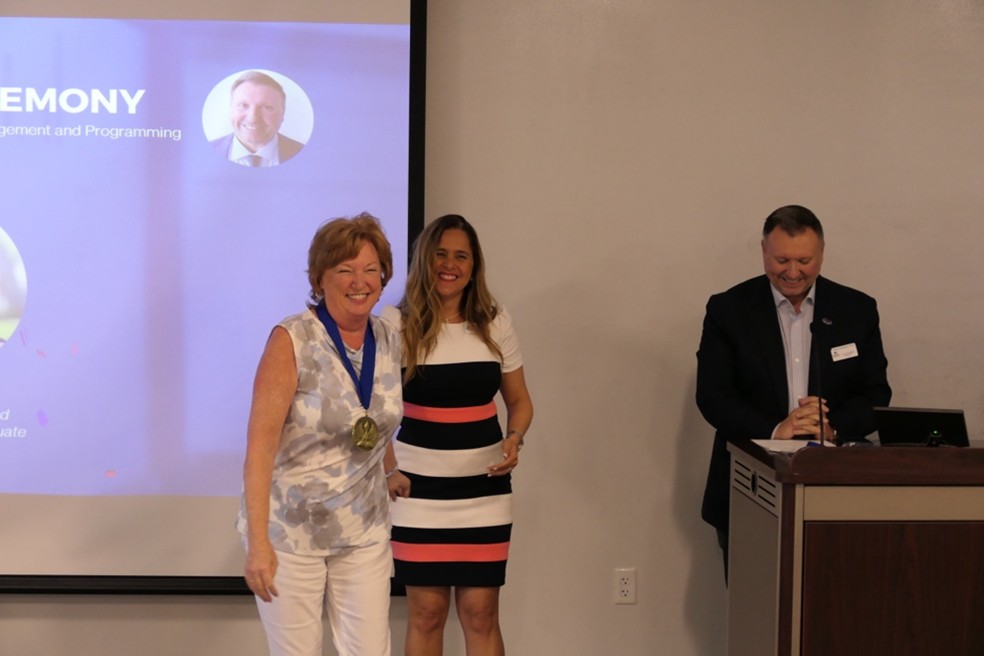
Drucker (left) received the 2025 Excellence and Innovation in Undergraduate Teaching Award for the College of Social Work and Criminal Justice. She was given her award during the Annual Research Symposium. Also pictured Naelys Luna, PhD, MSW, founding dean of the College, and Tony Andenoro, PhD, director of community engagement and programming.
Keeping the Emotional Tank Full
Central to Drucker's approach is the concept of the "emotional tank": an idea based on Dr. Ross Campbell's work in child development, but here applied across all ages. Like a car's gas tank, when our emotional reserves run on "residual junk," we don't function properly.
Drucker teaches five key components to maintain emotional wellness, each rooted in the connection between neuroscience and healthy aging: validation of feelings, focused attention, eye-to-eye contact, physical contact, and unconditional love.
“Donna’s work exemplifies the heart of social work – meeting people where they are, fostering meaningful connections, and transforming lives through compassion and evidence-based practice,” said Michael Robinson, PhD, MSSW, director of the Sandler School of Social Work.
The Power of Intergenerational Programming
Drucker's commitment to intergenerational connections sets her work apart. Through academic service learning, she brings students from her Human Behavior in Social Work and Families in Social Work courses into community settings to practice their skills with older adults.
"When you see little ones and our elders singing 'Twinkle, Twinkle Little Star' together—you don't know who's happier," she said. "That's the way we’re built. That's the way we’re designed, to be working together."
Her students initially arrive nervous, especially those who haven't spent considerable time with older adults or who lack grandparent relationships. But the connections they form are transformative.
"They want them to come back," Drucker noted. "They’re learning from each other, and it's so powerful."
The programming includes sessions on topics such as relationships, education, travel, and finance, and interactive activities like laughter yoga, which combines elements of traditional yoga practice with playful movement and laughter to promote well-being.
“Donna’s commitment to intergenerational engagement not only enriches the lives of older adults but also shapes our students into empathetic, skilled professionals,” Robinson said. “At the Sandler School, we are proud to support initiatives that bridge generations and build stronger, more connected communities.”
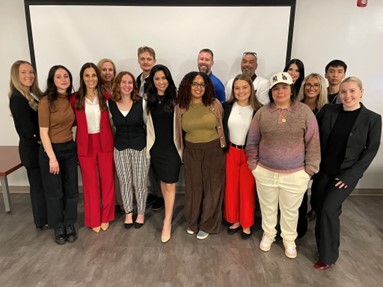
Drucker (middle) in the community with BSW students (L-R) Exzavia Pearson, Junia Turenne, Anisha Soto, Shicarro Shelton, Donna Drucker, Jonathan Jean Louis, Maria Listur-Menendez, Lauren Difederico, Naheemah Felix engaged in academic-service learning at John Knox Village (JKV), an independent senior living community located in Broward County
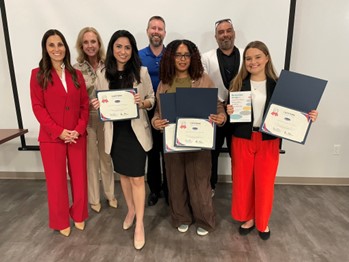
BSW students Maria Listur-Menendez (in green) and Shicarro Shelton (in stripes) facilitate a small group activity for brain health with JKV community members as they develop a personal action plan for increased socialization.
Building Support Systems and Breaking Isolation
Drucker's workshops provide practical strategies for combating isolation. She works with participants to develop personal action plans, examining what they need to build their cognitive reserves and create workable strategies for staying engaged with others and their community. "The most important commodity is to do an assessment on ourselves," she noted.
Drawing from research, Drucker shared that there are numerous practical ideas and recommendations that seniors can incorporate to promote emotional wellness in their daily lives:
- Engage in Lifelong Education – “Challenge your brain by participating in or teaching a class, mastering the buttons on your TV remote, switching up your routine, taking on a task, or doing something with your non-dominant hand,” like brushing your teeth.
- Volunteer – when you lend your time and talents to benefit others, it “has benefits for our brain and heart, as well as for those we are working with.”
- Invest in Social Interaction – “Share with one another. Have a couple of good friends to laugh and cry with and connect with family and friends.”
- Get Moving – “Physical activity is essential, as it incorporates every part of our complex bodies and is a defense for depression and dementia,” citing walking and dancing as her two favorite ways to move.
- Prioritize Zzzs – Getting the right amount of restful sleep is key, because it “lets your body and mind rest and rejuvenate.”
- Systemize Support – When it comes to building a personal action plan, there is strength in numbers. “Be open to accepting help. Develop a buddy system and support each other in building your plan with a balance and combination of activities you like to do by yourself, with one other person, with a small group, and with a large group.”
- Choose Joy – “Decide to be the best you can be right where you are.”
Students as Future Change Agents
The impact of Drucker’s service-learning programs on Florida Atlantic students extends far beyond academic requirements. Drucker watches them transform through community engagement.
"When I look at our students, they’re shining so brightly," she said. “They’re excited and thankful for the opportunity and experience and feel ready to take it to the next level. Their vast knowledge, coupled with their positive energy and desire to be catalysts for change, that’s what it’s all about."
Working one-on-one with seniors prepares Drucker’s students for their future internships and careers in social work, building a new cohort of professionals committed to intergenerational collaboration.
"We need to have these opportunities," Drucker stressed. "The textbook goes just so far. Now let's put it into action, into the real world, and that's what's going to take us to the next level."
Drucker envisions expanded programming and greater infrastructure support for aging populations. While medical advances extend lifespan, she advocates for increased funding to match quality of life with longevity.
"We have a lot of medical advancements. We can keep people alive," she said. "But we don't have the funding or the infrastructure to follow through on the needs for the individuals."
For social work educators and practitioners inspired by her model, Drucker offers straightforward advice: "Lean into it. Don’t be afraid of it. Go and explore. Go volunteer somewhere. Put yourself out there."
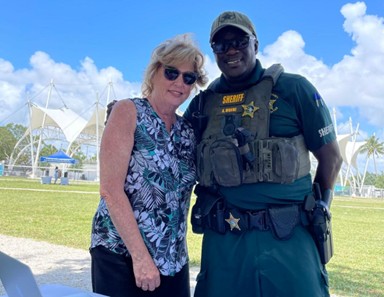
Drucker with Deputy Aaron Moore, community liaison for the Broward County Sheriff's Office, Pompano Beach District, for Community Connect: A Holistic Resource Extravaganza, hosted by Handy, Inc., in Pompano Beach.
A Model for Community Partnership
Drucker's work represents a powerful model of university-community partnership, where academic expertise meets real-world needs. Her initiative addresses a critical public health issue while fostering the intergenerational connections essential for thriving communities.
“Donna’s integration of experiential learning and academic service-learning immerses students in community-based projects that deepen their understanding of human behavior and family systems while addressing pressing social needs,” said Precious Skinner-Osei, PhD, MSW, associate professor and BSW program coordinator. “These experiences prepare students for internships and professional roles with clarity, competence, and purpose.”
As social isolation continues to impact individuals across age groups, Drucker's approach offers hope and practical solutions. By keeping emotional tanks full, building support systems, and creating meaningful connections across generations, she's helping combat one of the most pressing challenges of our time.
"We are in this together," Drucker concluded. “We are each a purposeful and important member of the community and not meant to do life alone. When we continue to build our relationships, learn from each other, and take care of each other, that's where we find balance and can truly thrive."