Award-Winning Insight: Professor Diana Sun Rewrites the Reentry Story
Wednesday, Dec 03, 2025
Few early-career scholars make their mark as quickly as Diana Sun, Ph.D., assistant professor in the School of Criminology and Criminal Justice. Her study on white-collar reentry, published in Justice Quarterly, has earned the 2025 Outstanding Article or Book Chapter Award from the American Society of Criminology’s Division of White-Collar and Corporate Crime. It’s an honor that both highlights her academic rigor and underscores the School of Criminology and Criminal Justice’s growing reputation for high-impact research.
Extending the Conversation on Reentry
The award Sun is receiving for her study is one of the most competitive recognitions in the field. Published recently in Justice Quarterly, Sun’s paper represents a milestone achievement for a scholar still in the early stages of her academic career.
“It was surreal,” said Sun, who joined Florida Atlantic University’s School of Criminology and Criminal Justice in 2022. “I had to reread the email and have my husband confirm I wasn’t imagining it. To have the first lead-author publication from my dissertation recognized like this—by people whose work I’ve long admired—means so much.”
Sun’s article, “Resiliency in Reentry, Sensitivity in Strangers: An Examination of White-Collar Offenders and Their Reentry Process,” builds on longstanding debates about how white-collar offenders experience incarceration, traditionally framed by two competing ideas: the special sensitivity hypothesis, which argues that those unaccustomed to prison life struggle more acutely, and the special resiliency hypothesis, which suggests that social capital and professional experience help them adapt.
Her contribution was to ask a new question: What happens after they’re released from prison?
By extending these frameworks into the reentry phase, Sun identified a gap in how criminologists understand the concept of resilience. Her qualitative study, which drew on interviews conducted in partnership with a federal probation office, revealed that white-collar offenders’ experiences diverge sharply from established reentry models.
Unlike many returning citizens, her participants typically had secure housing, family support, and a quick return to employment. But they also faced social stigma and heightened social anxiety. Many worried about being “Googled” or recognized in social situations, describing a persistent fear that their criminal record would resurface in casual interactions.
“These white-collar offenders often had supportive families to come back to, they had a home ready for them, sometimes they had a job usually waiting for them as well,” explained Sun. “They're not sharing the same problems that we typically would see with other populations. “Instead they're talking about and focusing on very different forms or priorities: they’re fearful of social situations, they’re concerned about other people’s perceptions.”
That contrast—material stability paired with social isolation—offers a more nuanced picture of reentry. It reframes resilience not as simple success but as adaptation within an altered social landscape.
By translating established theories from incarceration to reentry, Sun’s research opens new lines of inquiry—about class, stigma, and the meaning of rehabilitation in a digital age—and cements her place as one of Florida Atlantic’s emerging research leaders.
“When Dr. Sun shared with me she received the award, it may have come as a surprise to her but it was no surprise to me,” said Ryan Meldrum, Ph.D., director of the School of Criminology and Criminal Justice. “Diana’s research has always combined analytical rigor with theory to address important questions in ways that provide key insights for justice practitioners and researchers.”
The Research Behind the Recognition
Sun’s study grew from her doctoral research at the University of Cincinnati, where she earned both her master’s and PhD. in criminal justice. Working with her mentor, Dr. Michael Benson, she designed an ambitious mixed-methods project that combined surveys and in-depth interviews to explore the lived experiences of individuals convicted of white-collar crimes.
Her access to participants was facilitated through a partnership with a federal probation office, where she conducted semi-structured interviews with individuals under supervision for both white-collar and non-white-collar offenses. That access provided a rare window into the realities of reentry, allowing her to compare patterns across social class and offense type.
The process was not without obstacles. Sun gathered her data immediately before the COVID-19 pandemic, only to have her fieldwork paused when in-person interviews became impossible. Continuing remotely required flexibility, patience, and persistence.
After completing the analysis, Sun submitted her first manuscript—adapted from her dissertation—to Justice Quarterly. The review process, she said, was long and intense: “One of the reviewers pushed me to think more deeply about the meaning of ‘middle class’ and how that shapes the reentry process. It's a stronger paper for taking in all that feedback.”
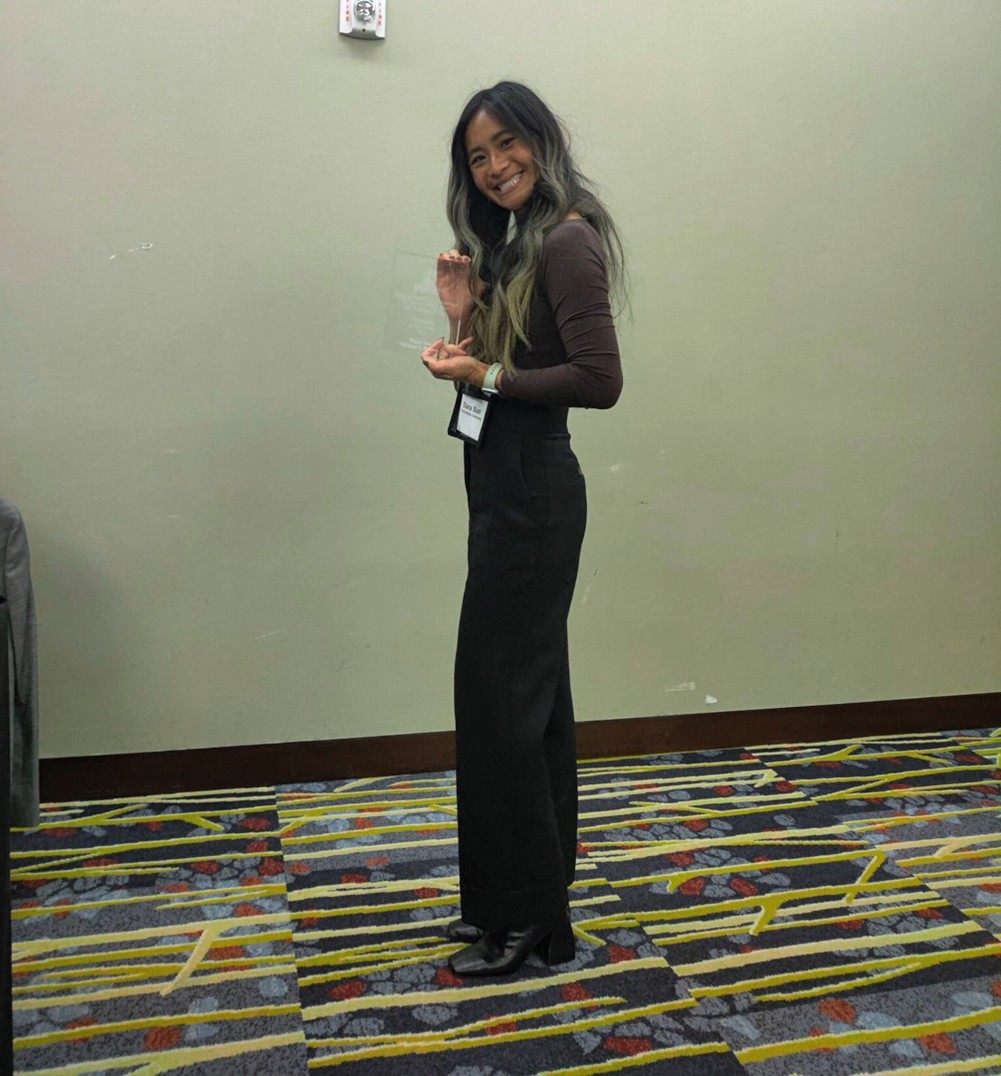
Dr. Sun with her award from the American Society of Criminology’s Division of White-Collar and Corporate Crime for 2025 Outstanding Article or Book Chapter Award
A Scholar on the Rise
Sun’s academic path began on the opposite side of the country. A first-generation college student from Long Beach, California, she entered the University of California, Irvine as an undergrad without a clear sense of what she wanted to study—until a course in criminology changed everything.
“I really connected with the material,” she said. “I got very interested in understanding how poverty plays a role in why people engage in crime. Does it matter what community you're living in? Does that have an impact on how you behave? Those questions sparked this interest, and then I got involved with research as an undergraduate, which really showed me that I could ask questions and I could figure out the answer if I go and collect the data.”
Encouraged by her mentors at UC Irvine, she pursued graduate studies at the University of Cincinnati. Her dissertation expanded on an often-overlooked topic—female white-collar offenders—addressing a gap in prior research that had focused almost exclusively on men. That early work continues to inform her scholarship, which examines how gender, class, and opportunity shape the experience of crime and punishment.
Now at Florida Atlantic, Sun is channeling that momentum into collaborative projects that connect criminology with related disciplines, including social work and public health. She’s also applying her expertise in data collection and analysis to questions about the opioid epidemic and community resilience, reinforcing the School’s focus on evidence-based, interdisciplinary research.
“I’m lucky to be surrounded by colleagues who inspire me,” she said. “There’s a strong culture of collaboration here, and that’s been invaluable for an early-career researcher. I’ve learned so much from the faculty around me.”
A Member of the Florida Atlantic Community
When Sun joined Florida Atlantic in 2022, she was looking for a place that valued both rigorous research and meaningful community impact. Florida Atlantic’s diverse student body, collaborative faculty culture, and commitment to applied scholarship made it an ideal fit.
“I was drawn to Florida Atlantic because of its diversity—not just in demographics, but in perspectives,” she said. “It’s a place where students bring very different experiences into the classroom, and where those experiences actually shape how we talk about crime and justice.”
Sun sees her own work as contributing to the interdisciplinary energy of the university. Her research on white-collar reentry intersects with public policy and sociology, while her ongoing studies on opioid overdoses connect criminology with public health and community resilience. The result is a scholarship that not only advances theory but also informs prevention, rehabilitation, and policy design.
Teaching the Evidence
Alongside her research, Sun has quickly become a valued instructor in both undergraduate and graduate programs. She teaches Law, Crime, and the Criminal Justice System, a general education course that introduces students to the study of criminology, as well as upper-level classes in Criminology and White-Collar Crime.
Teaching the same intro course that first inspired her career feels like coming full circle.
“It's the same class that I fell in love with, that kind of kick-started my whole career trajectory,” she said, “so it's kind of come full circle that I get to teach that class now to undergraduate students. “Hopefully, I can connect with my students in that same way to inspire them to go on to a career in the field as well.”
Sun’s approach emphasizes critical thinking and data literacy. Students learn to engage directly with public data sources, such as the FBI’s Uniform Crime Reports, census datasets, and hotspot mapping tools, to evaluate how perceptions of crime align (or don’t) with empirical evidence.
“I tell my students that you might have a perspective, and that’s great, you should have a perspective,” she said. “But what does the data actually say? Does it really support your perspective or not? And this is what I mean by being good consumers of research. I want my students to understand how they can go out and find the data they need to answer their questions—and ask better questions.”
Through both her teaching and scholarship, Sun is helping to position Florida Atlantic as a leader in evidence-based criminology: a place where emerging ideas about justice and rehabilitation take root.
“Florida Atlantic has given me a platform to grow as a researcher and educator,” she said. “The support I’ve received here has been incredible, and I’m excited for what comes next.”
“The award is a recognition of the quality and impact of Dr. Sun’s work, and I believe it is but one of many to come,” Meldrum said. “I have every expectation that as Diana advances her research portfolio, she will continue to attract recognition from the field and influence future criminal justice policymaking.”