Two Schmidt College of Science Faculty Named Inaugural Research Team Leaders as Part of VIP Consortium
Tuesday, Dec 16, 2025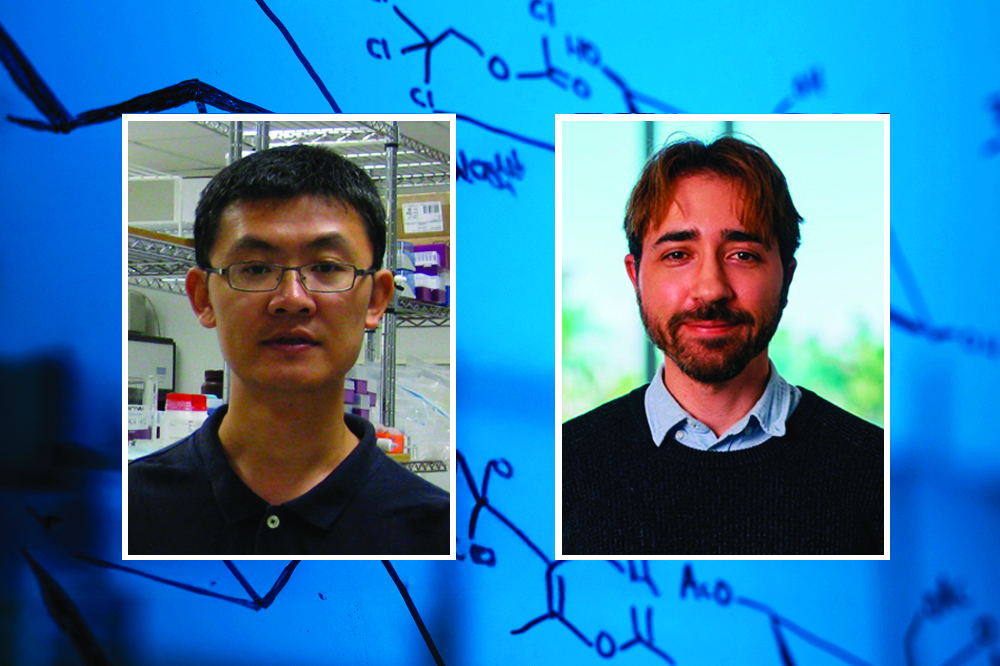
Florida Atlantic University made history in September when it officially launched its first Vertically Integrated Projects (VIP) program and joined the international VIP Consortium – becoming the first university in Florida to join this global network of more than 50 institutions of higher education dedicated to research-driven, cross-disciplinary learning. The initiative is supported by a $2.2 million grant from the Fund for the Improvement of Postsecondary Education (FIPSE) that was awarded to the university in late 2024 by the United States Department of Education.
Four outstanding faculty-led teams were selected as the university’s first VIP teams from a highly competitive pool of 31 proposals. Two of the teams include faculty leaders in the Charles E. Schmidt College of Science: Deguo Du, Ph.D., professor, Department of Chemistry and Biochemistry, and Rodrigo Pena, Ph.D., assistant professor, Department of Biological Sciences.
In alignment with Florida Atlantic’s Road to R1 initiative, the VIP program is a critical part of building a high-performance, inclusive research infrastructure. It supports faculty research productivity, strengthens the student pipeline into graduate and research-intensive careers, and enhances institutional metrics like graduation rates, retention, job placement and external funding.
“Mitochondrial Damage by Amyloid-Beta in Alzheimer’s Disease”
Du, along with Kevin Yunqing Kang, Ph.D., associate professor, Department of Ocean and Mechanical Engineering within FAU’s College of Engineering and Computer Science; and Ewa Wojcikiewicz, Ph.D., associate professor, Department of Biomedical Science within FAU’s Charles E. Schmidt College of Medicine, received $46,500 in funding to uncover how amyloid-beta interacts with mitochondrial membranes to trigger early cellular damage in Alzheimer’s disease. By identifying the molecular steps that lead to aggregation and toxicity, the group aims to reveal new targets for therapeutic intervention and train students in interdisciplinary biomedical research.
“The VIP Consortium represents an important step for Florida Atlantic as it provides a sustainable structure for integrating research, education and mentorship across different colleges, aligning with the university’s R1 mission and national visibility in cutting-edge, collaborative science,” expressed Du.
The group’s work addresses one of the least understood events in Alzheimer’s disease – the intracellular aggregation of amyloid-beta. By clarifying how peptide-membrane interactions impair energy production and cell survival, the team’s research could open new directions for early diagnosis and therapeutic development.
“This funding will allow us to establish a sustainable, cross-disciplinary research team that integrates experimental and computational approaches to study amyloid-β–membrane interactions,” said Du. “It will also support essential resources for the proposed biophysical and biochemical studies and enable early-stage students to gain meaningful research experience and contribute to advancing our understanding of Alzheimer’s disease mechanisms.”
Du and his team are currently recruiting undergraduate students and hope to start the project by the end of October. Student responsibilities will include building mitochondrial membrane models to test Aβ binding and using computational modeling to predict molecular interactions.
“Astroglia Roles in Central Nervous System Aging”
Pena, together with Casey Spencer, Ph.D., assistant professor of neuroscience in Florida Atlantic’s Harriet L. Wilkes Honors College, received $46,500 for the first year to understand, in detail, how the brain ages. The team will investigate the support cells in the brain called glia, which are known to start malfunctioning during aging. This malfunction triggers the neural circuit breakdowns that underlie dementia. By using a combination of AI-driven computational modeling in Pena’s lab, as well as genetics, electrophysiology and high-resolution imaging Spencer’s lab, the team will measure how astrocyte (support cells) function changes with age and affects brain circuits.
“If we can show exactly how aging glia push neurons toward failure, we will have revealed new cellular and molecular targets that could be used to slow or prevent Alzheimer’s disease and related dementias,” noted Pena. “Beyond the medical payoff, the project demonstrates an interesting bench-to-computer workflow that any lab can adapt: collect rich biological data, analyze it with AI and feed the insights back into experiments. In that sense, the work is both a scientific investigation and a template for modern and data-intensive biology that FAU students and researchers will be using.”
The consortium’s seed money will permit the team to bring 14 new students, who are mostly first and second-year undergraduates, into the lab. It will also allow the group to cover the consumable supplies for electrophysiology and confocal microscopy and secure the needed computing resources for image analysis and AI-driven modeling simulations.
Research on the study is already underway. Pena’s computational neuroscience lab is currently writing code for glial cells and gathering small simulations. On the experimental side, Spencer is capturing nervous system images and testing changes to motor circuit function in different age cohorts. Some students have already been recruited for the project.
“Student participants will learn advanced AI methods to extract information from experiments and apply it in computational models,” shared Pena. “They will also learn how to manipulate genes in living animals, record real-time electrical activity from a neural circuit and capture and analyze high-resolution images of the aging brain. They will also practice presenting their findings, mentoring younger teammates, and, in many cases, they will earn co-authorship on conference abstracts and journal papers.”
By the end of the first year, Pena expects to have enough preliminary data to submit larger proposals to the National Science Foundation and the National Institutes of Health.