Postdoc Spotlight on Alumnus Juan Lopez, Ph.D. ‘24, M.S. ‘18
Monday, Mar 30, 2026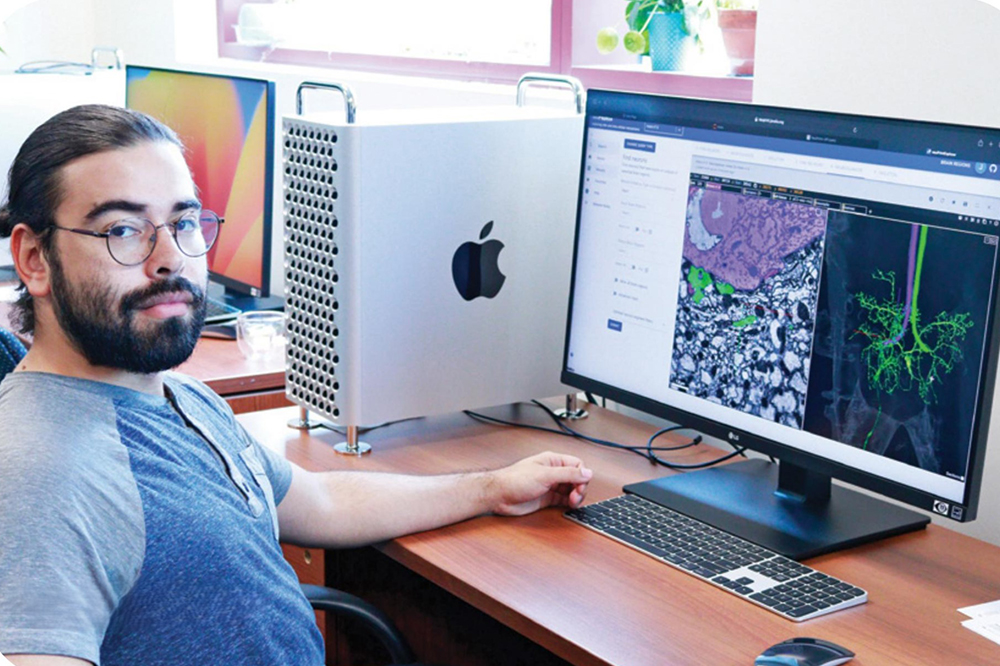
Two-time Florida Atlantic alumnus Juan Lopez, Ph.D., is a postdoctoral researcher in the lab of Rodrigo Pena, Ph.D., an assistant professor of biological sciences in the Schmidt College of Science. His work is helping to push the boundaries of computational neuroscience using fruit fly (Drosophila melanogaster) connectomes— a dataset that provides a revolutionary map of every neuron and synaptic connection in an adult fruit fly’s brain and ventral nerve cord.
For Lopez, neuroscience always intrigued him as an area of research, but he wanted to grow into a more computational role within the field. He previously worked with fruit flies while earning his Ph.D. in integrative biology-neuroscience with Rod Murphey, Ph.D., a professor of biological sciences in the college, and he found it difficult to move out of the space without sacrificing some of his skillsets in the process.
“With computational neuroscience, I could use all my experience with flies and fly neuroscience while also shifting towards a new and exciting area of expertise,” recalled Lopez. “After being introduced to the concept of computational neural models, I became a quick adapter and have not looked back. It is becoming increasingly popular among neuroscientists to learn coding, and computational neuroscience is a natural extension of this trend. What calls to me most is the idea that I can take something like the connectome and, one day, simulate entire circuits on demand, answering several questions in minutes versus the days, weeks and months spent on experiments focused on a single question.”
In Pena’s lab, Lopez uses the fruit fly’s recently published connectomes to analyze how neurons connect to each other in various contexts, including the Giant Fiber (GF) System of Drosophila, a neural circuit that controls this fruit fly’s rapid escape reflex. Lopez explained that the power of the connectome extends beyond pretty visuals.
“It uses advanced segmentation algorithms and convolutional neural networks to automatically recreate the 3D structure of one neuron and its connections as a distinct structure from all the others,” said Lopez. “There is also a treasure trove of data on synapse locations, neurotransmitter identity and connection directionality. The vast amount of data is smoothly accessed using small python scripts, letting us analyze all the neurons in any of the three connectomes we use at once—over 100,000 neurons!”
Pena’s lab is working to use the connectome for more than analysis. Since researchers can access the full structure of neurons, they are also using modeling methods to simulate communication between neurons.
“This helps us make accurate predictions about how circuits function, which we use as part of our collaborations,” shared Lopez. “Being able to simulate a circuit before running an experiment with such detail available greatly narrows the focus of experiments, saving both time and resources.”
As a researcher at Florida Atlantic, Lopez enjoys a high degree of independence which he values, along with his colleagues who are a constant source of ideas and inspiration.
“To me, having the flexibility to conduct research in my own way is the best freedom a post-doc can ask for,” noted Lopez. “I discovered connectomics last year, and it quickly became a favorite topic of mine. As I dug into it, I realized Dr. Pena’s lab was uniquely positioned to utilize such rich datasets. When I presented the concept to him, he quickly found ways to let me explore use cases for research without limits. This freedom to ‘play’ is an invaluable part of becoming a better scientist.”
Since he began working with Pena, the team has been met with great success in both publishing and presenting their findings. Their publications include: “Frazzled/DCC Regulates Gap Junction Formation at a Drosophila Giant Synapse” in ENeuro and “Axo-Axonic Synapses on Descending Neurons in the Drosophila Ventral Nerve Cord” in bioRxiv.
Lopez has also been accepted as a speaker at the upcoming Simulated Bodies: Whole Body Biomechanical Models conference in April at the Howard Hughes Medical Institute Janelia Research Campus in Ashburn, VA. He will also present at a workshop hosted by the Pena lab about computational neuroscience for Florida State University’s CompNeuroSociety on Florida Atlantic’s Jupiter campus later this year.
In addition, Lopez is pleased to join Pena and Casey Spencer, Ph.D., assistant professor of neuroscience in Florida Atlantic’s Harriet L. Wilkes Honors College, who will spearhead one of the university’s four Vertically Integrated Projects (VIP) projects: Nervous System Aging and Glia: Modeling with Experimental Insights. Last fall, Florida Atlantic made history when it joined the international VIP Consortium—becoming the first university in Florida to join this global network of more than 50 institutions of higher education dedicated to research-driven, cross-disciplinary learning.