Physics Professor’s Project Among First Approved for New Roman Space Telescope
Monday, Aug 31, 2026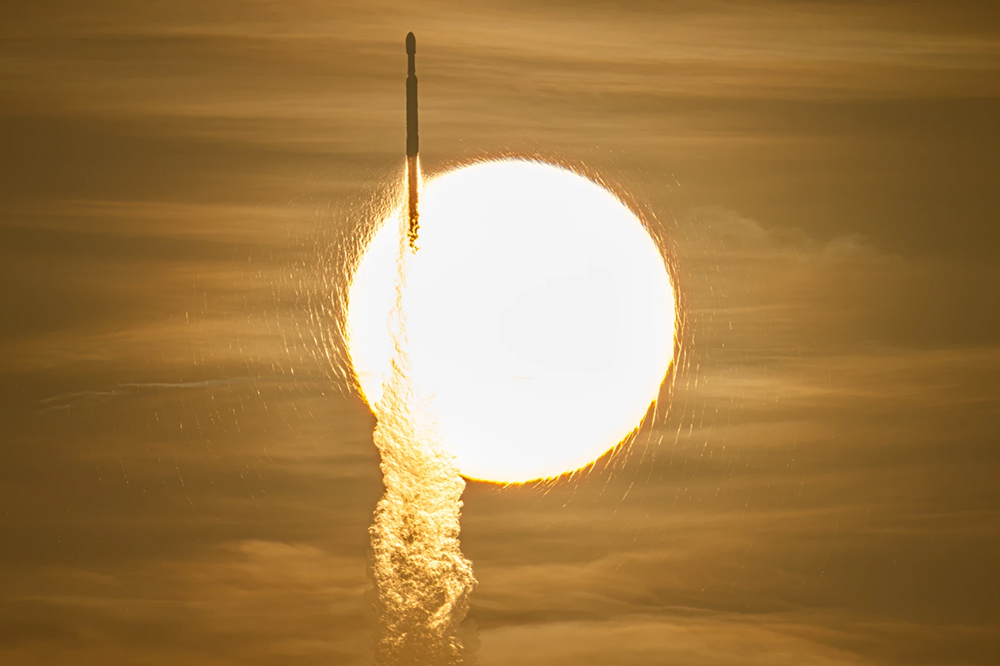
Another new era of space exploration is officially underway! The Nancy Grace Roman Space Telescope was aboard the SpaceX Falcon Heavy, which successfully launched on Aug. 30 from NASA’s Kennedy Space Center in Florida. Named after NASA’s first chief astronomer, the “mother of the Hubble Space Telescope,” the powerful Roman Space Telescope will probe cosmic expansion, the history of the universe and distant exoplanets.
Ata Sarajedini, Ph.D., professor, Department of Physics, Schmidt College of Science, will be making history as part of the first accepted cycle of research the state-of-the-art observatory will conduct. As co-investigator on the project, “A Legacy Survey of Andromeda and Triangulum with Roman,” his team will use their allotted 310 hours of observing time to study variable stars in the M31 (Andromeda) and M33 (Triangulum) galaxy systems.
“This is very exciting! Being awarded telescope time – especially on a new instrument – is very competitive, with only a small percentage of proposed projects being accepted,” shared Sarajedini. “I feel privileged to have been selected as part of a group who will be one of the first to work with Roman data.”
With an impressive field of view at least 100 times larger than Hubble’s, the Roman Space Telescope could potentially measure light from a billion galaxies in its lifetime. This observatory will also be able to block starlight to directly see exoplanets and planet-forming disks, complete a statistical census of planetary systems in our galaxy, and answer essential questions about dark energy, exoplanets and infrared astrophysics.
“The Roman’s 300 megapixel camera will dramatically impact our ability to find many more variable stars in M31 and M33 with much higher precision,” noted Sarajedini. “It will likely revolutionize our understanding of how these galaxies formed and are interacting.”
Currently, NASA anticipates that “first light” will occur later in 2026. Researchers hope to begin receiving data from the Roman Space Telescope in early 2027.
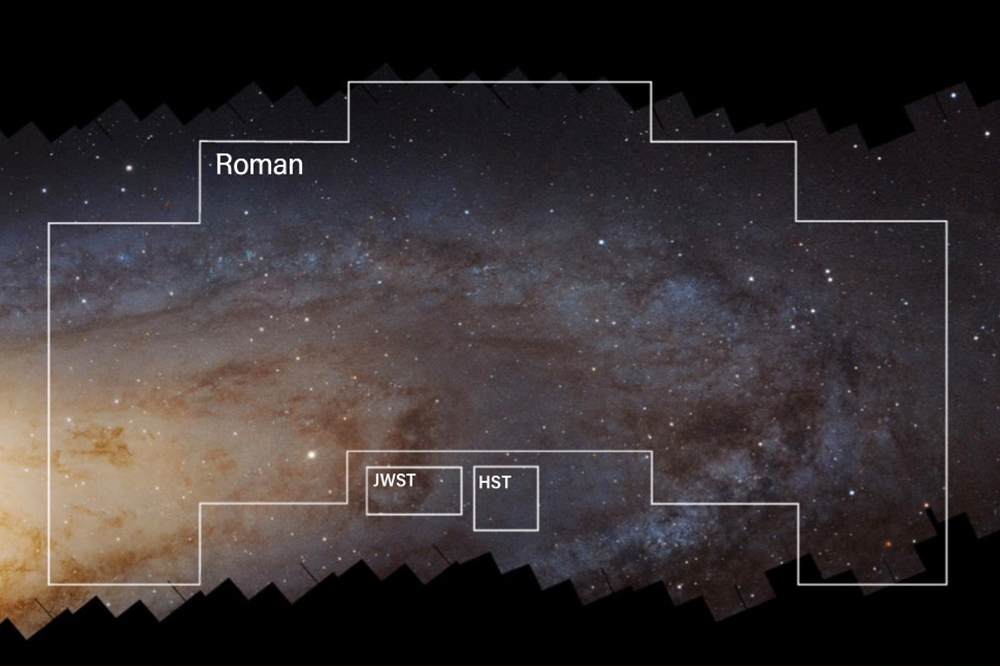
Photo credit: (top) NASA/John Kraus, (bottom) NASA.