Seaweed Sleuth: Ph.D. Student Ellyn Willse Dives Into Sargassum’s Secrets and Its Impact on Florida’s Coast
Monday, Jun 15, 2026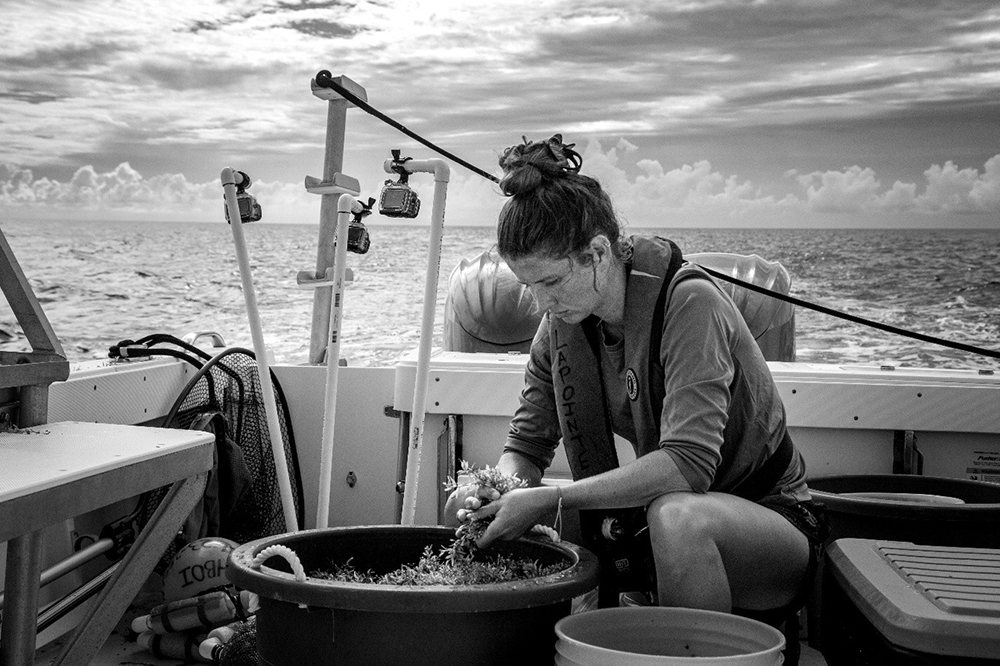
For most South Florida beachgoers and coastal business owners, the massive blankets of sargassum seaweed washing ashore this summer are an unwelcome, foul-smelling crisis. But for geosciences Ph.D. student Ellyn Willse, the floating brown algae is a goldmine of ecological data. While the public views sargassum as a shoreline nuisance, Willse sees it as a vital, drifting ecosystem—one that holds the key to protecting endangered wildlife, safeguarding our seafood supply, and providing critical data points to inform public health decisions.
From Fort Pierce to Key West, her research examines the animals—such as fish and sea turtles—that live in sargassum, and how factors like distance from shore, location, water quality, season and patch size affect this ecosystem. Since the formation of the Great Atlantic Sargassum Belt in around 2011, this area is receiving increased amounts of sargassum. Her research aims to deepen our understanding of these offshore ecosystems, which serve as essential fish habitats, critical refuges for endangered sea turtles, and support many commercially important fish species.
“When sargassum comes onshore, it decomposes and causes numerous ecological, economic and human health problems,” explained Willse. “Understanding how sargassum changes as an ecosystem as it moves inshore is important for managing this issue and for understanding the potential ecological consequences versus the benefits of removing sargassum in the water before it comes onshore.”
Another part of her research looks at arsenic in the sargassum food web. Using stable isotopes, Willse investigates how arsenic moves through the ecosystem of sargassum-associated organisms.
“This is important because it will contribute to the understanding of arsenic transfer in aquatic ecosystems,” stated Willse. “Since many sargassum-associated organisms are consumed by humans or are prey for animals that are consumed by humans, arsenic concentrations in these species are a potential human health concern.”
Mahi-mahi is one fish population that Willse closely examines. As a fish that is closely linked to sargassum, changes in Florida’s mahi-mahi populations could relate to sargassum abundance and the availability of its prey species.
“Mahi-mahi are an important fisheries species, especially recreationally, so understanding this population in Florida has implications for both our food supply and tourism income,” noted Willse.
Willse conducts her sargassum studies under the supervision of Brian Lapointe, Ph.D., a research professor at FAU Harbor Branch Oceanographic Institute.
“Dr. Lapointe is a great mentor because he is very supportive and encourages me to explore my own ideas in my research,” said Willse. “He has studied sargassum for decades, so he is an amazing resource and one of the top scientists in this field. He has multiple research projects going on that I have been able to participate in, which have allowed me to learn about a variety of topics and methods. He also provides a great mix of guidance while also letting me learn and figure things out for myself.”
Photo credit: Sharon Hart, FAU associate professor of art. Hart uses sargassum as a developing medium and joined Willse on a sampling trip.