Fins, Feeds and Algorithms: How Jumpstart Postdoc Darien Satterfield Is Using AI to Track Blacktip Sharks
Tuesday, Oct 28, 2025
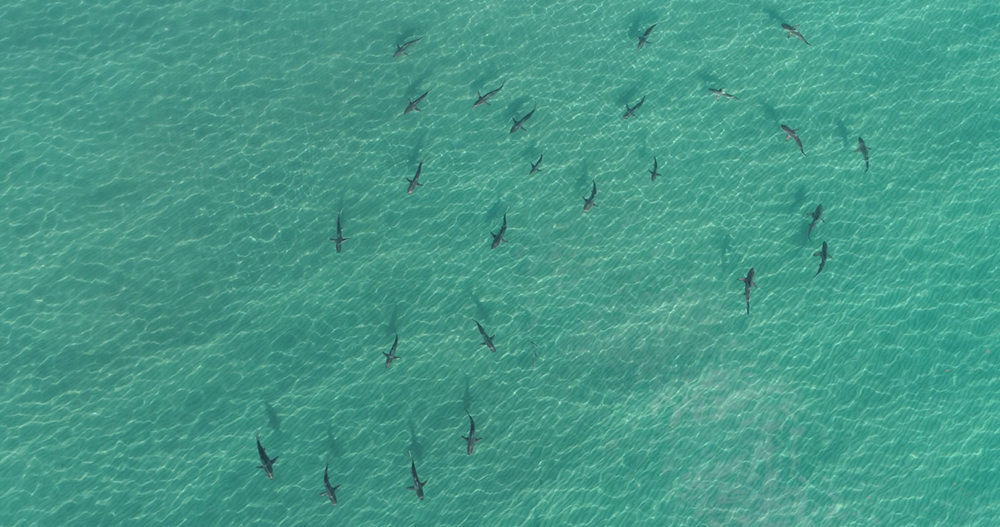
 One of the biggest challenges in animal behavior is understanding the way that large groups move cohesively and in an ordered manner. Massive aggregations are often difficult to observe, and there are gaps in scientists’ understanding of the relationships between individual responses to sensory stimuli and group level organization. However, in the clear, shallow waters off eastern Florida, blacktip sharks form massive seasonal aggregations, providing an opportunity to address these gaps.
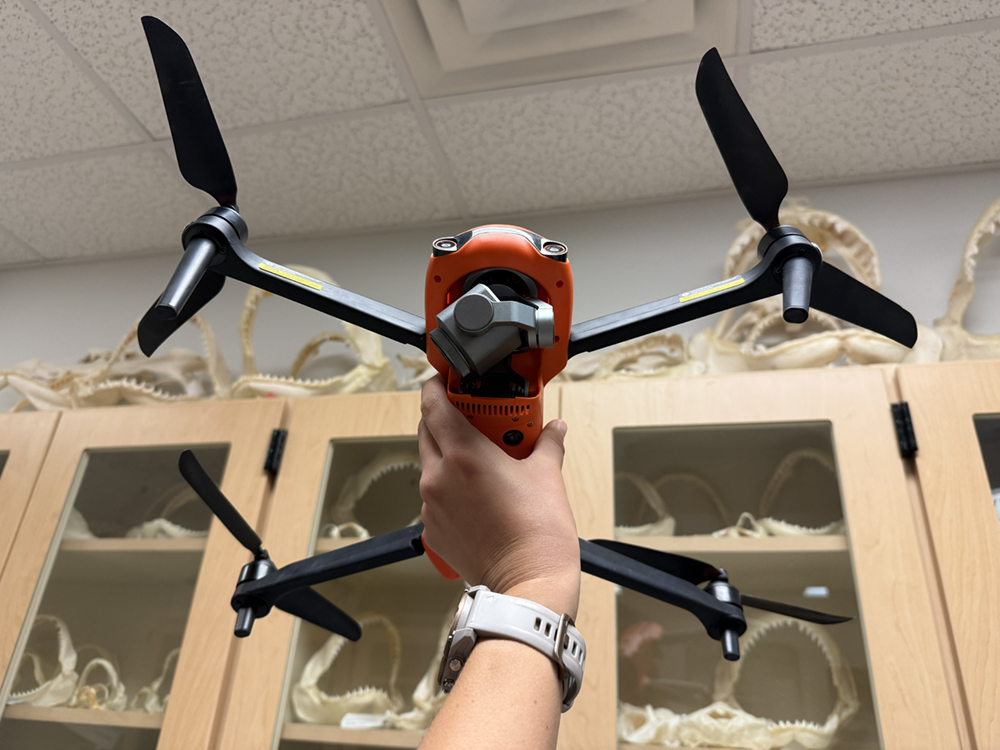
Darien Satterfield, Ph.D., a Jumpstart Postdoctoral associate in the Charles E. Schmidt College of Science, is leveraging drone videography and machine learning to track the swimming paths of blacktip sharks. Her team applies similar algorithms to those that are commonly used in video games to reconstruct first-person visual fields of the sharks. In addition, she uses deep-learning pipelines to monitor the sharks’ swimming responses to motion stimuli within their visual perception.
“We use drone footage of shark schools to inform agent-based models,” stated Satterfield. “These simulations allow us to develop and test hypotheses about the adaptive benefits of rapid shifts between ordered and disordered motion after disturbances in large predator groups.”
Because these shark aggregations are legally protected, Satterfield’s team cannot create disturbances in the field. Data-driven simulations provide a powerful tool to address questions that would be impossible to test empirically. More broadly, this framework offers a promising way to study collective behavior in sensitive ecological systems where manipulative experiments are not feasible.
“My postdoc project heavily involves the use of AI and machine learning, which are both skills that were entirely new to me when I started,” noted Satterfield. “My background is in evolution, morphology and behavior, and I recognized that all of those fields are moving towards the use of AI tools. I really wanted to gain that experience so I can market those skills during my faculty job searches.”
The Jumpstart Fellowship Program is designed to bring together a postdoctoral scholar and two principal investigators who have never worked together before, to foster innovative research. This is the third year of the initiative, which Charles E. Schmidt College of Science Dean Valery Forbes launched in 2022 to “jumpstart” multidisciplinary research collaborations between faculty and postdoctoral associates. Satterfield is working with Associate Professor Marianne Porter, Ph.D., principal investigator, and Assistant Professor Ashkan Fahimipour, Ph.D., co-principal investigator, in the Department of Biological Sciences.
|
|
“What I enjoy most about working in the Schmidt College of Science is being part of a community that values interdisciplinary research and supports bold, innovative science,” said Satterfield. “My work closely aligns with the college’s strengths in marine and environmental research, and I appreciate being in an environment where tackling complex, large-scale ecological questions is encouraged. I also enjoy the opportunities to mentor and collaborate with students through programs like OURI, LEARN and SURF. It is fantastic how the college encourages undergraduate access to research experiences and mentorship opportunities.”