The Catalyst for Change: FAU Unlocks New Design for Faster, Cleaner Carbon Dioxide Conversion
Monday, Feb 23, 2026
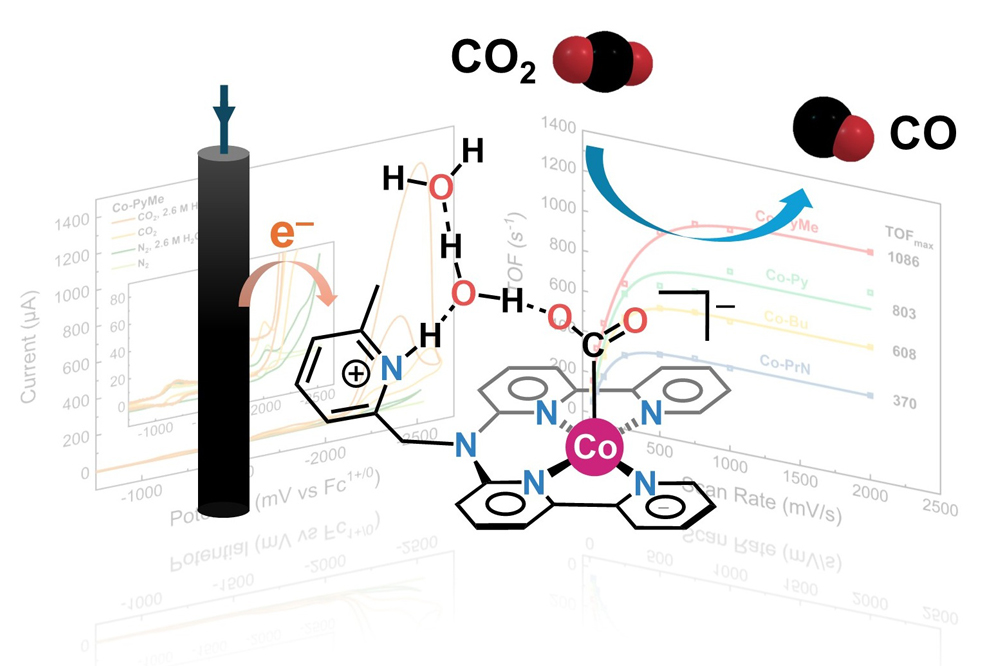 Reducing carbon dioxide (CO2) emissions is paramount to help mitigate the harmful effects of climate change on ecosystems, economies and human health. Assistant Professor of Chemistry and Biochemistry Zhu-Lin Xie, Ph.D., in the Schmidt College of Science, is working to understand how molecular structure influences proton and electron transfer, which is crucial for developing more effective catalysts.
Results of his study, “Selective CO2 Reduction by Bis(bipyridine)cobalt(II) Catalysts: The Role of Pendant Pyridine as a Proton Acceptor,” were recently published in the journal, ACS Catalysis .
The overall objective of Xie’s research was to develop structurally well-defined molecular catalysts that enable efficient and selective electrochemical CO2 reduction, converting waste greenhouse CO2 into value-added fuels or commodity chemicals. Specifically, his team aimed to understand how secondary coordination sphere (SCS) functional groups, such as pyridine and amine groups, influence CO2 reduction catalysis in molecular cobalt systems.
“It is very gratifying to see this work published, especially because it is a result of a collaborative effort involving several universities and national laboratories,” stated Xie. “These collaborations allowed us to access state-of-the-art research facilities and to combine synthesis, electrochemistry, spectroscopy and theorical simulations to reveal the role of the pendant pyridine groups in enabling the cobalt active site to achieve superior catalytic activity for CO2 reduction.”
The insights gained in this work, particularly regarding hydrogen-bonding networks, proton relays and redox-active scaffolds, provide general design principles to improve catalyst performance by facilitating fast proton and electron transfer. It is also relevant to many catalytic transformations beyond CO2 reduction, such as nitrogen fixation, water oxidation and hydrogen evolution reduction.
This study was conducted through a collaboration among researchers at Florida Atlantic University, Argonne National Laboratory, SLAC National Accelerator Laboratory, the University of Illinois Chicago and the University of Illinois Urbana-Champaign.