7/31/2026
Summer of Discovery
FAU Harbor Branch Hosts 52nd Annual Summer Intern Symposium
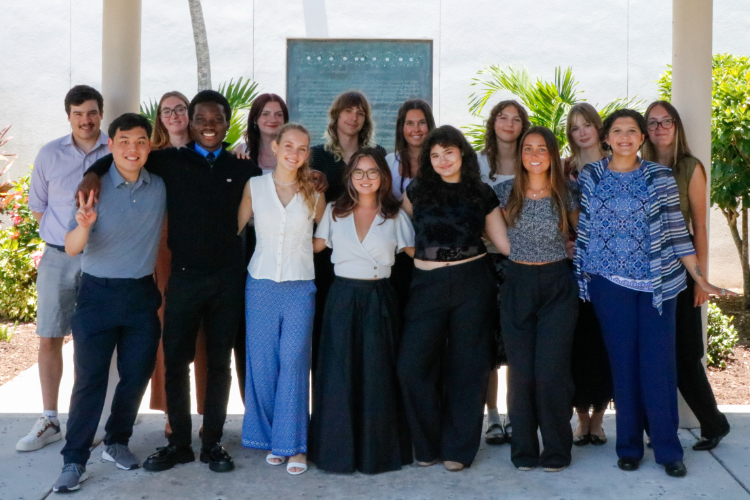
Florida Atlantic University’s Harbor Branch Oceanographic Institute marked 52 years of its summer internship program, which culminated on July 23 with the annual Harbor Branch Summer Intern Symposium.
Seventeen[EG1.1] students from universities across the United States spent 10 weeks making important contributions to marine science, engineering and biotechnology research underway at the institute. During the symposium, students gave 15-minute oral presentations on their summer projects and answered questions from the audience. The program was organized into three sessions by research focus: engineering and technology; ecosystem restoration and sustainable aquaculture; and oceans and human health. Each student shared successes, challenges, initial findings and next steps for further studies.
“Every year we say, ‘This is the best group of presentations yet,’ and this symposium was no exception,” said Amy Wright, Ph.D., research professor at FAU Harbor Branch. Wright and fellow research professor Esther Guzmán, Ph.D., oversee the summer intern program and organize the annual symposium. “The amount of work these students accomplish in 10 short weeks is so impressive, as well as their ability to present a compelling narrative about their research in front of an audience.”
Projects presented in the engineering and technology session focused on developing new technology applications and innovations. For instance, Braden Weaver (Southern Illinois University, Carbondale) tested a deployment system for water quality sensors affixed to drones designed to monitor aquaculture ponds. Benjamin Gowell (Florida Atlantic University) tested the reliability of remote underwater video to characterize ecological diversity in artificial reef communities. Other projects studied autonomous bioluminescence sensors, irradiance sensors, the efficacy of a new stormwater treatment product, and a computer software for modeling underwater turbines.
During the ecosystem restoration and aquaculture session, students presented projects that contributed important data to ongoing research. For instance, Lillian Hall (Hanover College) worked on optimizing a new analysis tool for testing the viability of fish eggs to be grown in an aquaculture setting. Adrie Young (Wesleyan University) designed an experiment to test if sea cucumbers could help optimize seagrass restoration efforts. Other projects studied phytoplankton, seagrass seed germination techniques, testing natural coloration in farm-raised fish, and optimization of feeding protocols for Florida pompano.
The final session featured projects dedicated to biomedical research using marine natural products and marine mammal health. Two students – Joseph Marful-Sau (Grambling State University) and Jennifer Sharr (Indian River State College) studied cancer-fighting properties of compounds derived from marine natural products. Julia Lee (Hamilton College) identified a sponge in the Harbor Branch specimen library that contained a molecule with potential anti-parasite properties. She then determined the chemical structure of the molecule – which she could not reveal because she had submitted it for a United States patent. Elizabeth Singh (Cummings School of Veterinary Medicine, Tufts University) analyzed 26 years of blood samples from stranded cetaceans to search for key health and physiology indicators to better understand why they stranded.
The FAU Harbor Branch Summer Intern Program was started in 1974 with a gift from Ed and Marion Link. The Link Foundation has supported 495 interns over more than five decades with an emphasis on supporting students focused on ocean engineering. The Gertrude E. Skelly Foundation has funded 105 interns to date, supporting students working on biomedical marine research. Summer interns are also funded by the Marilyn Link Internship Endowment and the Marilyn C. Link Memorial Internship funded by the Harbor Branch Oceanographic Institute Foundation.
“The intern symposium is a representation of the varied and valuable research that happens at FAU Harbor Branch, and it gives us strong hope about the next generation of scientists and engineers,” said Guzmán.
- Ada Arwood (Furman University), Mentors: Fernando Paredes, Ph.D., Benjamin Panitz and Li sun Chin
- Alexander Choi (University of California, Berkeley), Mentor: Malcolm McFarland, Ph.D.
- Celeste Copay (Montgomery College), Mentor: Amy E. Wright, Ph.D. (Not pictured)
- Mya Gomez (Florida Atlantic University), Mentors: Michael Twardowski, Ph.D. and Wayne Slade, Ph.D.
- Benjamin Gowell (Florida Atlantic University), Mentor: Matt Ajemian, Ph.D.
- Lillian Hall (Hanover College), Mentors: Paul Wills, Ph.D. and Li Sun Chin
- Julia Lee (Hamilton College), Mentor: Priscilla Winder, Ph.D.
- Joseph Marful-Sau (Grambling State University), Mentor: Esther Guzmán, Ph.D.
- Jenna Nall (University of Arkansas), Mentors: Fernando Paredes Ph.D. Jasmine Perez, and Erica Slaten
- Lanie Roberts (Hanover College), Mentors: Jordon Beckler Ph.D., Sofia Cuellarsola and Jonathan Terzado
- Jennifer Sharr (Indian River State College), Mentor: Esther Guzmán, Ph.D.
- Elizabeth Singh (Cummings School of Veterinary Medicine at Tufts University), Mentor: Annie Page, DVM, Ph.D.
- Olivia Smith (University of South Florida), Mentor: Rachel Brewton, Ph.D.
- Jacqueline Venuto (State University of New York, New Paltz), Mentor: Wayne Slade, Ph.D.
- Adrie Young (Wesleyan University), Mentor: Michael McCoy, Ph.D.
- Braden Weaver (Southern Illinois University, Carbondale), Mentors: Bing Ouyang Ph.D. and Paul Wills Ph.D.
- Polly Womack (Florida Atlantic University), Mentor: William Baxley MS, P.E.