10/9/2026
Research Update from the West Florida Shelf
Gulf Research Expedition Collects Valuable Samples, Data to Support Florida RESTORE Mesophotic Reef Project
In August, a research team from Florida Atlantic University, Florida State University (FSU), and the National Oceanographic and Atmospheric Association (NOAA) embarked on a research expedition aboard the Louisiana Universities Marine Consortium research vessel, the R/V Point Sur. This was the second of four research cruises funded by a nearly $1 million grant from the Florida RESTORE Act Centers of Excellence Program to study the influences of key nutrient sources on mesophotic coral ecosystems along the west Florida shelf.
Unlike shallow reefs, which live in sunlight, mesophotic reefs are found at twilight zone depths. These ecosystems depend primarily on nutrients from deep-water upwelling or river plumes to support growth of marine phytoplankton, the base of the food web for corals and other marine species. This project aims to improve understanding of how different nutrient sources – transported by ocean currents – influence the food supply, community structure and productivity of mesophotic coral ecosystems located approximately 300 to 450 feet below the surface.
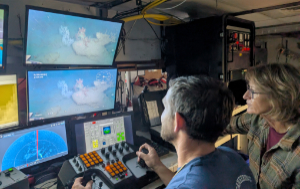
The study area during this cruise encompassed parts of the Mississippi Delta, the De Soto Canyon (an area of significant upwelling), and the west Florida shelf and slope, collecting various types of samples from depths of 150 to 2,600 feet, including several areas that are mostly unexplored. Mesophotic ecosystems were explored using the remotely operated vehicle (ROV) Mohawk, owned and operated by the University of Southern Mississippi (USM).
The cruise, led by chief scientist Sandra Brooke, Ph.D., from the FSU Coastal and Marine Laboratory, and the project's principal investigator Mingshun Jiang, Ph.D., from Florida Atlantic's Harbor Branch Oceanographic Institute, was comprised of a multi-disciplinary team, each focused on a different research component: physical oceanography and modeling; sediment biochemistry; plankton community and dynamics; coral reef ecosystems; and larval fish modeling.
“During this research cruise we collected essential environmental and biological information through field measurements and observations to meet the objectives of this project,” said Jiang. “Through collaboration, we were able to leverage expertise and cutting-edge scientific equipment to contribute to a more comprehensive understanding of the resources that feed mesophotic coral ecosystems and illuminate challenges that could upset the delicate ecological balance.”
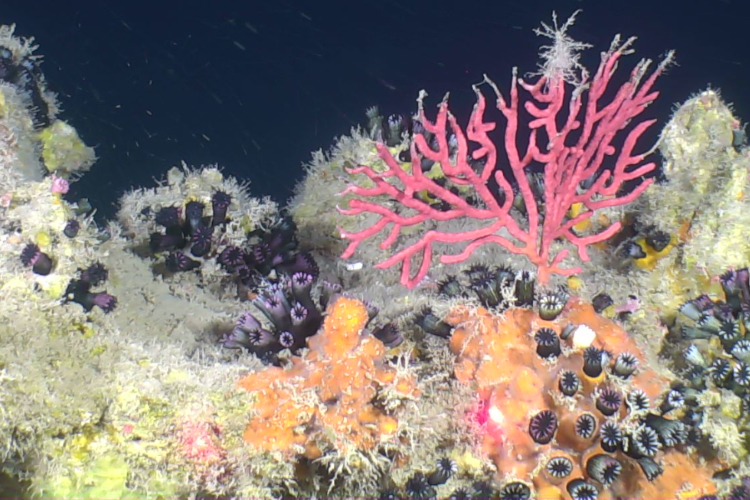
During each dive, the ROV Mohawk collected continuous high resolution digital video and images that will be used to characterize communities associated with mesophotic hard-bottom habitats in two target regions: the northern sites with relatively high nutrients and a lower nutrient site further south. The community analysis will focus on corals and sponges and their dominant associated invertebrate and fish assemblages. The ROV also collected water samples, environmental data and fragments of stony corals and octocorals, which will be analyzed for growth, reproduction and tissue lipid content to identify any physiological differences between the sites. This information will provide insight into how these communities may respond to potential changes in productivity from natural cycles and/or anthropogenic changes.
“These mesophotic habitats are incredibly rugged and complex and support many species of corals and associated invertebrates and fishes,” said Brooke. “We found exactly what we needed for our research objectives, and I am looking forward to exploring this fascinating area again on our next cruise.”
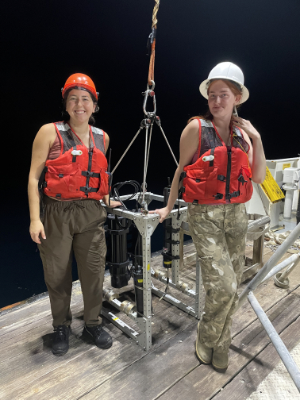
Hydrographic surveys collected data on currents, water quality and productivity. During surveys, two ship-board acoustic doppler current profilers (ADCPs) were used to measure current speed and direction and to highlight the acoustic deep scattering layer – a key indicator of migrating zooplankton. An optical plankton characterization system called AUTOHOLO along with other instruments were also deployed during surveys to quantify and identify plankton communities in different locations and at varying levels (up to 1,500 feet) of the water column. The goal was to capture data around diurnal vertical migration (the daily movement of microscopic organisms from the bottom to the surface and back to the bottom) of zooplankton and larvae, which is important for understanding benthic and plankton ecology.
Sediment samples were also taken at select sites with muddy or sandy sediments. Microscopic organisms and other organic matter swirl through the water column and eventually settle on the seafloor. But this settlement is not necessarily permanent, as ocean dynamics can stir up deep-water sediment, releasing trapped nutrients and making them available to mesophotic coral ecosystems far from the river mouths. Characterizing layers of sediment helps improve understanding of how nutrients move not only from the surface down, but also from the bottom up.
"We are trying to determine to what extent sediment composition has on the distribution and proliferation of the west Florida shelf's mesophotic coral communities,” said Sofia Cuellarsola, a Florida Atlantic master's degree student who participated in the research cruise. “Much of the Gulf is nutrient-poor, so it would be interesting to see how important a role the shelf sediments play in providing nutrients to support productivity of these precious mesophotic coral ecosystems."
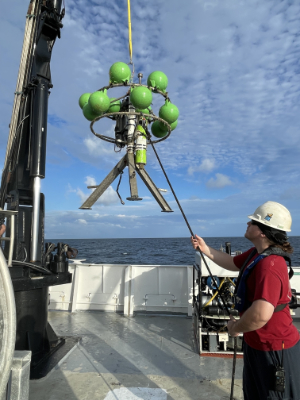
The team also recovered three benthic landers which had been deployed during the project's previous research cruise in October 2025. These autonomous observational units record ocean dynamics and biological activity directly on the seabed. These measurements are valuable because they provide information that hasn't been altered by the changes in temperature and pressure that are inherent in bringing samples from the deep sea up to the surface. They also collect data for extended periods, providing information on seasonal or periodic environmental changes that cannot be collected during our short research cruises.
Six graduate students participated in the research cruise, including five from Florida Atlantic: Ph.D. students Madison Bennett, Olivia Ruchti, and Mason Thackston, and master's students Cuellarsola and Jonathan Terzado. These students are studying under the mentorship of FAU Harbor Branch co-principal investigators of the project: Jordon Beckler, Ph.D., and Aditya R. Nayak, Ph.D. One Ph.D. student, Laura Anthony, and a technician, Katarina Simonson, from FSU also participated under the supervision of Sandra Brooke Ph.D.
Planning for future research cruises to support this project is in the works. In the meantime, the team is focused on data retrieval and analysis of the samples collected during this expedition.