9/4/2026
Microplastics Found Across 95% of Protected Florida Wetland
Study shows water movement carries microplastics into Spruce Bluff Preserve.
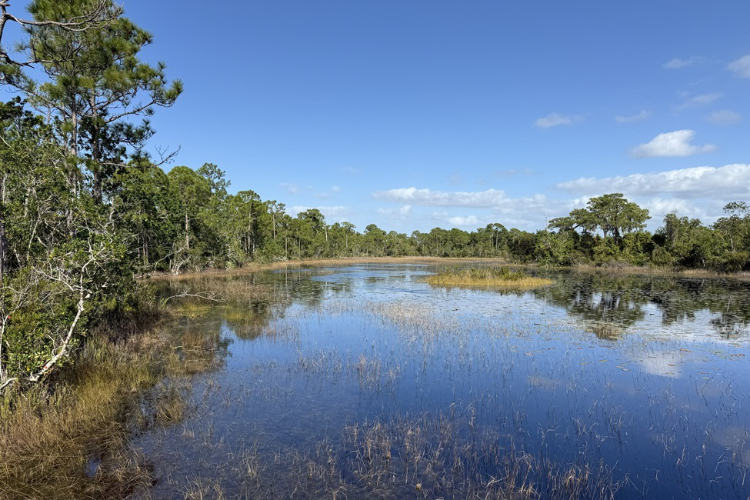
Microplastics are well documented in marine and coastal environments, but freshwater wetlands have received far less attention, leaving important questions about how these tiny particles move and accumulate in these ecosystems. To help fill that gap, researchers from Florida Atlantic University’s Charles E. Schmidt College of Science examined sediment from 40 sites across eight ecological zones at Spruce Bluff Preserve, a 97-acre freshwater wetland along Florida’s St. Lucie River.
The study, published in Evolving Earth, found microplastics in 95% of samples across every ecological zone, with the highest concentrations near the river and a flood-control canal, suggesting that water movement helps transport and concentrate the particles. Most were smaller than 2.5 millimeters, and fibers were the most common type. The findings suggest that even protected wetlands can be widespread recipients of plastic pollution, underscoring that protection from development does not necessarily mean protection from contamination. They also highlight the need to consider microplastics in wetland conservation and stormwater management.
“Perhaps the most striking finding is that the microplastics weren’t simply scattered randomly across the preserve – they appeared to follow the pathways of water,” said Erik N. Johanson, Ph.D., senior author and an associate professor in the Department of Geosciences within FAU’s Charles E. Schmidt College of Science. “The river edge and flood-control canal had some of the highest concentrations, suggesting that these areas can act as conduits and collection points for plastic moving through the landscape. It shows that even in a protected wetland, what happens upstream can ultimately show up in the sediment.”