8/3/2026
FAU Tracks Deep-Sea Dolphins
Research fills gaps in Florida waters
Did you know that multiple species of dolphins call Florida's coastal waters home? The FAU Marine Mammal Stranding and Population Assessment team (MMSPA) conducts photo-identification research on both the inshore bottlenose dolphins of the Indian River Lagoon and the offshore species of the Atlantic Ocean.
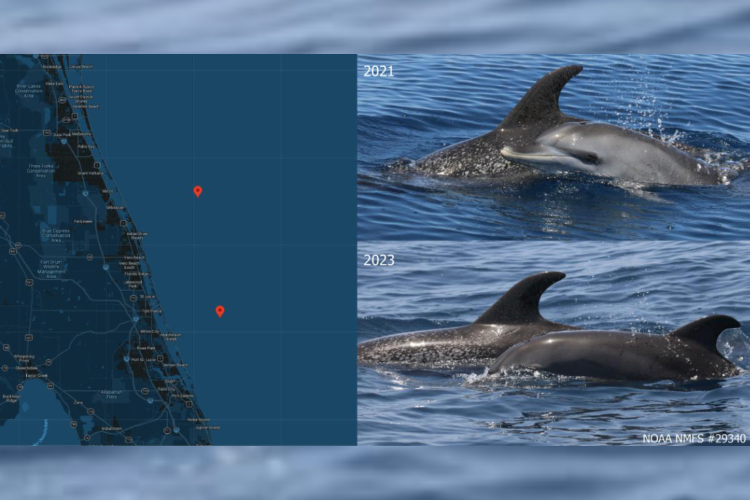
Meet Perdita (PDTA), an Atlantic spotted dolphin (Stenella frontalis) sighted twice by the MMSPA team: once in 2021, approximately 20 miles off Sebastian Inlet, and again in 2023, roughly 15 miles off Hutchinson Island. Southeast Florida's continental shelf drops off steeply, meaning the deep waters that Atlantic spotted dolphins prefer aren’t too far from local beaches.
PDTA was first sighted with her calf, c1PDTA (top right). When the team encountered her again in 2023, not only was c1PDTA still by her side — a brand-new calf (c2PDTA, bottom right) had joined the family. Atlantic spotted dolphins are born spotless, gradually developing their characteristic markings as they age. The MMSPA team looks forward to resighting the PDTA lineage someday – perhaps with a few more spots to show for it.
While inshore bottlenose dolphin populations are relatively well-documented, significant gaps remain in our understanding of marine mammal communities just beyond the coastline. By venturing offshore and collaborating with research partners, FAU's marine mammal research program aims to help fill those gaps — contributing data on species diversity, abundance, distribution and habitat use of cetaceans in Florida's coastal waters.
If you see a marine mammal while out on the water, remember to stay 50 yards away. If you see a marine mammal in distress, call the FWC hotline (888) 404-3922.