9/18/2026
FAU Scientist Helps Create Caribbean 'Frozen Zoo' During Historic Deep-Sea Expedition
Harbor Branch researcher tests simpler way to preserve deep-sea life while training Caribbean scientists to build a living biobank
A Florida Atlantic University scientist has helped create a “frozen zoo” of deep-sea marine life during the first locally led expedition to explore Trinidad and Tobago’s deep-water ecosystems.
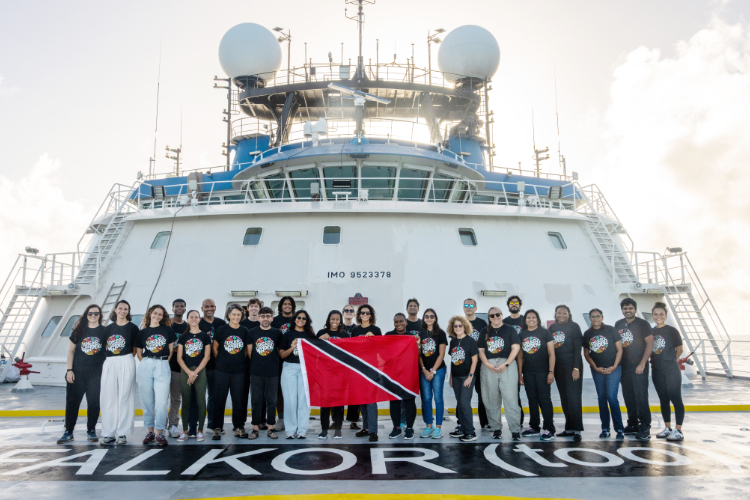
Megan Conkling, Ph.D., a research scientist at FAU’s Harbor Branch Oceanographic Institute, spent a month aboard Schmidt Ocean Institute’s R/V Falkor (too) as part of the Deep Wonders expedition, which brought together a primarily Trinbagonian science team and international collaborators to explore some of the country’s least-studied marine environments.
Led by Trinbagonian deep-sea biologist Diva Amon, Ph.D., the team discovered 25 active cold seep ecosystems, documented 20 suspected new species and mapped more than 11,000 square kilometers of previously uncharted seafloor using Schmidt Ocean Institute’s advanced ocean exploration resources and technology.
Conkling’s role focused on how to preserve living biological material collected from these remote environments when specialized freezing equipment may not be available or reliable.
Traditional cryopreservation commonly relies on temperatures of -80°C or colder. Conkling and collaborators at CryoCrate have been testing a novel cryoprotectant that allows marine tissues to be initially frozen at -20°C, the temperature of a conventional freezer. FAU Harbor Branch was the first laboratory to test the cryoprotectant medium on a marine species, beginning with sea sponges.
"This expedition gave us the opportunity to test this approach under the kinds of real-world conditions where we hope it can make a difference," Conkling said. "If we can preserve living tissues using equipment that is much more readily available, more scientists around the world could have the ability to build and maintain these biological resources."
Using specimens collected by the remotely operated vehicle (ROV) SuBastian, Conkling and collaborators cryopreserved more than 1,200 vials of tissue representing more than 86 species, including deep-water sponges, corals, sea cucumbers, sea urchins and sea stars.
Some of the cryopreserved material will be split with half of the material remaining in Trinidad and Tobago, while the other half of the samples will return to Harbor Branch for long-term viability study and future restoration research. Conkling also trained 15 expedition participants in the cryopreservation technique, helping local scientists to continue building the collection after the expedition ended.
"Being part of this expedition was an incredible opportunity to help create the first 'frozen zoo' in the Caribbean," Conkling said. "We're preserving living biological resources that can provide an invaluable baseline for understanding how these ecosystems change over time."
Cryopreservation differs from traditional preservation methods such as storing specimens in ethanol because it can preserve viable cells and tissues. That could allow researchers years from now to conduct genetic and biological studies using material collected today and examine how marine organisms respond to changes in temperature, salinity and other environmental conditions.
The approach also could make biobanking more practical for deep-sea organisms that are difficult and expensive to collect again.
During the expedition, ROV SuBastian descended as deep as 4,000 meters, or over 13,000 feet, roughly 1.5 Golden Gate Bridges placed end-to-end. The vehicle is tethered to the ship via a wire. Pilots and technicians operate it from the vessel's mission control room and scientists direct operations to collect essential samples and data.
Among the expedition's discoveries were cold seep ecosystems powered by chemosynthesis, where microorganisms convert methane into energy rather than relying on sunlight, as well as suspected new species of corals, carnivorous sponges, squat lobsters and among other animals. FAU professor emeritus Shirley Pomponi, Ph.D., also participated in the expedition as an independent research collaborator.
The preserved samples returning to Harbor Branch will now undergo longer-term study, with researchers assessing how well tissues remain viable after six months and again after one year.
If the technique proves successful across a broad range of marine organisms, it could provide scientists with a simpler, more accessible method for preserving ocean biodiversity for future research.
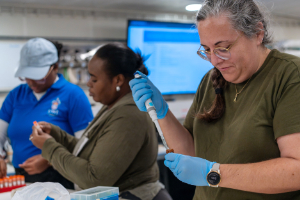
Megan Conkling, Ph.D., participated in a landmark research expedition aboard Schmidt Ocean Institute’s R/V Falkor (too) testing a novel cryopreservation system to preserve living specimens from the deep sea. Photo credit: Mónika Naranjo González / Schmidt Ocean Institute
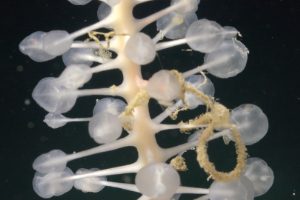
Carnivorous Sponge – The expedition explored depths of more than 13,000 feet, documenting 20 suspected new species, including a carnivorous sea sponge. Photo credit: ROV SuBastian/Schmidt Ocean Institute