Ten Years Later: Class of 2015 Returns to Guide Tomorrow's Physicians
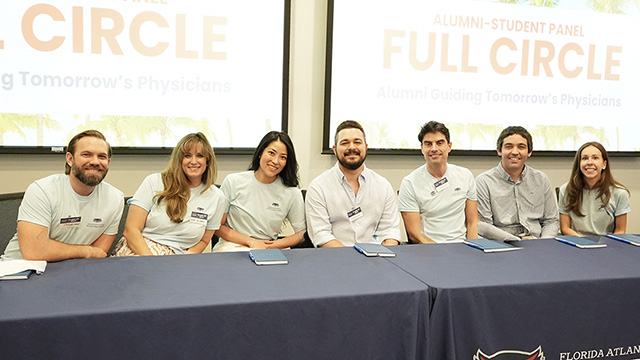
Excitement filled the Schmidt College of Medicine as seven distinguished Class of 2015 graduates returned to participate in the Alumni Panel during Reunion Weekend 2025. Current medical students filled the lecture hall, eager to learn about their potential futures through the experiences of those who once sat in their seats. As one first-year student remarked afterward, "I loved hearing the insights of the class of 2015 as a current M1. Listening to their stories and advice was extremely valuable."
This special gathering, "Full Circle: Alumni Guiding Tomorrow's Physicians," created a meaningful bridge between generations of medical professionals. Through personal stories, candid reflections, and practical advice, alumni from multiple specialties - Pediatric Emergency Medicine, Rheumatology, Cardiology, Neuroradiology, Pulmonology, OBGYN, and Internal Medicine/Pediatrics - shared their journeys from medical school to fulfilling careers.
The Formative Power of Medical School Experiences
Q1: Thinking back, what Schmidt College of Medicine experience most influenced your career choices?
Dr. Katie Patel, Pediatric Emergency Medicine: "The mentorship approach at Schmidt College was transformative for my career path. Our faculty consistently treated us as respected colleagues rather than students. This professional respect created an environment where I felt valued and empowered to grow. The meaningful relationships we built extended beyond academics - we'd have social gatherings where faculty would join us, creating genuine connections that shaped how I approach medical education in my career."
Dr. Susie Sennhauser, Cardiology: "The transformative moments that shaped my career path often came from unexpected opportunities. I was connected with influential mentors through Dr. Ira Gelb, who encouraged me to explore the field of critical care. What began as a rotation I hadn't initially considered ultimately revealed my passion and shaped my entire career trajectory. These introductions and experiences profoundly influenced my professional journey, teaching me that mentorship can reveal strengths and interests you didn't know you had."
Dr. Doug McConnell, Internal Medicine/Pediatrics: "My time at the Schmidt College of Medicine helped me discover something more fundamental than just medical knowledge - it helped me understand myself and what I truly needed to find fulfillment in medicine. Rather than focusing exclusively on grades and achievements, I learned to value community, meaningful relationships, and personal well-being as essential components of a sustainable medical career. This self-awareness gave me the confidence to trust my instincts when I was the only one in our class choosing the combined Internal Medicine/Pediatrics path."
Dr. Thomas Difato, Neuroradiology: "The educational approach at the Schmidt College of Medicine significantly influenced my specialty choice and career satisfaction. Our program recognized that students learn differently - whether through traditional lectures, hands-on experiences, or observational methods - and provided opportunities that accommodated these various learning styles. This personalized approach helped me discover my passion for radiology and the learning environment where I thrived."
Giving Back: The Cycle of Mentorship
As the discussion shifted to why these busy professionals make time to mentor current students, a theme of reciprocal benefit emerged across specialties.
Q2: As practicing physicians, what motivates you to stay connected to the college and mentor current students?
Dr. Adam Schertz, Pulmonology: "Engaging with students and residents keeps me intellectually sharp and deeply connected to the art of medicine. Over time, our practice evolves beyond textbook knowledge into nuanced clinical judgment. Sharing these insights - the practical wisdom that transforms knowledge into effective patient care - is incredibly rewarding. Teaching requires articulating the 'why' behind clinical decisions, continually refining my practice."
Dr. Nicole McConnell, OBGYN: "The greatest motivation is witnessing their remarkable growth journey. This transformation is inspiring, from their first clinical experiences to becoming confident practitioners. This connection creates meaningful long-term relationships - I've had the privilege of hiring former residents who have become trusted colleagues and friends. There's no greater professional reward than contributing to someone's development and welcoming them as peers in our medical community."
Dr. David Dillon, Rheumatology: "Staying connected fulfills multiple meaningful purposes. Professionally, it allows me to share specialized knowledge in rheumatology, a field that students often have limited exposure to during their education. Being raised in Palm Beach County, maintaining these local connections helps me contribute to my community's healthcare future. Each time I return to campus, I'm energized by students' enthusiasm and reminded of my journey, which brings renewed purpose to my daily practice."
Time-Travel Advice: Letters to Their Younger Selves
The conversation grew more reflective as alumni considered what wisdom they would share with their medical school selves. These insights revealed how perspective shifts with experience and highlighted recurring themes about balancing excellence with sustainability.
Q3: If you could sit down with your med school self, what advice would you give?
Dr. Susie Sennhauser, Cardiology: "I'd encourage my younger self to maintain interests and activities that bring joy and fulfillment outside medicine. While excellence in our field requires dedication, integrating your passions and personality into your medical career creates a more sustainable and satisfying professional life. The aspects that make you unique - your interests, perspectives, and experiences - ultimately strengthen your connection with patients and colleagues."
Dr. Katie Patel, Pediatric Emergency Medicine: "I'd advise my younger self to approach clinical rotations with genuine curiosity rather than predetermined specialties in mind. When you enter each rotation thinking, 'Could this be my future?' rather than 'I already know what I want,' you'll gain more from every experience. Trust that when you find the right specialty fit, you'll recognize that alignment between your strengths and the field's demands."
Dr. Doug McConnell, Internal Medicine/Pediatrics: "I'd remind myself that medical school represents a unique opportunity to build foundational knowledge to support your entire career. While residency and practice are filled with competing demands, this is your chance to truly understand the 'why' behind medicine. The effort invested in thorough understanding during these formative years yields dividends throughout your career."
Dr. Thomas Difato, Neuroradiology: "Consider how your specialty choice aligns with your personal life goals and values, not just your professional interests. Medicine is demanding regardless of specialty, but finding a path that accommodates your priorities - whether that's family time, geographic preferences, or work-life balance - significantly impacts long-term satisfaction. Remember that this journey is about creating a sustainable, fulfilling life in medicine, not just checking professional achievement boxes."
The Transformative Power of Mentorship
When asked about influential mentorship moments, the alumni's responses revealed how these relationships can fundamentally shape clinical practice and professional identity. Each story highlighted different aspects of effective mentorship, from challenging conventional thinking to modeling professional values.
Q4: Can you describe a powerful mentorship moment in your career, either as a mentee or mentor?
Dr. Adam Schertz, Pulmonology: "The mentorship that transformed my approach to medicine featured weekly one-on-one meetings with my mentor throughout my residency and fellowship years. Beyond the generous time investment, what made this relationship remarkable was how he challenged me to think differently about medicine. Rather than simply teaching procedures or protocols, he encouraged me to examine the foundations of clinical reasoning and build my understanding from first principles. This experience has shaped how I mentor others - focusing not just on what we know, but on developing the intellectual curiosity and critical thinking that advances medicine."
Dr. David Dillon, Rheumatology: "My most influential mentorship connection began through the Schmidt College of Medicine's community preceptor program when I was paired with Joseph Forston, M.D., who later became my employer. What started as an educational relationship developed into a lasting professional partnership that guided me from medical school through residency and fellowship. Additionally, Dr. Gelb's influence taught me that technical excellence must be paired with genuine human connection - being a good person who treats patients with dignity and respect creates trust that transcends knowledge."
Dr. Susie Sennhauser, Cardiology: "A transformative mentorship moment came when a senior cardiologist challenged me to reconsider standard approaches and develop my authentic professional voice. This guidance taught me that effective physicians must thoughtfully question established practices and advocate confidently for their patients. This mentor demonstrated that professional confidence isn't about personality type but developing and effectively communicating evidence-based convictions. I was encouraged to trust my clinical judgment, even when it meant respectfully challenging conventional wisdom."
Preparing for Medicine's Future
As the formal panel concluded, the discussion turned toward practical advice for navigating the rapidly evolving healthcare landscape. Each alumnus offered perspectives from their specialty on emerging trends and enduring principles that will shape tomorrow's medical practice.
Q5: What should today's students be preparing for in the future of medicine?
Dr. Adam Schertz, Pulmonology: "The future of medicine will increasingly incorporate precision approaches tailored to individual patient genetics and characteristics. Students should develop strong foundations in genomics, data interpretation, and emerging therapeutic strategies. Drug development is accelerating through AI integration, bringing rapid innovations across specialties. Establishing continuous learning habits is essential; dedicate time regularly to review emerging research so that staying current becomes second nature."
Dr. Nicole McConnell, OBGYN: "Developing strong financial literacy early in your career creates freedom and opportunities throughout your professional life. While we enter medicine primarily to help others, thoughtful financial planning enables you to practice medicine on your terms. Resources like financial podcasts designed specifically for physicians can provide valuable guidance tailored to our unique career path. Starting these practices during residency - when your habits are forming - positions you for long-term financial well-being."
Dr. Thomas Difato, Neuroradiology: "Choose your specialty based on genuine interest rather than trending popularity or compensation projections, as these factors fluctuate significantly throughout a career. In radiology, for example, we've seen dramatic shifts in demand and practice patterns over time. Focus instead on understanding how your field integrates with the broader healthcare system - this systems perspective will become increasingly valuable as medicine becomes more interconnected."
Student Q&A: Distilled Wisdom
Following the structured panel, current students engaged the alumni with questions that revealed their most pressing concerns about medical careers. Two themes emerged with particular resonance.
On Building Valuable Connections
The alumni collectively emphasized how relationships formed during medical school create networks that provide professional resources and personal support throughout careers. These connections often transcend expected boundaries - classmates become research collaborators, referral sources, and life partners. Faculty relationships frequently evolve into mentorships that open unexpected doors to career opportunities and advancement. As one alum noted, "The person sitting next to you in anatomy lab today might be your most important professional contact in ten years."
On Choosing a Medical Specialty
When addressing uncertainty about specialty selection, alumni shared a consistent message: authentic self-discovery trumps external expectations. They urged students to use clinical rotations to observe not just the specialty but their responses to the environment. The recurring wisdom focused on honest self-reflection through questions like "Could I do this every day?" and noticing which clinical settings consistently energize rather than drain. Their stories of unexpected career paths - specialties discovered through chance exposures or mentorships - reinforced the importance of remaining open to possibilities beyond initial plans.
As the event concluded, the energy in the room reflected something more profound than a simple exchange of information. These conversations had created a tangible connection between generations of physicians - a reminder that medical education is not just about acquiring knowledge but joining a continuing tradition of practice, mentorship, and growth.