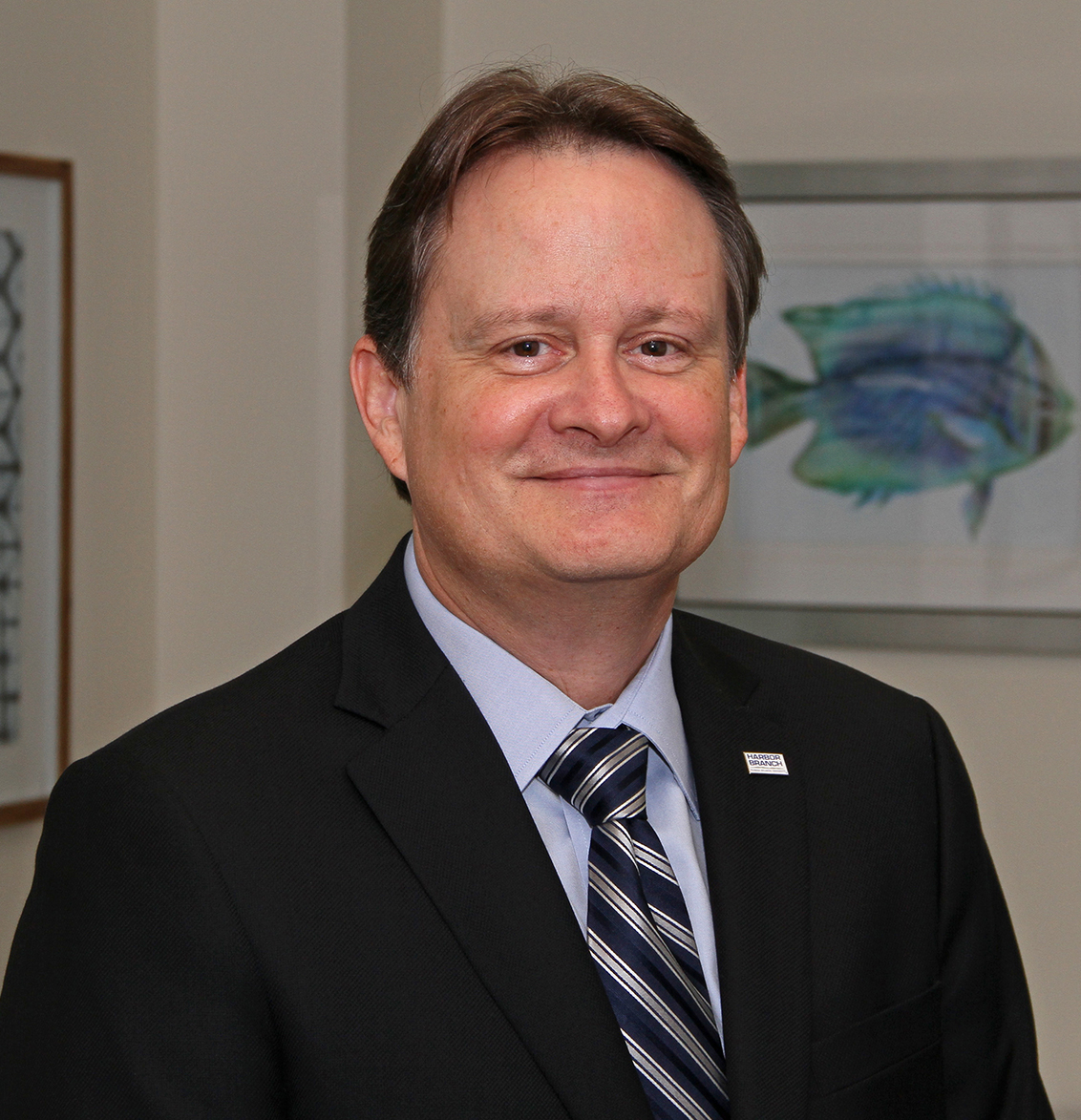
James M. Sullivan, Ph.D., joined Florida Atlantic University’s Harbor Branch Oceanographic
Institute in 2015 and was named executive director in 2018. Prior to that, he held senior positions
in academia and industry, serving as research faculty at the University of Rhode Island’s
Graduate School of Oceanography and as a senior oceanographer for Sea-Bird Scientific, a company
that manufactures instruments for measuring and monitoring ocean activity.
Throughout his career, Sullivan has received funding from major federal science agencies including
the National Science Foundation, National Oceanic and Atmospheric Administration, National
Oceanographic Partnership Program, Office of Naval Research, National Aeronautics and Space
Administration, and the National Institutes of Health. His research interests include the biological
and physical mechanisms that control the spatial-temporal dynamics of phytoplankton populations in
coastal oceans, harmful algal bloom dynamics, bioluminescence in the ocean, and the development and
use of optical and autonomous sampling instrumentation and analytical techniques to study these
processes.
He has developed or co-developed equipment including a moored autonomous vertical profiler, a
bathyphotometer, an in situ hyperspectral spectrophotometer, and an in situ holographic microscope
for 3D characterization of undisturbed particles in the ocean. Sullivan has published more than 50
peer-reviewed papers and has held editorial positions for several international scientific journals.
He currently serves as an editor of Optics Express.
Sullivan earned his master’s and doctorate degrees in biological oceanography, with
specializations in phytoplankton physiology and ecology as well as bio-optics and biophysics, from
the University of Rhode Island Graduate School of Oceanography.
As executive director, he is leading a strategic effort to develop interdisciplinary research by
combining expertise across FAU centers and colleges including Harbor Branch; the Institute for
Sensing and Embedded Network Systems Engineering (I-SENSE); SeaTech: Institute for Ocean and Systems
Engineering; the Florida Center for Environmental Studies; the Charles E. Schmidt College of
Science; the Harriet L. Wilkes Honors College; and the College of Engineering and Computer Science.