Daniel Van Zant
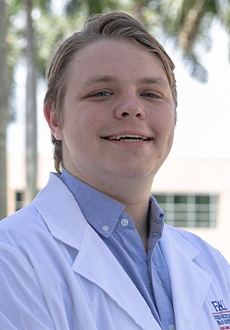
Entered: Neuroscience Graduate Program NGP 2022
Mentor: Elan Barenholtz Ph.D.
Thesis Topic: Using Large Language Models to Automate Drosophila Theory Validation
B.S. Psychology, Florida State University, Tallahassee, FL
“My primary research interests are using large language models to automate model validation in computational neuroscience. For the validation analysis I am focused on drosophila connectomics data and augmenting the connectomics tool ‘FlyBrainLab’. I am also working with the National Drug Early Warning System on a NIH training grant to predict substance abuse trends by using machine learning on data scraped from online drug discussion forums.
The NGP has an extremely interdisciplinary group of faculty members which has been perfect for putting together my supervisory committee as my dissertation topic is very interdisciplinary. I have gotten the opportunity to take some useful classes from some excellent professors including "Scientific Communication", "Methods in Complex Systems", "Computational Neuroscience" and "Nonlinear Dynamical Systems". My favorite part of the NGP so far has been the many excellent events and networking opportunities. In addition to the events hosted by the Stiles-Nicholson Brain Institute, I have also gotten the chance to attend many events through my affiliation with the The Center for Complex Systems and Brain Sciences, Center for Future Mind, Rubin and Cindy Gruber AI Sandbox, and the Machine Perception and Cognitive Robotics Lab (all of which are hosted here at FAU). In the past year, I have gotten the chance to meet and learn from such great thinkers as Dr. Andre Fenton, Dr. Stephen Wolfram, and Dr. Sara Walker to name a few. FAU also has an impressive network of complex systems neuroscientists that are based right here at the university.
During my first year, I was able to rotate with Dr. Barenholtz and Dr. Hahn, Dr. Dawei Li, and Dr. Behnaz Ghoraani. All of them are doing fascinating dry lab brain research which uses state of the art machine learning methods. Although my final choice of lab was Dr. Barenholtz and Dr. Hahn’s Machine Perception and Cognitive Robotics Laboratory (MPCR), I was glad to be able to make connections and learn some of the methods employed in multi-omics and biotechnology.”