Kaylee McMillian
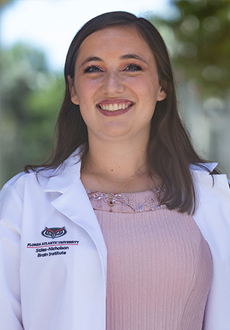
Entered: Neuroscience Graduate Program NGP 2024
Mentor: Irem Korucu, Ph.D.
Thesis Topic: TBD
B.S. Biology/Chemistry, University of Charleston, West Virginia
"I’m currently conducting research in Dr. Irem Koruku’s lab, where we are preparing to investigate how executive function develops in preschool-aged children using behavioral coding methods. The lab focuses on how environmental and contextual factors shape executive function. I’m particularly interested in how early cognitive skills—such as attention, self-control, and working memory—emerge and develop, especially in children facing challenges like ADHD, developmental delays, and educational inequalities.
I earned my bachelor’s degree in biology and chemistry from the University of Charleston. During that time, I worked with Dr. Julie Brefczynski-Lewis on pioneering brain imaging tools such as the Bedside PET Scanner and the PET Helmet. Our team helped demonstrate that portable neuroimaging could be a revolutionary development for clinical care, especially in remote or underserved areas. One highlight was contributing to the first-ever brain scan performed in a fully immersive virtual reality setting—an experience that showed me how innovation can break down barriers to healthcare access. Being from West Virginia, I’ve seen how limited educational resources and healthcare disparities impact children in rural communities. The state ranks low in child well-being indicators, with many families facing significant hurdles to obtaining quality care and early support. These experiences inspired me to focus my research on addressing these inequities, aiming to develop tools and knowledge that can make a real difference for the children who need it most.
I chose FAU’s Neuroscience Graduate Program because it offers a wide range of resources and encourages interdisciplinary collaboration. During my first year, I rotated through Dr. Teresa Wilcox’s lab, which studies mother-infant synchrony, and Dr. Nancy Jones’s lab, which focuses on emotional development in babies. These rotations helped clarify my research goals and confirmed my passion for developmental neuroscience with a strong societal impact.
Looking ahead, I hope my research contributes to identifying early markers of developmental challenges and designing interventions that improve outcomes for children facing these hurdles."