
More than a decade ago, a neuroscience research group began homing in on a gene discovered in roundworms for its intriguing links to dopamine signaling.
The group has since shown the human version of the same gene may hold clues for new treatments for multiple brain disorders ranging from addiction to Alzheimer’s disease.
Now, with the help of more than $600,000 in new grants, these Florida Atlantic University researchers hope to add glioblastoma, the most aggressive form of brain cancer, to that list.
The gene, called MBLAC1, was first fingered as an important molecule for cellular signaling and health by neuroscience experts in the lab of Randy D. Blakely, Ph.D, executive director of Florida Atlantic’s Stiles-Nicholson Brain Institute.
For the glioblastoma project, the Blakely lab has joined forces with the lab of Gregg B. Fields, Ph.D., vice president for research and executive director of the Institute for Human Health and Disease Intervention (I-Health) at Florida Atlantic. Ania Knapinska, Ph.D., research professor in Florida Atlantic’s Charles E. Schmidt College of Science, I-Health member, and Fields’ collaborator, is the principal investigator.
The work is supported by $562,000 from the Florida Department of Health’s Cancer Connect program and a $50,000 grant from Palm Health Foundation.
The Blakely lab previously found that the protein expressed by the roundworm version of MBLAC1 protein works in a novel way to sustain appropriate levels of copper, a vital micronutrient that is tightly linked to processes of energy creation.
“This protein is fundamentally controlling the ability of cells to produce energy,” Blakely said. “We know that cancer cells are dependent on a maintained source of energy because they’re growing rapidly and metastasizing. These are very energydemanding changes.”
CELLS IN SYNCITIUM
ART OF SCIENCE SUBMISSION
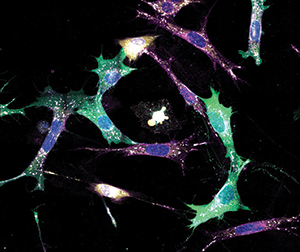
Emaad Mirza, staff, Stiles-Nicholson Brain Institute
Mentor: Srinivasa Subramaniam
This coculture of U87 glioblastoma cells and Q7 healthy mouse striatal cells displays what I consider to be the biggest conspiracy of cells. Between many cells in this image exist fine nanostructures known as tunneling nanotubes (TNTs). TNTs are conduits between cells that involve a direct cytoplasmic connection capable of moving the cell's most integral cargo. Conceptually, I performed this experiment to validate the transmission of mitochondria from the healthy Q7 cells to the burdened U87 glioblastoma cells.
The labs are collaborating to explore how eliminating the gene or its downstream support for copper homeostasis and energy production affects the growth and spread of glioblastoma tumors. Their tools include a mouse model developed by Blakely that precludes MBLAC1.
The plan also includes the development of a method to rapidly screen drugs for the ability to block MBLAC1 activity. The effort aims to find ways to limit glioblastoma spread and add years of life to those affected with this deadly cancer.