
Brain Imaging Helps Uncover How People Cope
The aftermath of natural disasters, layoffs and widespread infectious diseases impact communities in different ways, with different abilities to “bounce back.”
“Resilient communities are those that are able to adapt to various challenges that they face,” said Andrew Newberg, MD, director, MRI Research and Discovery Center at Florida Atlantic. “These communities, built of resilient people, are those who are able to navigate the challenges as best as possible, deal with the ups and downs, and find effective ways of solving problems and moving forward.”
Communities are comprised of people, and Newberg has been studying individuals using functional magnetic resonance imaging (fMRI), to peer into the mind. With fMRI, scientists can see how the brain reacts to situations in real-time by monitoring blood flow and the strength of brain networks. More blood flows to highly active areas, which appear brighter on a scan than inactive or less active regions.
Newberg’s previous work has focused on communication, spirituality and different mental states to explore how people experience and approach the world. Now, he will apply his knowledge toward gaining a better understanding of how people can improve the way they handle difficult situations.
“Our plan is to do human studies with fMRI to look at how the brain functions in people who respond to challenges differently that we can detect with sensitive imaging tools,” Newberg said. For example, he will use the scans to see whether there are differences in brain activity between resilient people and those who do not seem to adapt well to change and adversity. He will also look at the effects of various types of interventions with the goal to improve resilience.
Because the limbic system is the emotional center of the brain, changes in resiliency may be apparent in this area. Other regions that could play a role are the frontal lobe, which is responsible for decision-making and language, and the temporal lobe, which processes sounds and is involved in forming and retrieving memories.
Newberg said he is excited about the possible collaborations that the Center for the Resilient Mind could foster. “Working together across disciplines will hopefully lead to a much better way of understanding resilience and will help everyone, both on an individual as well as a global level to be more resilient,” he said.
 Religion is an important component of many people's lives and
communities. Using brain imaging technology that measures blood flow, researchers can analyze brain activity
when people are engaged in spiritual activities, such as prayer and meditation, to see how it relates to
people's perceived religious experience.
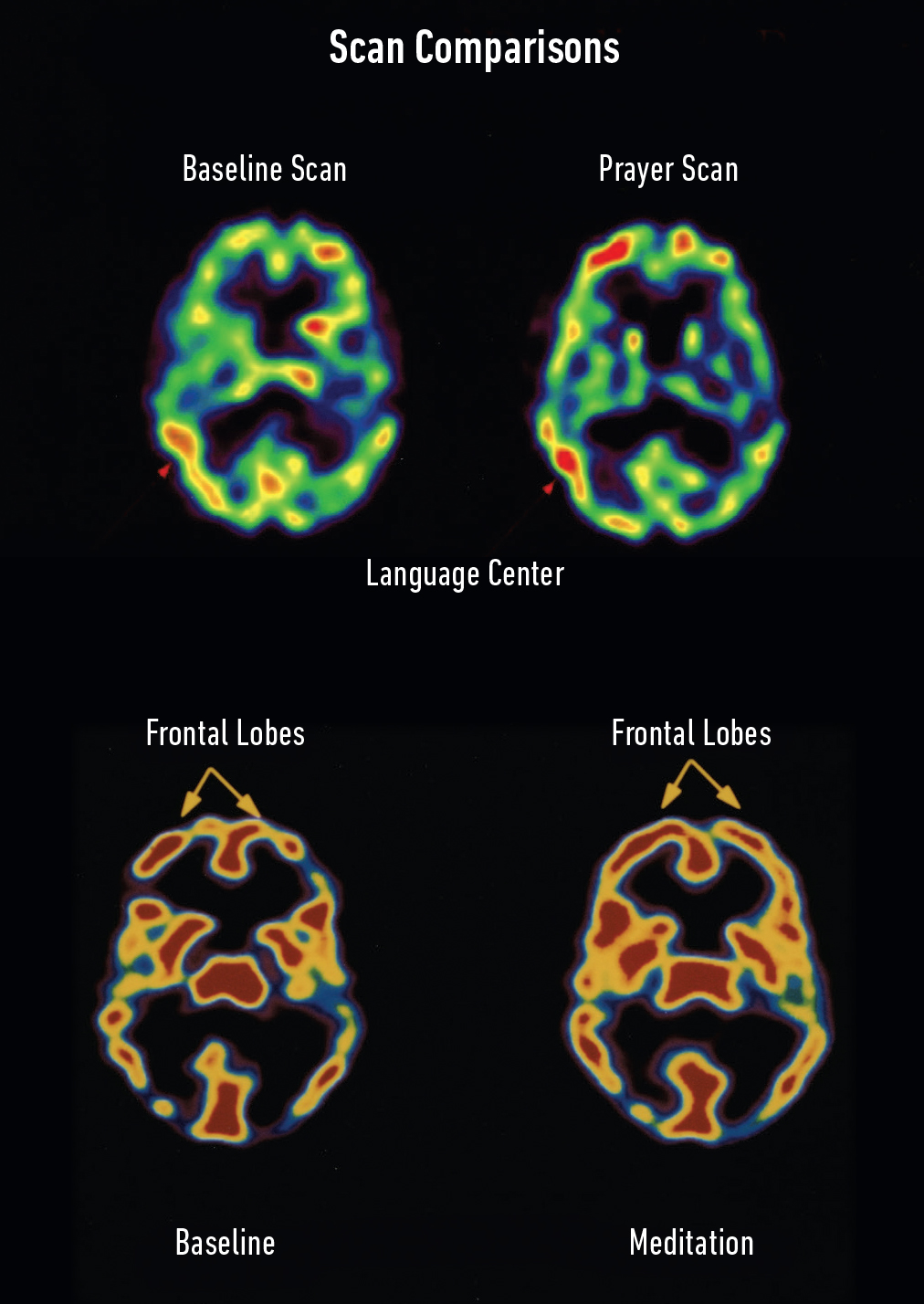
Religion is an important component of many people's lives and
communities. Using brain imaging technology that measures blood flow, researchers can analyze brain activity
when people are engaged in spiritual activities, such as prayer and meditation, to see how it relates to
people's perceived religious experience.