New Funding Allows Doctoral Students to Focus on Research
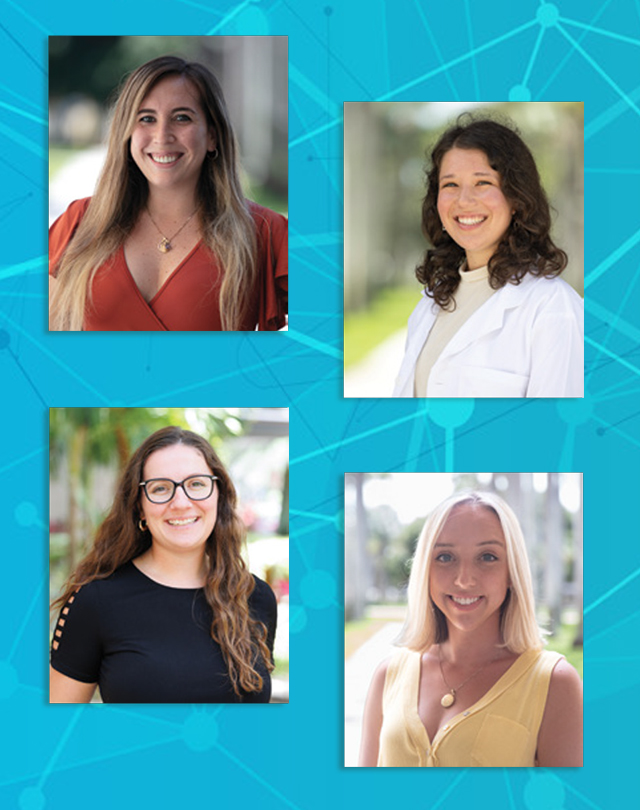
This year, four graduate students studying at Florida Atlantic’s Stiles-Nicholson Brain Institute were appointed as June Jones Scholars. The new program provides one semester of stipend support to assist the students in focusing on their research instead of having to receive their stipend through undergraduate teaching. This frees up 20 hours of their week to devote to innovation and discovery in the lab. An additional two students are set to be awarded the scholarship during the Summer 2025 semester. The program is made possible by funding from the June Jones Foundation.
Neuroscience Graduate Program
Mentor: Ali Danesh, Ph.D.
Alvarez’s current research investigates vestibular function (the sensory system in the inner ear that helps maintain balance and spatial orientation) in Parkinson’s disease (PD) using artificial intelligence technology to obtain various movement metrics to assess both gait and balance. PD symptoms are predominantly characterized by deficits to motor function, which correlates to deficits seen in vestibular function, both of which have been associated with an increased fall risk for PD patients. Some work has shown that proper characterization of vestibular function can predict fall risk in patients and therefore can potentially be used to contribute to preventative measures. Recent work has also linked vestibular function to cognitive disorders and quality of life in patients. The research on this in PD is limited and further investigation is needed to delineate the relationship between cognitive function and the vestibular system. Therefore, Alvarez said, the goal of her work is to further characterize vestibular function and its possible correlations to cognitive decline in the PD population.
Neuroscience Graduate Program
Mentor: Rodrigo Pena, Ph.D.
Krubitski's research focuses on understanding the dynamics of co-transmission, a process where neurons release multiple neurotransmitters simultaneously. Co-transmission introduces a level of precision in synaptic signaling that differs from single neurotransmitter transmission that has been widely studied previously. There is little known about co-transmission, particularly how it contributes to synaptic integration and its role in normal and pathological conditions, which is what I aim to study. Specifically, Krubitski is currently studying the co-transmission of glutamate
and GABA, which produces biphasic activity patterns that depend on temporal and amplitude differences in excitatory and inhibitory signals. This biphasic activity also determines how they are integrated in the postsynaptic neurons, which affects spiking dynamics and neural communication. Her work uses modeling techniques to explore how dendritic filtering and temporal integration shape these dynamics. In simulating different combinations of temporal and amplitude differences, we are able to identify different summation patterns in the postsynaptic neuron, such as high-pass, band-pass and low-pass filtering, which affects how the neuron integrates and propagates the incoming signal. Additionally, she examines different currents such as persistent sodium and hyperpolarization-activated currents and their roles in enhancing excitatory summation and inhibitory filtering in co-transmission as opposed to synaptic transmission.
Integrative Biology – Neuroscience Graduate Program
Mentor: Randy D. Blakely, Ph.D.
Walsh’s research specifically emphasizes the role of the presynaptic serotonin transporter (SERT) and neuroinflammation. Her current studies investigate the molecular and genetic mechanisms underlying neurodevelopmental and neuropsychiatric disorders, with a special emphasis on how altered serotonin signaling contributes to these conditions. The goal of this work is to uncover insights that could lead to better treatments for disorders by understanding the interaction between serotonin signaling and neuroinflammation, she said.
Neuroscience Program
Mentor: Summer Sheremata, Ph.D.
Wiseman’s research explores how the two brain hemispheres process visual information differently, particularly during a phenomenon called visual crowding. Visual crowding occurs when a viewer can identify a target, such as a letter, when it is alone, but cannot identify the same target when it is surrounded by distractors, such as within a word. Visual crowding is a fundamental limit of attention and is highly associated with dyslexia, a common learning disability. While crowding has long been investigated, the allocation of attentional resources and lateralization during crowding is limited. The goal of Wiseman’s research, she said, is to better understand how contralateral biases in behavioral and neural data impact common human behaviors, such as reading, and to benefit future dyslexia research.