Summer Institute in Computational Social Science Fosters Social and Health Collaborations
Wednesday, Jun 24, 2026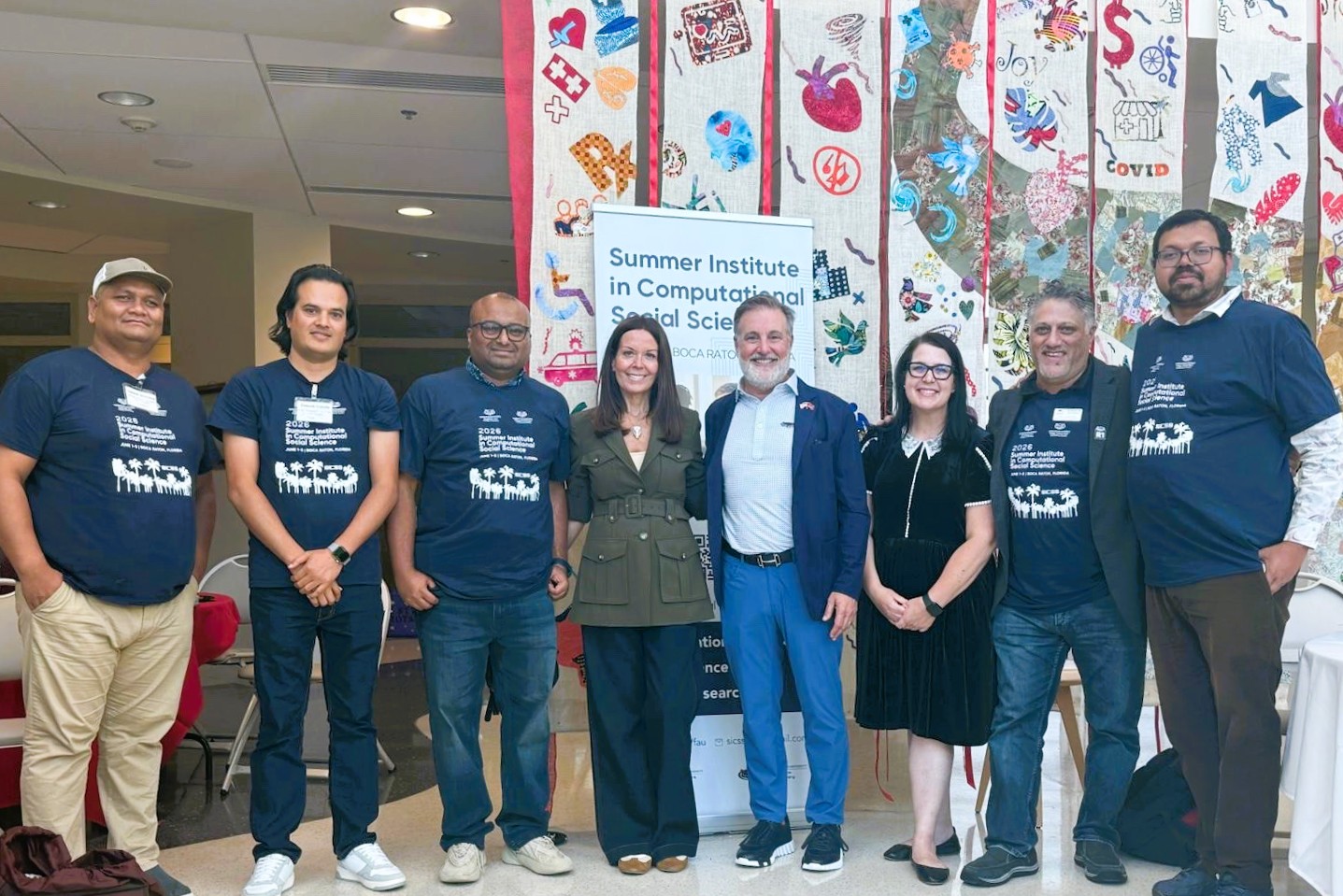
The Phyllis and Harvey Sandler School of Social Work in the College of Social Work and Criminal Justice at Florida Atlantic University joined forces with the Christine E. Lynn College of Nursing to host the dynamic and inspiring 2026 Summer Institute in Computational Social Science (SICSS) this June. The result was an energizing collaboration that placed social work and nursing at the forefront of innovation in healthcare and computational science.
SICSS is part of a highly regarded global training network that brings together early-career researchers working at the intersection of social science and data science. Since 2017, the program has trained more than 2,200 researchers from 500 universities worldwide. The Florida Atlantic cohort included 26 participants, primarily from universities across Florida, along with several out-of-state attendees and one international participant.
Led by Debarshi Datta, Ph.D., assistant professor in the Christine E. Lynn College of Nursing, Morgan Cooley, Ph.D., associate dean for research and academic effectiveness in the Phyllis and Harvey Sandler School of Social Work, and a dedicated planning committee including Subhosit Ray, Ph.D., David Newman, Ph.D., and Alan Kunz-Lomelin, Ph.D., the two colleges demonstrated how interdisciplinary excellence can drive transformative solutions to today’s most pressing social and health challenges.
The partnership exemplified Florida Atlantic’s commitment to advancing bold, forward-thinking approaches that integrate human-centered care with cutting-edge data science. By bringing together the strengths of social work and nursing, the institute created an environment where compassion, evidence-based practice and technological innovation converged.
“With support and funding from SICSS, our planning team crafted a unique and rigorous institute centered around the learning goals of our prestigious group of participants who are working to address a range of social issues currently impacting our state and national community,” said Morgan Cooley, Ph.D.
Over the course of five immersive days, participants explored how data-driven approaches can illuminate complex social and health phenomena and inform equitable, impactful interventions.
Naelys Luna, Ph.D., dean of the College of Social Work and Criminal Justice, said the collaboration reflects Florida Atlantic University’s strategic priorities to discover solutions for healthier and safer communities while fostering collaboration across disciplines.
“Through this institute, we are intentionally breaking down silos to accelerate innovation. This institute demonstrates how integrating social work and nursing with computational science can generate powerful, data-informed solutions that improve health outcomes and create lasting impact in our communities. We are also equipping the next generation of leaders to design solutions that are not only innovative—but deeply human,” she said.
The program delivered an engaging learning experience, featuring interactive lectures, hands-on programming in Python and R, and collaborative research projects. With a strong emphasis on causal inference, participants also explored advanced topics such as text analysis, network analysis, survey experiments and machine learning. Distinguished faculty and guest speakers from academia, industry and government brought these concepts to life, showcasing real-world applications.
Throughout the week, participants engaged in meaningful project work and formed new professional connections. The institute championed transparency and innovation by promoting open and reproducible science, with all materials made available under an open-source license.
“As healthcare becomes increasingly data-driven, nurses and nurse scientists have an important role to play in developing and applying computational approaches to complex health challenges,” said Cameron G. Duncan, Ph.D., dean of the Christine E. Lynn College of Nursing. “Hosting SICSS at Florida Atlantic created an opportunity to explore those connections while bringing researchers from multiple disciplines together.”
The program culminated in project presentations and a celebratory certificate ceremony attended by Florida Atlantic President Adam Hasner and the First Lady Jillian Hasner.
Participants left the institute with new technical skills, hands-on experience working with real-world data and connections to researchers and professionals from across the country and around the world.