
FAU Receives $400,000 NSF Grant to Advance STEM Workforce Readiness
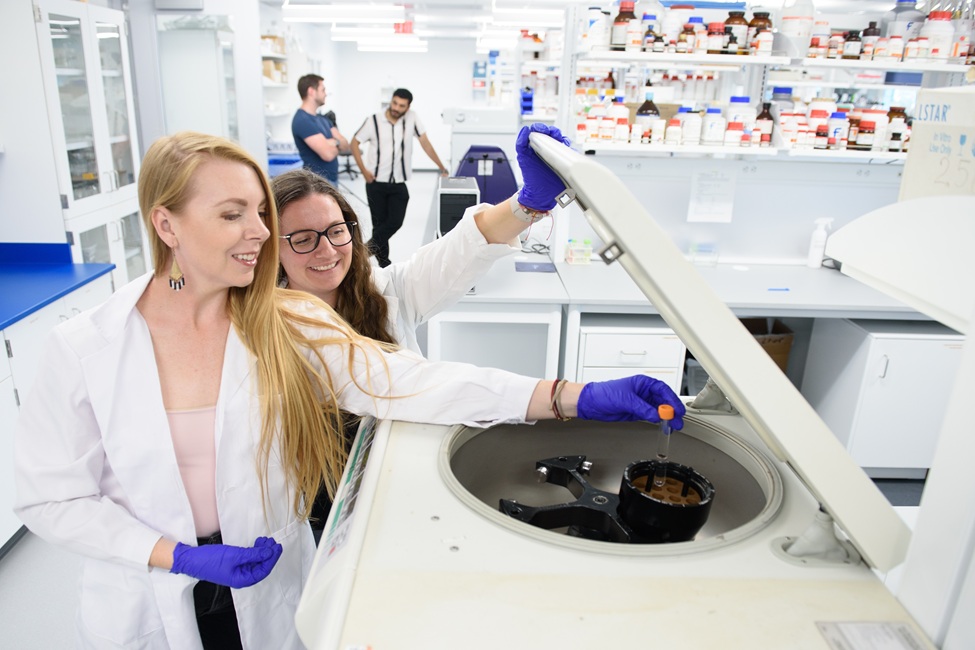
On the left, Bethany A. Stanhope, Ph.D., principal investigator and executive director of academic operations at FAU’s John D. MacArthur Campus, with Allison Walsh, an FAU neuroscience doctoral student. (Photo by Alex Dolce)
Grant Snapshot: Florida Atlantic University has received a $400,000 National Science Foundation grant for “Research to Reality: Connecting Discovery, Industry, and Innovation to Accelerate Workforce Readiness.” The three-year project will explore how industry-informed research, entrepreneurship training and early engagement can better prepare undergraduate students for careers in biotechnology and the life sciences.
The project will connect students with research, internships, industry experiences and AI-enabled learning while expanding access to workforce opportunities. The project team also will examine how these approaches can strengthen career readiness, particularly for transfer and first-generation students, and develop practices that can be adapted by institutions nationwide.
Florida Atlantic University has received a $400,000 grant from the National Science Foundation to address a growing challenge facing the nation’s biotechnology and life sciences sectors: the gap between undergraduate STEM education and the skills, experiences and professional readiness expected by today’s rapidly evolving workforce.
The U.S. bioeconomy is expanding rapidly, driven by advances in biotechnology, engineering biology, artificial intelligence and data-driven research. The sector could contribute as much as $4 trillion annually to the global economy and support more than 1 million U.S. jobs by 2030. Yet many STEM graduates enter the workforce without the practical experience and professional skills employers increasingly seek, including communication, teamwork, critical thinking, data management, quality control and applying scientific knowledge to real-world problems.
The challenge is particularly significant for undergraduates, who make up a major pipeline for entry-level bioscience jobs. Yet traditional labs often don’t provide the hands-on, real-world experience employers seek, leaving graduates less prepared to apply their knowledge in the workplace or navigate the growing range of careers in the bioeconomy.
Through the project, “Research to Reality: Connecting Discovery, Industry, and Innovation to Accelerate Workforce Readiness,” FAU will investigate how undergraduate STEM education can better connect scientific discovery with workforce preparation. The project is supported through NSF’s Improving Undergraduate STEM Education program and its Engaged Student Learning track, which supports the development, exploration and implementation of promising approaches for improving STEM education.
Led by principal investigator Bethany A. Stanhope, Ph.D., executive director of academic operations at FAU’s John D. MacArthur Campus in Jupiter; and co-PI Kelsie M. Bernot, Ph.D., an assistant professor of biology at FAU’s Harriet L. Wilkes Honors College, the project will leverage FAU’s research infrastructure, academic programs, entrepreneurship resources and partnerships with industry and regional life sciences organizations to investigate how undergraduate STEM education can better prepare students for careers in the rapidly evolving biotechnology and life sciences workforce.
“This grant gives us an opportunity to rethink how we prepare students for the life sciences workforce by bringing the realities of research, industry and innovation directly into the undergraduate experience,” said Stanhope. “Students need more than scientific knowledge; they need opportunities to solve authentic problems, work in teams, communicate their ideas and understand how research translates into real-world applications. This project will help us identify and strengthen those experiences so students graduate with the confidence, skills and practical experience to succeed in the rapidly evolving life sciences workforce.”
The three-year project will examine a “Research to Reality” framework that combines industry-informed research experiences, entrepreneurship and innovation education, internships and AI-enabled research modules. The team will study how these experiences strengthen students’ technical and professional skills, scientific problem-solving, career confidence and understanding of pathways into the life sciences workforce. The project also will explore how academic-industry partnerships can help students translate scientific ideas into practical solutions and prepare for careers in the growing bioeconomy.
“An important part of this project is helping students understand that scientific discovery is only one part of the journey,” said Bernot. “We want students to experience what happens when an idea has to move from the laboratory toward a real-world application. That means asking whether an idea is feasible, understanding who it could benefit, communicating its value, considering resources and constraints, and thinking creatively about implementation. By integrating entrepreneurship and innovation into STEM learning, we can give students a different way to see their scientific training and the many ways they can use it in their careers.”
The project also will expand access to research, internships and workforce opportunities through early-engagement and transfer-focused programming, with particular attention to first-generation students. By strengthening FAU’s partnerships with industry and organizations such as BioFlorida, the team will identify effective approaches for connecting academic training with workforce needs and develop scalable resources that can help institutions nationwide strengthen STEM workforce preparation.
The project team includes Kevin Cox, Ph.D., senior instructor and director, Florida Atlantic Entrepreneurship Institute within FAU’s College of Business; Raquel Assis, Ph.D., associate dean and associate professor, Department of Electrical Engineering and Computer Science and Department of Biomedical Engineering within FAU’s College of Engineering and Computer Science; and Rodrigo Pena, Ph.D., an assistant professor of biological sciences within FAU’s Charles E. Schmidt College of Science.
-FAU-
Tags: faculty and staff | students | research | jupiter