
FAU Engineers Prosthetic Hand That Learns, Adapts to Each User
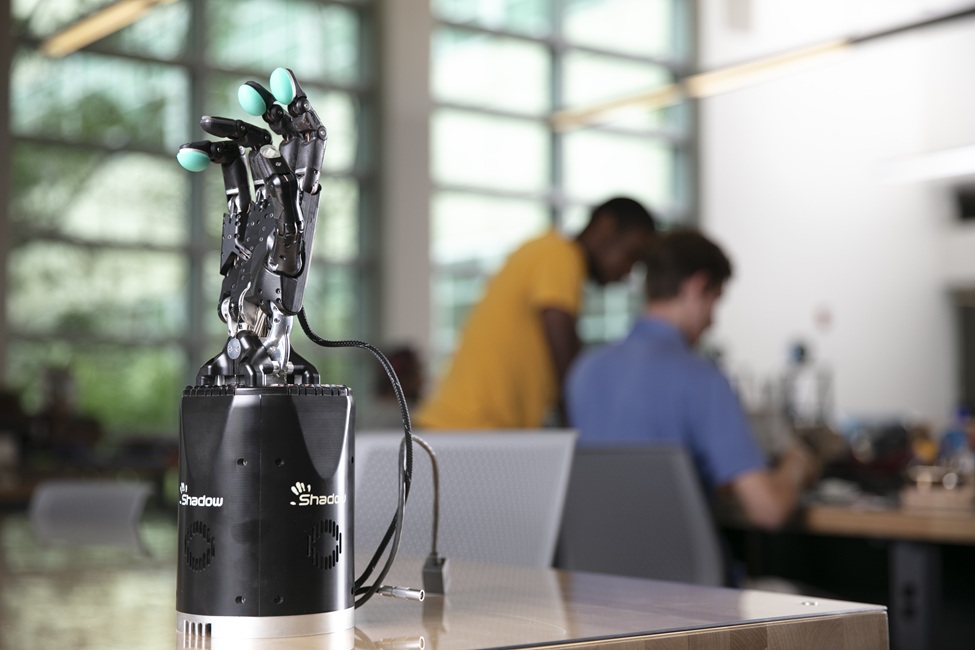
The trained AI model converts the user’s forearm muscle movements into real-time commands that control a robotic hand, allowing it to perform the intended gestures. (Photo by Alex Dolce)
Study Snapshot: Most prosthetic hands today still face a basic challenge: no two amputees are alike, yet most devices are built as if they are. This mismatch makes it difficult to achieve natural, intuitive control, often forcing users to constantly adapt to the device rather than the other way around. Even with advances in technology, prosthetic control still relies on weak muscle signals that can change with sweat, skin conditions, or daily movement, creating an unstable link between intention and action that can be frustrating and, in some cases, lead to device abandonment.
FAU College of Engineering and Computer Science researchers are addressing this by designing prosthetic systems that adapt to each individual. They begin by 3D scanning a person’s residual limb to create a custom 3D-printed wearable sleeve embedded with soft magnetic sensors that detect subtle muscle changes in real time. Each system is tailored with either 18 or 24 sensors depending on the user’s anatomy and paired with an individualized AI model that learns that person’s unique movement patterns. In testing with 10 study participants, the system showed strong real-time control of multiple hand and wrist gestures and maintained stable performance even under repeated use.
Most prosthetic hands today still struggle with a fundamental problem: no two amputees are the same, yet most devices are designed as if they are. That mismatch makes natural, intuitive control difficult, often turning what should feel like a seamless extension of the body into something that requires constant learning and adjustment.
Even with advanced technology, users are frequently left to interpret faint muscle signals that can shift with sweat, skin changes, or everyday movement – creating a gap between intention and control that can be frustrating and, in some cases, lead people to abandon the device altogether.
Researchers have made progress by improving how muscle signals are interpreted, but the core challenge remains: the signals are often unstable and hard to translate into natural movement.
To address this challenge, Erik Engeberg, Ph.D., is leading research to shift the focus from standardized devices to truly personalized systems that adapt to each individual. Engeberg is a professor at Florida Atlantic University’s College of Engineering and Computer Science, with appointments in the Department of Ocean and Mechanical Engineering and the Department of Biomedical Engineering. He is also a member of the FAU Stiles-Nicholson Brain Institute and the FAU Center for Complex Systems within the Charles E. Schmidt College of Science.
The approach begins with 3D scanning a person’s residual limb to create a custom 3D-printed wearable sleeve embedded with soft, flexible magnetic sensors. These sensors sit comfortably against the skin and capture subtle changes in muscle shape and pressure as the user attempts hand and wrist movements, allowing the system to interpret intent in real time.
The design is tailored to each individual, with sensor arrays configured with either 18 or 24 modules depending on limb size and anatomy and paired with an individualized artificial intelligence model that learns each person’s unique muscle patterns rather than relying on a generalized dataset.
In testing with 10 participants, including three upper-limb amputees, the system classified 19 hand and wrist gestures in real time, translating intent into control of a dexterous robotic hand. Results, published in IEEE Transactions on Neural Systems and Rehabilitation Engineering, show the system performed consistently and reliably under repeated use.
To assess durability, researchers applied more than 7,500 robotic force cycles over several hours while precisely measuring sensor response. The system showed a strong, stable relationship between applied force and output, accurately capturing pressure without loss of performance.
Even after thousands of cycles, signals remained clear and stable, with strong separation between signal and noise and only minor variation over time. Overall, the sensors showed no meaningful drift or degradation, maintaining accuracy, repeatability and responsiveness essential for real-world prosthetic control.
“Prosthetic control is not one-size-fits-all. Every individual brings a distinct movement signature shaped by their anatomy, injury history and how their remaining muscles function,” said Engeberg, senior author. “If we want these systems to truly work in everyday life, they have to be custom fit. By combining 3D-printed wearable sensors with individualized AI models, we’re moving closer to prosthetic systems that can respond naturally and in real time to a person’s intent, rather than forcing users to adapt to the limitations of the device.”
Findings also showed there is no single best sensor configuration for all users. Some participants achieved higher accuracy with fewer sensors, while others required more, with optimal setups varying based on individual anatomy and differences in injury history and remaining muscle function. In several cases, participants achieved more than 90% accuracy across multiple gestures only when the sensor layout was tailored to their residual muscles.
“Our results highlight that prosthetic performance is highly dependent on how well sensor placement and quantity are matched to the individual,” said Engeberg. “This suggests a future in which prosthetists can fine-tune sensor configurations much like a prescription, balancing both function and comfort for each user.”
The research also produced a shared dataset from all participants, including amputees and non-amputees, providing a valuable resource for the broader scientific community.
“This work speaks to something very practical: improving quality of life in a very direct way,” said Stella Batalama, Ph.D., dean of the College of Engineering and Computer Science. “When we close the gap between engineering innovation and what people actually need in their daily lives, especially for individuals who depend on prosthetic devices for independence, the impact goes far beyond the lab. It’s about restoring function, confidence and the ability to engage with the world more naturally.”
In the United States alone, an estimated 2.1 million people are living with limb loss, with around 185,000 amputations occurring each year. Globally, more than 50 million people are affected, a number expected to grow due to diabetes, vascular disease, trauma and conflict-related injuries. Upper-limb amputations are among the most challenging to restore functionally because of the complexity of natural hand and finger movement.
Study co-author is Wen-Yu “Marty” Cheng, a graduate student and Ph.D. candidate in FAU’s College of Engineering and Computer Science.
-FAU-
Tags: research | faculty and staff | AI | technology | engineering | brain institute