Wilkes Honors College Students Argue First Amendment Case in Judicial Simulation
by Chelsey Matheson | Wednesday, May 20, 2026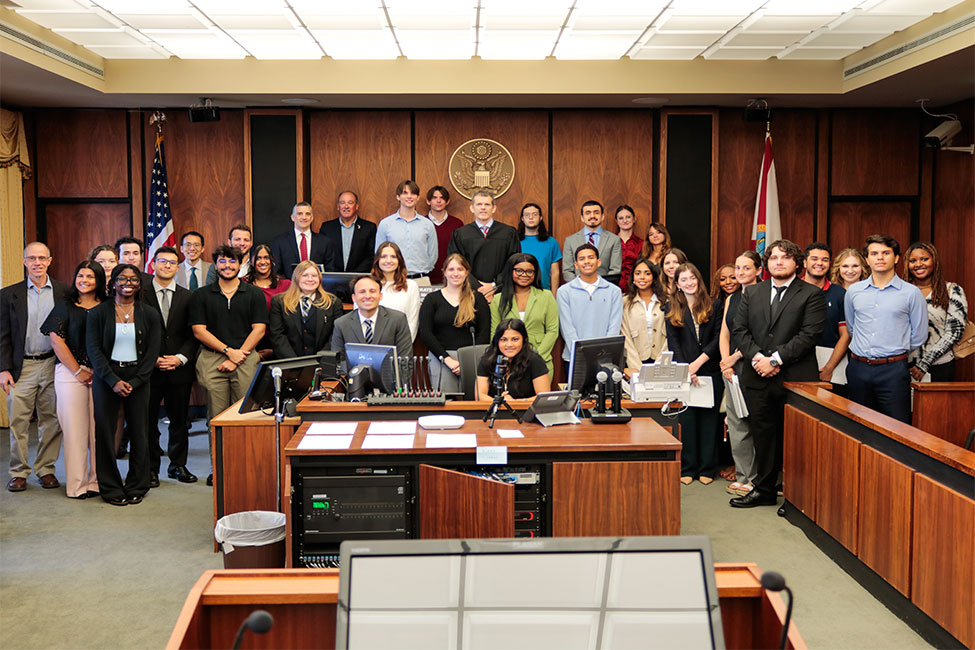
On an April morning, a group of students and one professor from Florida Atlantic University’s Harriet L. Wilkes Honors College gathered in the lobby of the Paul G. Rogers Federal Building and U.S. Courthouse in Downtown West Palm Beach. After checking in through security and handing over cell phones, they were ushered upstairs and into a federal courtroom.
There to greet them was a small group of attorneys ready to take them through a unique, hands-on exercise called Civil Discourse and Difficult Decisions (CD3).
“This was a very special opportunity for over 30 of our students not merely to observe, but to actively engage with top attorneys and a sitting federal judge in the federal courthouse,” said Mark Tunick, Ph.D., professor of political science at the Wilkes Honors College.
Michael Habib, an attorney at Jones Foster and an alumnus of the Wilkes Honors College, led the program, which is a national initiative of the federal courts to give students a simulated experience of legal proceedings in a federal courtroom based on real-life issues. This CD3 program was hosted by the Palm Beach Chapter of the Federal Bar Association.
“The program helps demystify the law and exposes students to our justice system in a positive and accessible way that many otherwise might never experience,” Habib said. “What makes the program so impactful is that it places students directly into the role of advocate, forcing them to think critically, speak persuasively, and wrestle with difficult constitutional questions in real time.”
After preliminary introductions, Habib kicked off the program with a civility self-reflection exercise. Students completed a questionnaire where they gauged their personal reactions to scenarios such as, “When a conversation gets very heated, I speak up,” and “I speak respectfully to people who disrespect me.” Habib guided the participants through a discussion of the questions, encouraging feedback from all the participants and laying the ground rules of civility for the day’s proceedings.
Then it was time to begin judicial simulation of the exercise. The students were presented with the case summary from a real First Amendment case related to the criminality of online threats. Then they heard the “facts” of the fictional First Amendment scenario they would simulate: A jilted boyfriend uploaded a rap song to a social media platform intimating a threat to his ex-girlfriend. The girlfriend deemed the statement to be an actual threat and reported it to the authorities.
The scenario hinged on whether the threat made within the song was protected under the First Amendment. Habib asked for volunteers to act as government prosecutors and volunteers to serve as defense attorneys. The remaining students comprised the jury.
The legal teams separated into their respective conference rooms with two attorneys assigned to coach each group. Val Rodriguez and Jim Baldinger guided the prosecution in developing their case, while Andrew Kwan and Ramzie Fathy mentored the defense. Silvia Ibrahim briefed the jury, leading a discussion about the merits of potential arguments that could be posed by both sides.
Magistrate Judge Ryon McCabe, U.S. District Court Southern District of Florida, presided over the case. Members of the defense and prosecution teams took turns presenting their arguments. After each student spoke, Judge McCabe asked follow-up questions, looking for clarification or challenging the logic of the argument, giving the students the experience of fine-tuning their statements under pressure.
“I was so proud of our students for how thoughtfully they responded to Judge McCabe’s challenging questions,” Tunick said. “They came away with a deeper understanding of what lawyers and judges do and how federal courts operate.”
After each side made closing remarks, the jury was asked to determine their verdict by vote. Though the majority found in favor of the government, a few members remained firmly with the defense, leaving the case in a mistrial – a stark lesson in the difficulty of determining a First Amendment case.
The debrief included a question-and-answer opportunity with Judge McCabe. He described his typical day (a lot of reading), the legal function of a grand jury, and imparted a human dimension to some of the challenges – and dangers – of being the judge presiding over a contentious legal decision.
Habib cited gratitude to his alma mater as one of his motivations for inviting the group to participate in the CD3.
“The Honors College played a tremendous role in the success I have achieved since leaving campus,” he said. “It fostered within me the critical thinking skills that lawyers — and, frankly, all informed citizens — should possess, and it gave me the space to develop my own voice, which I now use every day as an advocate.”
Click here to view the photo album.
Special thanks to Michael Habib (Jones Foster), Val Rodriguez (Law Offices of Valentin Rodriguez, P.A.), Andrew Kwan (Pankauski Lazarus PLLC], Jim Baldinger (Baldinger Mediation, LLC) Silvia Ibrahim (Law Clerk, Magistrate Judge Ryon McCabe), Ramzie Fathy and Judge Ryon McCabe for donating their time to mentoring the Wilkes Honors College students through the Civil Discourse and Difficult Decisions program.