‘Train the Brain’ Events Share Discoveries About Building Brain Resilience
by Chelsey Matheson | Monday, Nov 17, 2025
One of the most active areas of brain science is the basis of resiliency. Why do some people age well despite having heritable risks for Alzheimer’s disease or live successful, emotionally stable lives despite traumatic stress? Researchers across the globe are trying to understand discrepancies in brain resilience and decode neural mechanisms that strain or strengthen human capacities to deal with the challenges of life and provide new, evidence-based treatments, whether through activity, diet, social experience, art or medicine, leading the Stiles-Nicholson Brain Institute (SNBI) at Florida Atlantic University to develop a Center for the Resilient Mind, set to open in 2026.
To foreshadow the efforts of the new center, SNBI hosted a pair of events that explored breakthrough neuroscience research seeking to understand the basis of brain resilience and lay the foundation for new treatments to brain disorders. The events were sponsored by Palm Health Foundation, a lead sponsor of the center, and presented as part of the foundation’s annual “Train the Brain” public outreach series, held every October.
“Train the Brain: Neuroscience Research Symposium” and “Train the Brain: Neuroscience Community Conversation” featured SNBI researchers and scientists from across the United States, each sharing their expertise on brain health throughout the lifespan – from fetal and early life development through adulthood and the maturing brain.
The speakers and topics were consistent across both events, but the Neuroscience Symposium talks were tailored to the scientific community at Florida Atlantic and partner institutions, while the Community Conversation was geared toward a public audience. Both formats encouraged audience participation through question-and-answer sessions and meet-and-greet receptions with the speakers.
“We intentionally selected speakers whose science and presentation styles would engage highly experienced researchers and their trainees, as well as the lay public who often lack direct exposure to leading scientists in their fields,” said Randy D. Blakely, Ph.D., David J.S. Nicholson distinguished professor in neuroscience and executive director of SNBI. “We will definitely do this again next year.”
The event programs included the following presenters and topics:
Challenges to Resiliency in the Developing Brain
- Judy Van de Water, Ph.D., a professor of medicine at the University of California, Davis, described the impact of maternal antibodies associated with autism spectrum disorder, specifically how a severe infection in the mother could pass these molecules to the fetus with the potential to disrupt brain development.
- Alexandre Bonnin, Ph.D., an associate professor of pathology at the University of Southern California’s Keck School of Medicine, explained “neuroplacentology” – the influence of the placenta in fetal brain development and how its protective barrier can be breached as a result of maternal infection.
Challenges to Resiliency in the Adult Brain
- Ning Quan, Ph.D., professor of biomedical science at FAU’s Charles E. Schmidt College of Medicine, director of SNBI’s Program in Neuroimmunology and Glial Biology and a co-organizer of the events, addressed the mechanisms of body-brain immune coordination across the lifespan with both positive and negative outcomes.
- Jennifer Felger, Ph.D., associate professor of psychiatry and behavioral sciences at Emory University School of Medicine described effects of brain inflammation as it relates to depression risk, with insights that are opening a new door to diagnosis and treatment.
- Brittany D. Needham, Ph.D., an assistant professor of anatomy, cell biology and physiology at Indiana University School of Medicine, described the conversation between gut and brain, where resident microbes produce metabolites that can affect brain function – for better and for worse.
Challenges to Resiliency in the Aging Brain
- Henriette van Praag, Ph.D., associate professor in the Schmidt College of Medicine and SNBI, described her career-long search for the positive effects of exercise on brain and mental health from middle age through later life, revealing molecules released by muscle that support cognitive function.
- Corinne Lasmézas, Ph.D., director of SNBI’s David and Lynn Nicholson Center for Neurodegenerative Disease Research and a professor in the Schmidt College of Medicine, was the keynote speaker for both events. She shared her breakthrough research on new leads to forestall and treat debilitating neurodegenerative diseases including Parkinson’s disease.
The Neuroscience Symposium included talks from two of SNBI’s early career scientists, Paula Gajewski, Ph.D., an assistant research professor at SNBI, and Daniel Nemeth, Ph.D., a postdoctoral fellow in the Schmidt College of Medicine. Both researchers explored the effects of inflammation on brain function. Gajewski focused on its role in serotonin disruption and depression, and Nemeth mapped key indicators of the brain’s immune response by comparing a healthy versus inflamed brain.
“This was a very successful pair of events,” said Quan. “We were able to bring in world-class scientists to share their discoveries to the FAU research community and to members of the public thirsty for solutions regarding mental health issues. The scientific presentations inspired more research in the area of resiliency from the FAU faculty and their future collaborations with international experts. The talks for the public generated a lot of interest for the community to engage in holistic initiatives for mental health.”
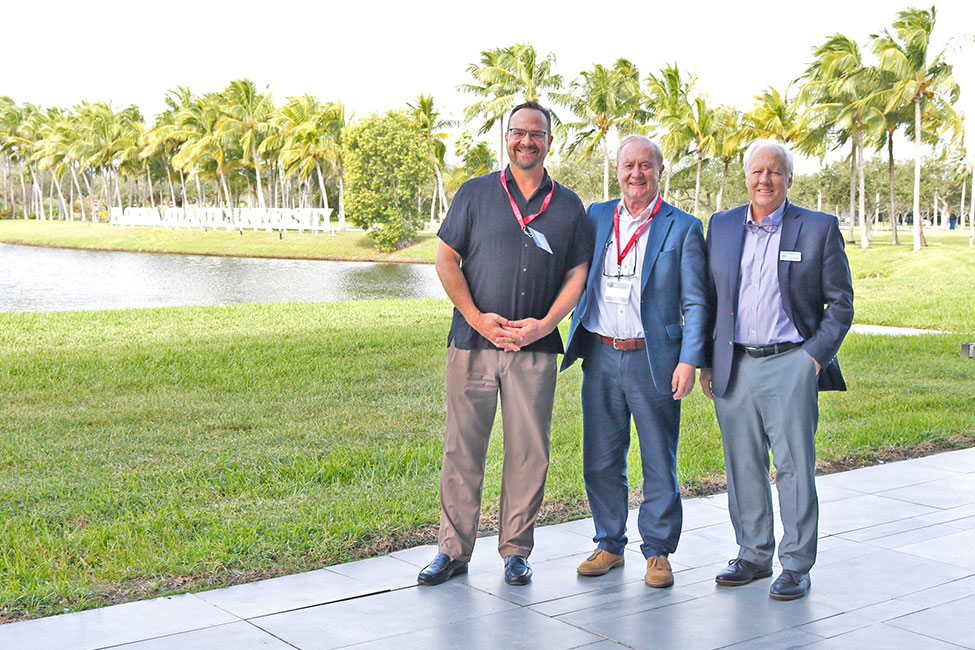
Patrick McNamara, president and CEO of Palm Health Foundation, James Goodwin, director of science and research at Brain Health Network, Randy D. Blakely, Ph.D., executive director of FAU Stiles-Nicholson Brain Institute
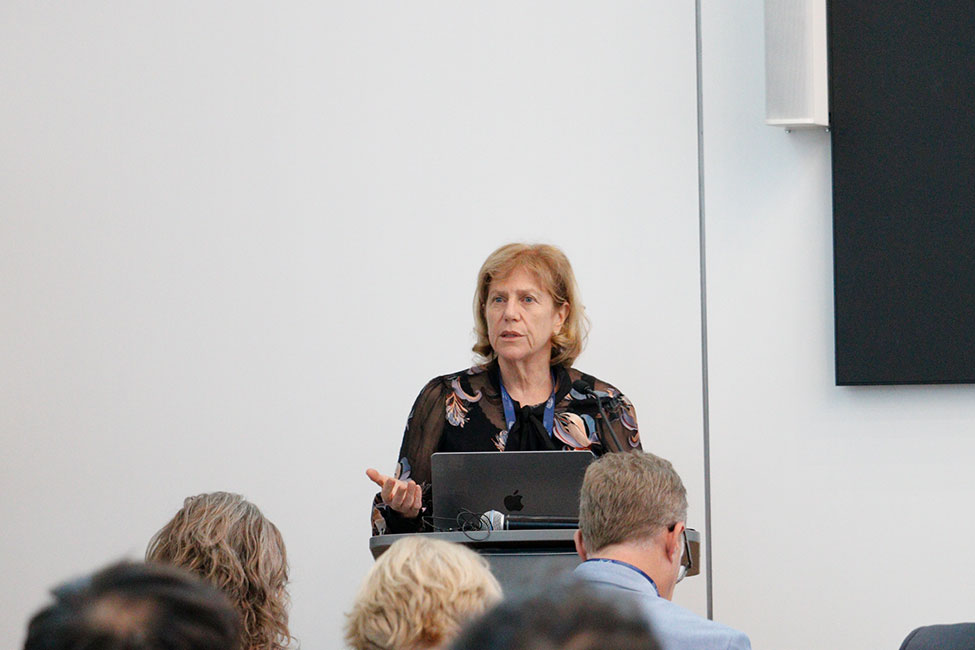
Henriette van Praag, Ph.D., associate professor in the Charles E. Schmidt College of Medicine and FAU Stiles-Nicholson Brain Institute, spoke about the positive effects of exercise on brain and mental health.
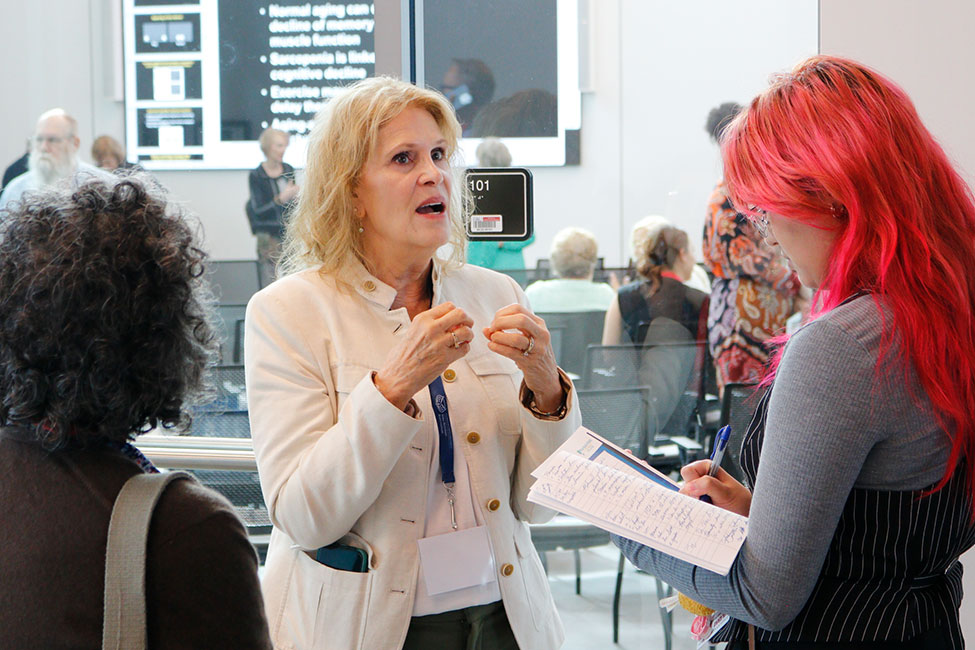
Judy Van de Water, Ph.D., professor of medicine at University of California, Davis, speaks to two symposium attendees during a meet-and-greet session.