New Neuroscience Class 2025
by Chelsey Matheson | Thursday, Oct 23, 2025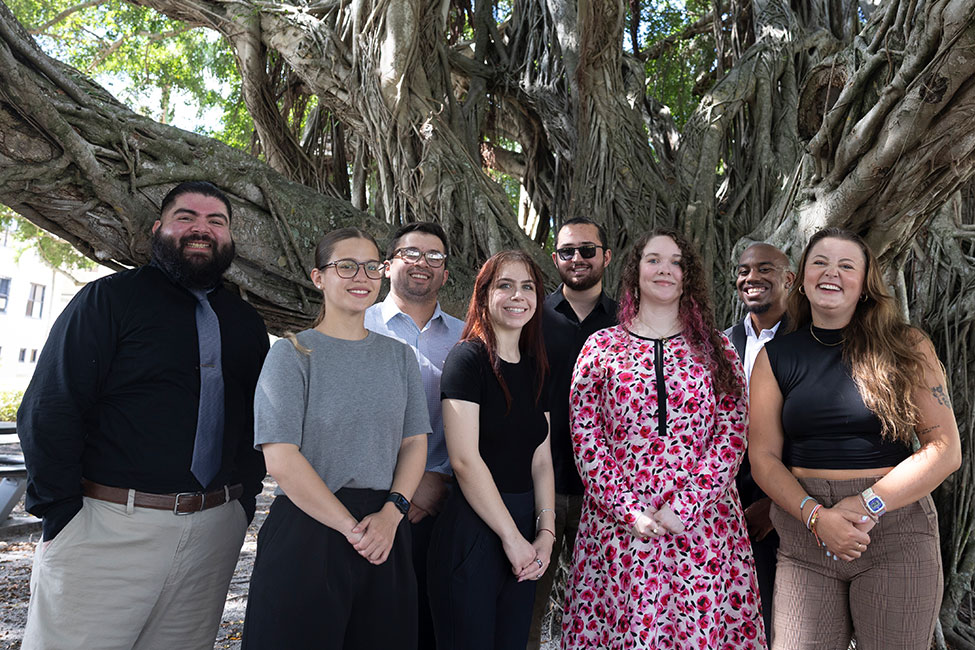
Florida Atlantic’s Stiles-Nicholson Brain Institute (SNBI) welcomed eight students to the Neuroscience Graduate Program (NGP) in the Fall 2025 Semester.
"This year’s incoming class is comprised of a distinguished group of neuroscience trainees marked by their excellent academic records and substantial hands-on research experience," said Randy D. Blakely, Ph.D., executive director of SNBI, David J. S. Nicholson Distinguished Professor of Neuroscience and professor of biomedical science in the Charles E. Schmidt College of Medicine.
The NGP is an interdisciplinary program, that exposes trainees to multiple research experiences that span the breadth of neuroscience inquiry and includes opportunities to train with world class scientists at Florida Atlantic and the Max Planck Florida Institute for Neuroscience. Research internships span the first year with students rotating through three research laboratories before they match to a research program and mentor that determine their doctoral focus.
Seven students in the class of 2025 were awarded Ewing-Capotosto Neuroscience Fellowships, supported generously by Anna Ewing and John Capotosto. Trainee Michael Robinson was also awarded a five-year McKnight Doctoral Fellowship that is administered and funded for the first three years by the Florida Education Fund, and for an additional two years by FAU. The McKnight fellowship supports African American and Hispanic United States citizens pursuing Ph.D. degrees in science, technology, engineering and math (STEM) and business at participating Florida universities, with the ultimate goal of increasing their representation in college and university faculty positions. Lindsey Knowles was awarded a two-year Graduate College Presidential Fellowship based on academic performance and high potential for success following doctoral training.
"These fellowships help promising young scientists shed some of the financial burden of pursuing their graduate research and education," Blakely said, "so they can focus on developing their knowledge and skills and take full advantage of the world-class research opportunities available to them at FAU. With our university now attracting superior applicants from around the country who have many other options, we face intense competition to recruit them to FAU, so support through these mechanisms is vital to ensuring the growth and success of our research programs."
"This year’s incoming class is comprised of a distinguished group of neuroscience trainees marked by their excellent academic records and substantial hands-on research experience," said Randy D. Blakely, Ph.D., executive director of SNBI, David J. S. Nicholson Distinguished Professor of Neuroscience and professor of biomedical science in the Charles E. Schmidt College of Medicine.
The NGP is an interdisciplinary program, that exposes trainees to multiple research experiences that span the breadth of neuroscience inquiry and includes opportunities to train with world class scientists at Florida Atlantic and the Max Planck Florida Institute for Neuroscience. Research internships span the first year with students rotating through three research laboratories before they match to a research program and mentor that determine their doctoral focus.
Seven students in the class of 2025 were awarded Ewing-Capotosto Neuroscience Fellowships, supported generously by Anna Ewing and John Capotosto. Trainee Michael Robinson was also awarded a five-year McKnight Doctoral Fellowship that is administered and funded for the first three years by the Florida Education Fund, and for an additional two years by FAU. The McKnight fellowship supports African American and Hispanic United States citizens pursuing Ph.D. degrees in science, technology, engineering and math (STEM) and business at participating Florida universities, with the ultimate goal of increasing their representation in college and university faculty positions. Lindsey Knowles was awarded a two-year Graduate College Presidential Fellowship based on academic performance and high potential for success following doctoral training.
"These fellowships help promising young scientists shed some of the financial burden of pursuing their graduate research and education," Blakely said, "so they can focus on developing their knowledge and skills and take full advantage of the world-class research opportunities available to them at FAU. With our university now attracting superior applicants from around the country who have many other options, we face intense competition to recruit them to FAU, so support through these mechanisms is vital to ensuring the growth and success of our research programs."