NeuroCollective Symposium
by Chelsey Matheson | Tuesday, May 27, 2025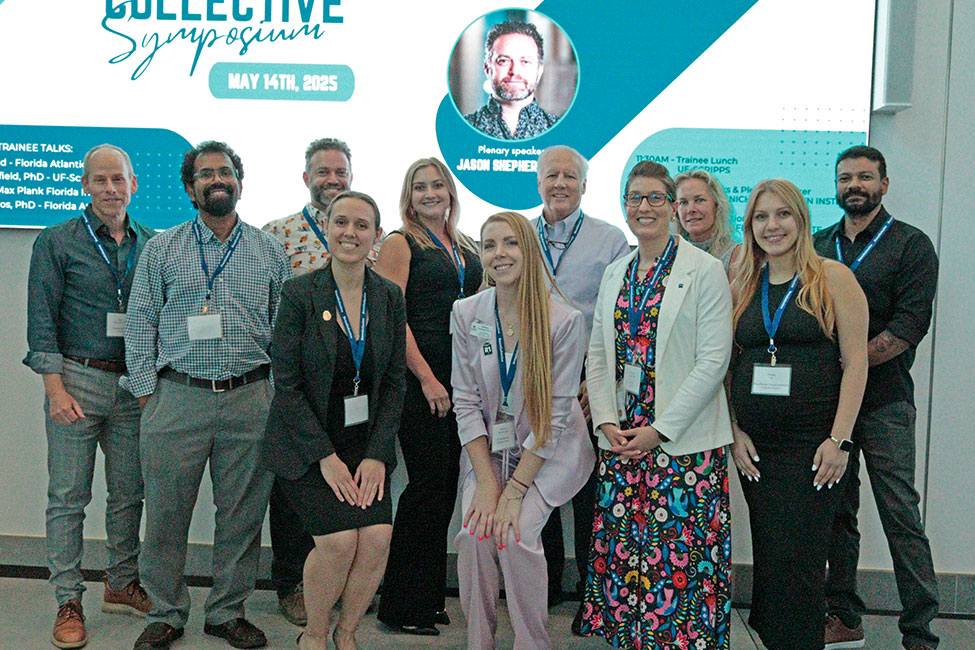
The biomedical research ecosystem at Florida Atlantic University’s John D. MacArthur Campus in Jupiter joined forces to host the inaugural NeuroCollective Symposium.
Co-hosted by Florida Atlantic University, the Max Planck Florida Institute for Neuroscience (MPFI), the Herbert Wertheim UF Scripps Institute for Biomedical Innovation and Technology (UF Scripps), and the ZEISS Microscopy Solutions Center, the day-long event highlighted the vibrant community of scientific trainees hosted on the multi-institute campus.
“FAU Jupiter is a one-of-a-kind hub for scientific innovation, and young scientists are key to this success. From high school students through postdoctoral fellows, trainees are essential members of every research lab, making important contributions that lead to new breakthroughs,” said Bethany Stanhope, Ph.D., executive director of academic operations at the FAU Jupiter campus. “The NeuroCollective Symposium offered a new platform for them to both showcase their research and learn from experts in their fields.”
The day opened with a career panel luncheon, hosted by UF Scripps. Panelists, who included representatives from academia, private industry and intellectual property licensing, were placed at tables throughout the room. They dined with small groups of students at their tables, allowing for information sharing and dialogue in a more casual format than a formal panel discussion.
After lunch, attendees moved venues to FAU’s Stiles-Nicholson Brain Institute (SNBI) for student research presentations and the event’s plenary speaker. Four graduate students were selected to speak based on their submitted abstracts. Goksu Oz, a doctoral student studying in the lab of Ryohei Yasuda, Ph.D., at MPFI, earned the “Best Talk” award for her presentation “A Novel Optogenetic Inhibitor of Protein Kinase C Reveals the Role of PKCŒ± in Prefrontal Cortex-Mediated Cue Association Learning”. Oz is part of the prestigious International Max Planck Research School (IMPRS) for Synapses and Circuits Ph.D. program, a partnership with FAU and the only such program in the United States.
Jason Shepherd, Ph.D., associate professor in the department of neurobiology and the Jon M. Hunstman Presidential Chair at the University of Utah, gave the plenary presentation, “Virus-like Intercellular Synaptic Plasticity.” Shepherd shared highlights of his groundbreaking research investigating how certain memory-related genes function through retrovirus-like mechanisms – a revolutionary insight into communication between neurons. Shepherd’s talk also highlighted the many contributions of his trainees to bringing these discoveries to light.
The event closed with an evening research poster session and reception at MPFI. More than 30 posters were selected, with representation from every institute on campus. Juan Lopez, Ph.D., earned the title of “Best Poster” for his presentation, “Modeling the Drosophila Escape Circuit.” Lopez is a postdoctoral fellow in the lab of Rodrigo Pena, Ph.D., an assistant professor, biological sciences, in FAU’s Charles E. Schmidt College of Science and a member of SNBI. Both symposium prizes were sponsored by SNBI.
“It was invigorating and inspiring to see such a strong gathering of our research community with the shared intention of elevating the next generation of scientists,” said Stanhope. “We look forward to creating more opportunities like this one in the future.”
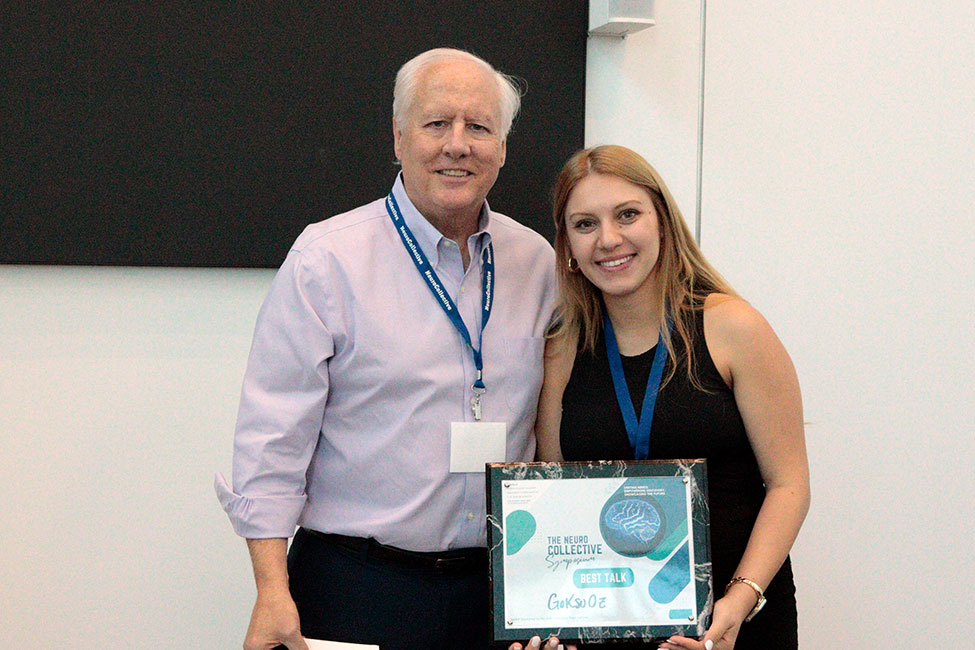
Randy Blakely, Ph.D., executive director of FAU's Stiles-Nicholson Brain Institute, with Gosku Oz, winner of the "Best Talk" award.
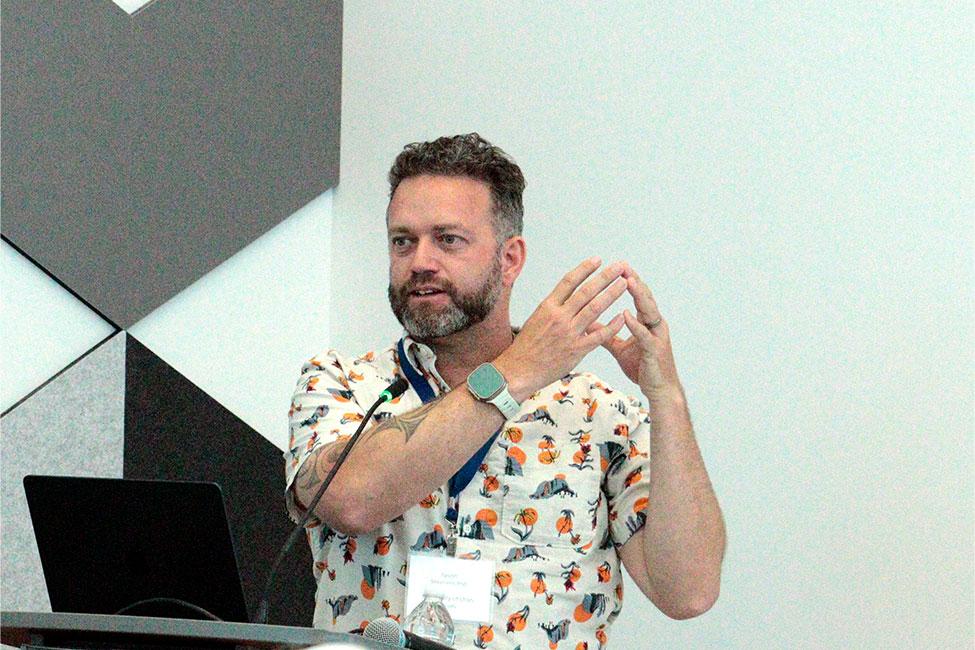
Jason Sheperd, Ph.D., from the University of Utah, gave the plenary presentation, a discussion of his groundbreaking research into communication between neurons.
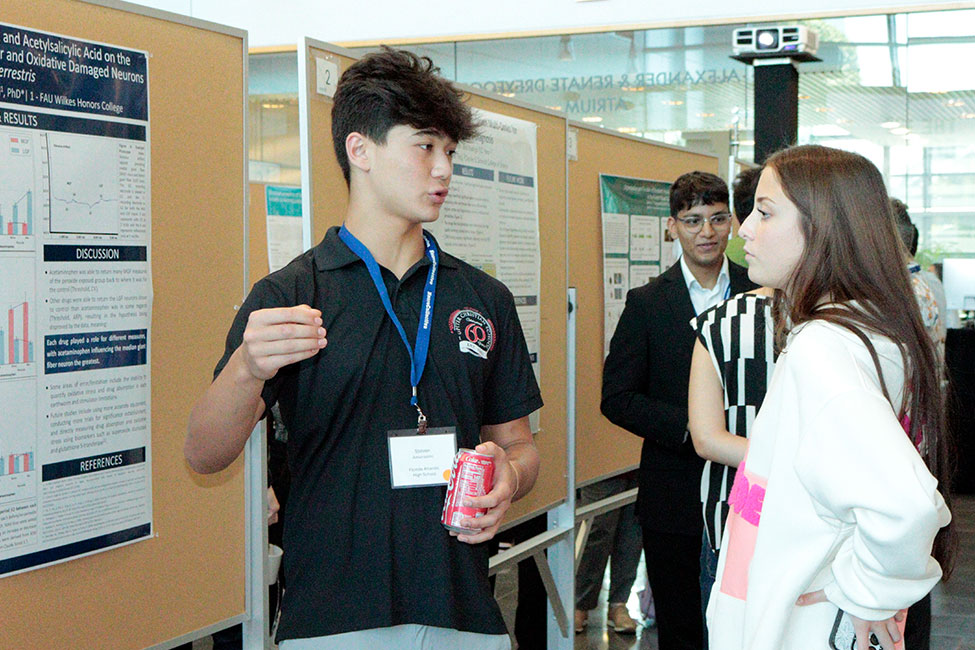
The NeuroCollective Symposium closed with a reception and research poster session hosted by Max Planck Florida Institute for Neuroscience.