Artificial Intelligence and Reinforcement Learning for Microgrid and Smart Community Energy Management
In 2016, U.S. electric utilities had about70.8 million advanced (smart) metering infrastructure (AMI) installations. About 88% of the AMI installations were residential customer installations. The community energy market is rapidly growing and evolving, and focus has increased on residential energy management. Residential electricity consumption accounts for 38% of the total electricity consumption in the U.S., making residential consumers a potential candidate for demand reduction during peak hours. Financial incentives for the consumers are key to encourage consumers to participate in such demand reduction events. There are different demand reduction strategies (e.g., incentive-based and price-based techniques) to encourage consumers to participate in the demand reduction events.
In this project, we will explore a variety of artificial intelligence and reinforcement learning methods to find a solution to efficiently meet the required criteria utilizing the available resources. For example, in the case of electrical energy management, the optimization algorithm should be adopted to use electric appliances to match the total electricity demand reduction while satisfying the users’ needs. An example of community microgrid is provided below.
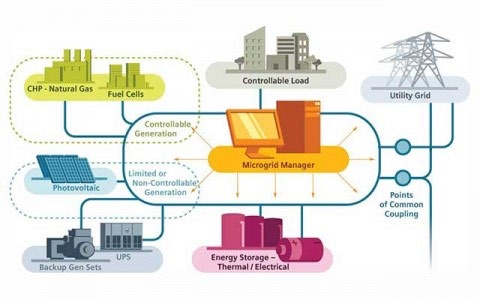
Key Components and Relationships:
Microgrid Manager (Central Control): Represented by a desktop computer setup in the center, this is the core intelligence that manages all aspects of the microgrid. Arrows indicate it communicates with and controls all other elements.
Controllable Generation (Upper Left): This section includes Dispatchable Distributed Energy Resources (DERs) that can be actively managed by the Microgrid Manager:
CHP - Natural Gas: Combined Heat and Power (Cogeneration) unit.
Fuel Cells.
Limited or Non-Controllable Generation (Lower Left): This section includes sources whose output is variable or weather-dependent:
Photovoltaic: Solar panels.
Backup Gen Sets (UPS): Uninterruptible Power Supply/Generators, typically used for emergency power.
Controllable Load (Upper Center): Represents the buildings, residential, or commercial, within the community. These loads can potentially be managed (e.g., through demand response) by the Microgrid Manager.
Energy Storage - Thermal/Electrical (Lower Center): This includes large battery banks and/or thermal storage systems, which are critical for balancing the grid and storing excess renewable energy. The Microgrid Manager controls the charging and discharging of this storage.
Utility Grid (Upper Right): Represents the main, large-scale power grid.
Points of Common Coupling (PCC) (Far Right): These are the physical connection points where the microgrid connects to, or disconnects from, the Utility Grid. The Microgrid Manager determines the operational mode (grid-connected or islanded) based on the status of these points.