Workforce Development for Future Smart Energy Systems
Florida Atlantic University leads the workforce development for future smart energy systems and prepares future STEM scientists and engineers. This is in collaboration with the University of South Florida, Florida International University, and the University of Central Florida.
Students and professionals are provided with mentored, hands-on training combining expertise across electrical engineering, communication, data science, and security. Participants develop and refine the multi-disciplinary skillsets needed for the data-centric power and energy industry using unique, remotely connected smart grid cyberinfrastructure. Participants extend their academic research portfolios, strengthening their career competitiveness as future cyberinfrastructure professionals and users. The project thus serves the national interest, as stated by NSF's mission: to promote the progress of science and to secure the national defense.
- Artificial Intelligence and Data Analytics
- Communication, Network, and Hardware Security
- Sensor Networks and Internet-of-Things
- Renewable Energy Modeling and Simulation
- Real-Time Learning and Microgrid Optimization
- Multi-Level Decision-Making Process of Intelligent Systems
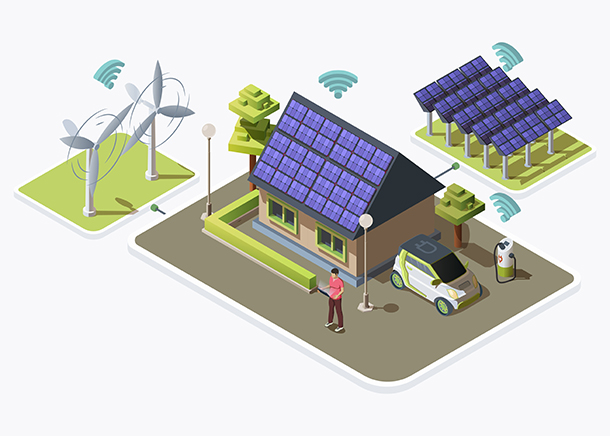
Smart Grid and Renewable Energy
Description of infographic: The Smart Grid and Renewable EnergyAn image of a light brown house with a light black roof and green windows sits in the center on a light khaki-colored lawn. Covering the roof are 30 small purple solar panels, and a blue Wi-Fi symbol above the house. In the front of the house is a person with a short-sleeved, light red shirt and a dark brown pants holding a tablet with light reflecting into their face. Behind the person on the right side of the house is a black and white car with green stripes and a grey power cord logo on the car’s rooftop. Next to the car is a green and white charging station for the car. Above the station is a Wi-Fi logo. Green trees also sit on each side of the house. Behind the house is a group of 15 purple solar panels on green grass with a blue Wi-Fi logo above it the panels On the left side of the house, two white windmills with a blue Wi-Fi above it sits on a green grass. In front of the house, there are two lampposts, one on either side, and an L-shaped hedge in the upper left corner.
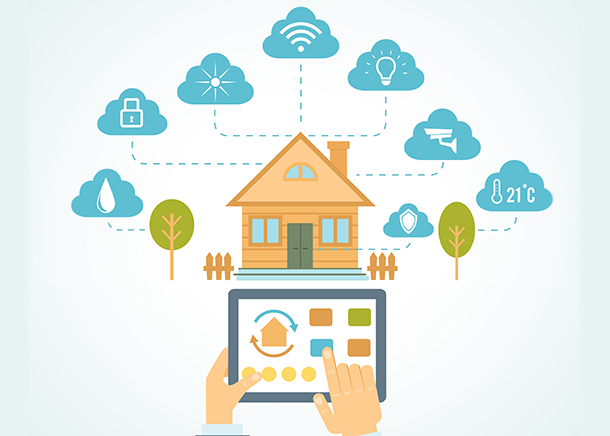
Internet of Energy
Description of infographic: Internet of EnergyIn the bottom center is an image of a hand holding a grey and white smart tablet with an orange house connected to different icons above it. On the smart tablet there are four cubes: orange, green, blue and orange. The right hand is half over the bottom right corner of the tablet, pointing to the blue cube with its pointer finger. Next to the hand are four yellow circles and the left hand holding the tablet has its thumb part on the first yellow circle. Above the yellow circles is a small orange house with a curved orange arrow under it and a bent blue arrow wrapping above. Both arrows are pointing clockwise around the orange house. Above the smart tablet, is orange house with blue windows and a green door. On each side of the house is an orange fence with three pickets each. To the left of the house stands a green tree, with four dashed lines extending from the left side of the tree connecting to a blue cloud with a white single drop of water. Directly above the blue cloud is another blue cloud with a white lock inside it and 12 dashed lines extending down to the right of it back to the orange house. Still on the left side next to the blue cloud lock is another blue cloud with the white sun inside and eight dashed lines extending down to the right back to the house. In the center over the orange house is a blue could with a white Wi-Fi symbol inside and five dashed lines extending down back to the center of the house. On the right side next to the Wi-Fi symbol is a blue cloud with a white lightbulb inside and nine dashed lines extending down and to the right back to the house. On the same side below the light eight dashed lines extended to the right up to a blue cloud filled with a white security camera. Below that extending from the green tree to the right is four dashed lines connecting to a blue cloud with a thermometer and 21 degree Celsius inside, and at the center of the house with the green door are eight dashed lines connecting to the blue cloud with a white shield inside.
- This paid, nine-day program focuses on virtual/remote training and providing students and professionals with an exciting experience that will prepare them for research or careers in engineering and science.
- This program welcomes professionals (e.g., power engineer or software engineer working in a related industry) to apply.
- Participants will typically work 9 a.m. to 4 p.m. each day. Participants are paid a $700/week stipend (total $1,400).
- Additional paid, project-based training opportunities are also available after the nine-day training. Please see the project descriptions below.
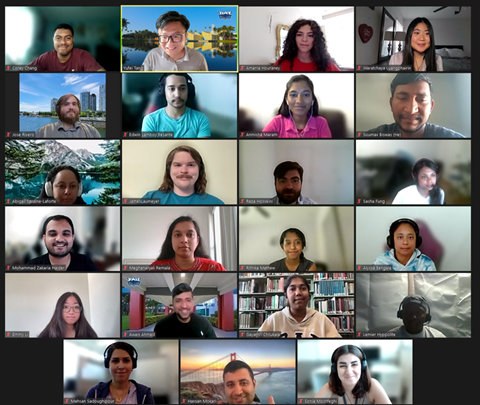
2021 Training Outcomes: 29 participants have been virtually trained for two weeks in the summer of 2021.
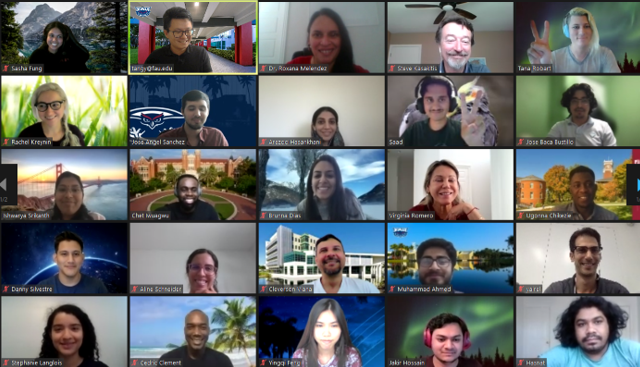
2022 Training Outcomes: 44 participants have been virtually trained for two weeks in the summer of 2022.
Project-based Training:
We plan to provide two additional longer-term research projects for the Summer/Fall of 2022. Participants are encouraged to take the two-week training to build the basic skills. Certain amount of incentives are also provided if participants are selected on the additional projects. The projects are described below.
Community Microgrid Energy Management
Led by Zhen Ni, Ph.D.
In-Person or Remote project
Learn more
Machine Learning Techniques to Detect GPS Spoofing Attacks
Led by Dongliang Duan, Ph.D.
In-Person or Remote project
Learn more
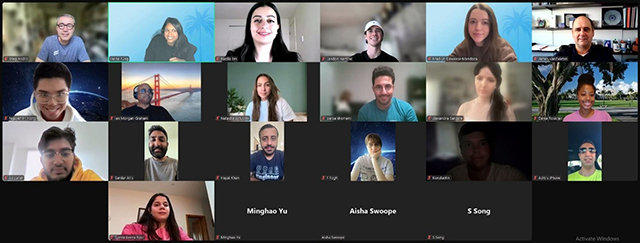
2024 Training Outcomes: 23 participants have been virtually trained for two weeks in the summer of 2024.
Nine-Day Training:
| Days | Training Topics | Software/Coding Environment | Instructor |
|---|---|---|---|
| Week 1 | |||
| May 11, Monday |
Morning: an intensive training section to introduce machine learning concepts, neural networks, and deep learning models. Afternoon: a hands-on data science training section to teach programming, experiment designs, and reporting skills (using Python) for object detection and text classification, as well as anomaly detection. |
Python, Scikit-learn, and Tensorflow | Dr. Hill Zhu |
| May 12, Tuesday |
Morning: a short course on electric power systems and smart grids (e.g., renewable energy integration). Afternoon: a hands-on project on attack and defense design and analytics of the smart grid using deep learning. High-resolution spatial-temporal datasets will be collected from benchmark smart grids. |
Python and Jupiter Notebook | Dr. Yufei Tang and Dr. Sasha Fung |
| May 13, Wednesday |
Morning: program overview, followed by a tutorial on basic knowledge of communication and network security, common vulnerabilities, and security attacks. Afternoon: communication and security designs for smart grid systems, including two-way communication architecture, attack generation, security setting, and data collection. |
Python 3 and Scapy Library | Dr. Zhuo Lu and Mr. Chi Zhang |
| May 14, Thursday |
Morning: a short course on renewable energy generation, with a focus on modeling and conversion. Afternoon: a hands-on project of marine renewable energy numerical simulation to model different environmental conditions and turbine systems and then run the simulator using these numerical models. |
Matlab/Simulink and WEC-Sim | Dr. James VanZwieten |
| May 15, Friday |
Morning: a short course on the introduction of microgrid energy systems. This course will have discussions on the key components and algorithms of microgrids and their applications to data centers and other critical infrastructures. Afternoon: a hands-on project on microgrid energy management with AI methods. In the project, students will study how to apply reinforcement learning methods for microgrid energy operation, battery management, and community load incentive designs. |
Matlab and Python | Dr. Zhen Ni |
| Week 2 | |||
| May 18, Monday |
Morning: a tutorial on basic operating principles, control, and protection of bulk power grids. Example use cases to demonstrate false data injection (FDI) in power grids will also be discussed. Afternoon: a hands-on example of a real-time power grid model, and associated control, and protection algorithms using OPAL-RT simulator, and highlights the vulnerable measurement nodes and control nodes from a cyber-attack perspective. |
Matlab | Dr. Sumit Paudyal |
| May 19, Tuesday |
Morning: a short course on network science and graph signal processing with applications in smart grids, such as security and reliability analysis of smart grids. Afternoon: two hands-on network analytics projects for smart grid reliability and security. The projects will provide practice on how the physical structure of the smart grid and the embedded structures and patterns in energy data and measurement time series can be modeled using networks and analyzed using network analytics techniques to address reliability and security challenges in smart grids. |
Python and Matlab | Dr. Mahshid R. Naeini |
| May 20, Wednesday |
Morning: a four-hour course on IoT/CPS security vulnerabilities and attacks. The course will take real attacks as examples to introduce various attack surfaces of IoT/CPS platforms, including the device interfaces, backends, and supply chain. Afternoon: a hands-on laboratory based on vulnerable p2p cameras, showing how to pen test the device by enumerating and exploiting the vulnerable device interfaces such as open ports or web interfaces, and how to review the security of the devices by reverse-engineering the firmware. |
Python and Jupiter Notebook | Dr. Xueqiang Wang |
| May 21, Thursday |
Morning: a tutorial on hardware security. The tutorial will discuss intellectual property protection and logic camouflaging techniques for ICs at the layout level. The tutorial will also cover the basics of methods for hardware trojan detection in ICs. Afternoon: a hands-on demonstration and design implementations of machine-learning-based hardware trojan detection for an embedded system. |
Python and Jupiter Notebook | Dr. Dayane Alfenas Reis |
Project-based Training:
We intend to offer an extra four long-term research projects, which can be conducted either in-person or remotely, subsequent to the completion of the training. Participants are strongly urged to undertake the nine-day training to establish foundational skills. A specified level of incentives will be extended to selected participants who participate in these supplementary projects. Further details about the projects can be found below, and individuals interested in their availability are encouraged to reach out directly to the lead faculty mentor.
Spatial-Temporal Big Data Analytics for Cyber-Physical Energy System Cybersecurity
Led by Yufei Tang, Ph.D.
Reinforcement Learning for Resilient Micro-Gird Infrastructure
Led by Zhen Ni, Ph.D.
Adaptive Defense against Malicious Network Inference in Critical Infrastructures
Led by Zhuo Lu, Ph.D.
Graph Signal Learning for Situational Awareness under Graph Uncertainties
Led by Mahshid Naeini, Ph.D.
Submit the following information in one email to Sasha Fung. ( cybertrainingfau@gmail.com ).
- One-page statement of interest that describes your motivations, expectations, and long-term objectives.
- A two- or three-pages CV featuring essential personal details, including demographic information.
- Complete transcript.
Application Window Opens: Feb. 15, 2026
Application Deadline: April 12, 2026
Notification Date: On or before April 20, 2026
Nine-day Training: 05/11/2026 – 05/21/2026 (subject to change)
- Preference will be given to graduates and professionals in science or engineering. Exceptional senior undergraduates will also be considered.
- Selections will be based on a combination of research interests, academic qualifications, and faculty recommendations.
For additional information please contact Yufei Tang, Ph.D. at (561) 297-4781 and tangy@fau.edu.
Print the NSF CyberTraining Flyer, here.
This program is currently funded by the National Science Foundation grants OAC 2320972/2320973/2320974/2320975. This program has been funded by the National Science Foundation grants OAC 2017597/2017194 & 1949921/1923983
Let's have an adventure. Collect experiences and meet people you'll never forget. It's time to write your story, and we've got the perfect setting.