HIDDEN LIFE IN BURROWS & REEFS
BY DR. KELSIE BERNOT, DR. RAQUEL ASSIS, DR. ANDIA CHAVES FONNEGRA, AND DR. YAOUEN FILY
Keywords:
bioinformatics, sequencing, eDNA, data analytics, ecology, biodiversity, sponge, tortoise, burrow, resilience 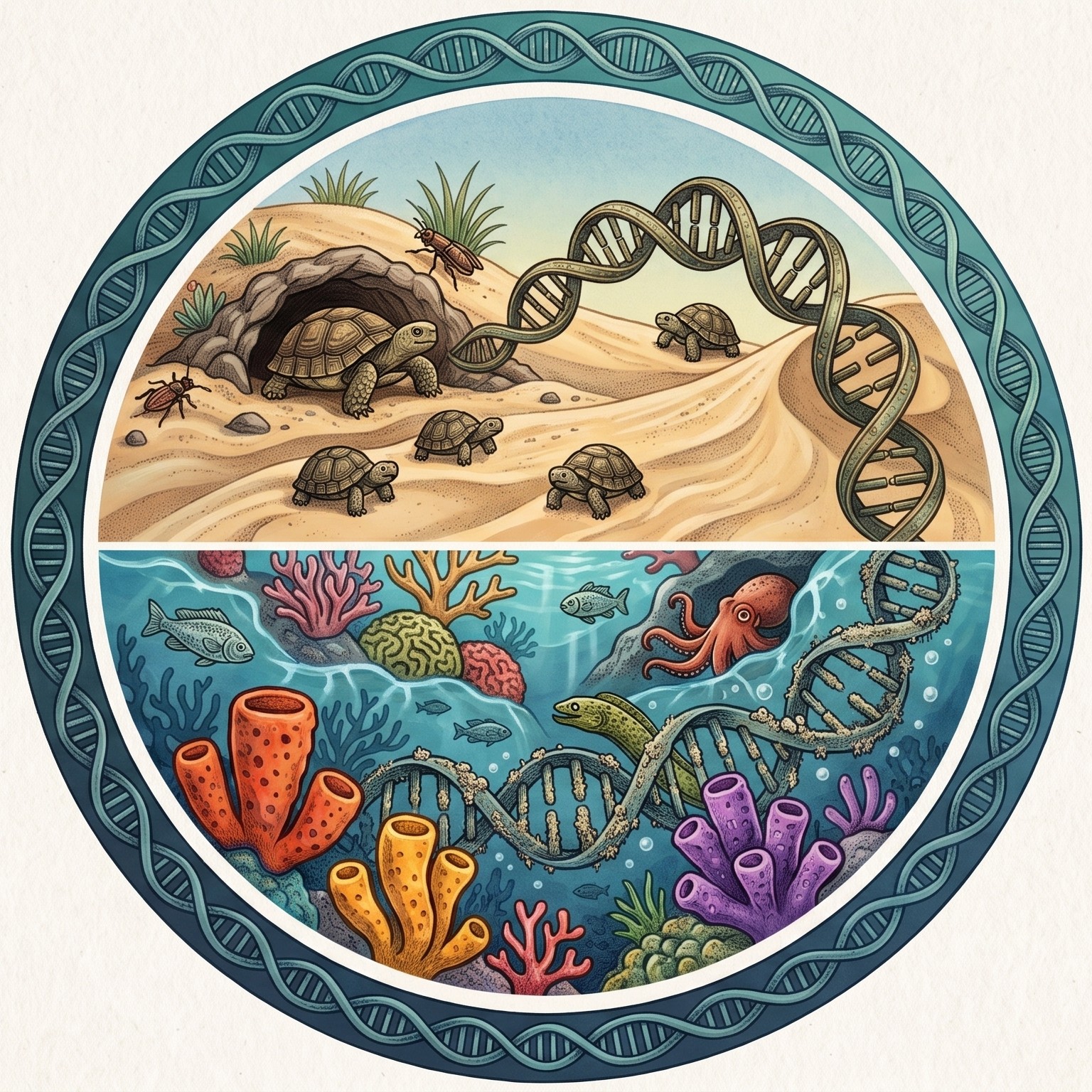
OUR RESEARCH
Think about the hidden organisms that you could interact with in a day – tiny plants, insects, microbes, and more! All of them make up the ecosystem in which you live. Our project leverages nanopore sequencing to analyze environmental DNA (eDNA) from two contrasting yet equally rich habitats: terrestrial gopher tortoise burrows and marine sponges. These burrows and sponges are seemingly disparate systems, but they are linked by their darkness and shared function as habitats for many other organisms while contributing to nutrient cycling. You might also think those environments are just for the tortoise to hide or the sponge to filter water. However, we have observed many other species inside these tortoise burrows and sponge canals. What about the organisms too small to see? To identify the unseeable ones, we will examine the community composition of eukaryotes. We will catalog species by comparing the DNA they shed in their habitats with direct observations/identifications and genomic reference databases, improving our understanding of the biodiversity of these dark, hidden places where information remains comparatively limited.
OUR STRATEGY
Students will have the opportunity to learn and contribute to:
- Sample collection in the field ranging from dry-land tortoise burrows and marine sponges (via snorkeling).
- DNA extraction, barcoding, and sequencing in a campus laboratory.
- Data analysis, including coding, statistical modeling, and visualization using computational tools (can be done virtually).
No experience is necessary. We will train students for any aspect of the project they wish to learn.
OUR IMPACT
This project seeks to:
- Improve methods for using environmental DNA (eDNA) to identify eukaryotic organisms.
- Help design better greenway management and coastal ecosystem resilience strategies.
- Train the next generation of interdisciplinary scientists, including biologists with strong bioinformatics skills.
Overall, we aim to harness emerging sequencing technologies to expand our view of biological variation and better manage habitats where many species interact.
OUR TEAM
Kelsie Bernot, PhD
Raquel Assis, PhD
Andia Chaves Fonnegra, PhD
Yaouen Fily, PhD
Tags:
vip