
FAU I-SENSE Evolves to Reflect Decade of Impact Across Cities, Spaces
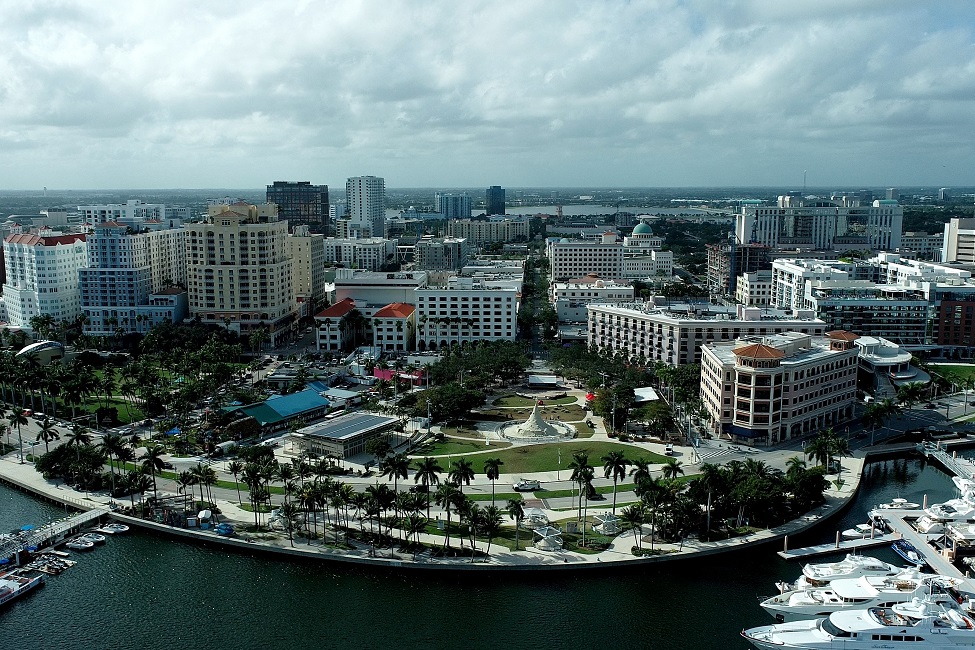
An aerial view of the City of West Palm Beach, a smart city and an FAU I-SENSE collaborator.
A Decade of I-SENSE: After more than a decade of advancing sensing technologies and intelligent systems, FAU’s Institute for Sensing and Embedded Network Systems Engineering (I-SENSE) is evolving its identity to better reflect the breadth of its impact. Renamed I-SENSE: The Institute for Smarter Cities, Spaces, and Health, the institute continues its mission of developing innovative technologies that help communities, industries and organizations better understand and respond to complex challenges. Since its founding in 2015, I-SENSE has grown into a university-wide research hub of more than 80 members and 12 faculty fellows spanning engineering, computer science, ocean science, healthcare and other disciplines.
Through interdisciplinary collaboration and partnerships with academia, industry and government, I-SENSE researchers are advancing solutions that improve urban infrastructure, strengthen weather resilience, enhance national security, protect coastal and marine environments, modernize energy systems and transform healthcare. Institute-affiliated researchers have secured more than $76 million in external research funding as principal investigators, while also generating patents, startups and nationally recognized research infrastructure. Equally important, I-SENSE is helping prepare the next generation of scientists and engineers through hands-on research experiences that translate discovery into real-world impact.
After more than a decade of advancing sensing technologies and intelligent systems, Florida Atlantic University’s Institute for Sensing and Embedded Network Systems Engineering (I-SENSE) is evolving its identity. As part of its continued evolution, I-SENSE will be renamed I-SENSE: The Institute for Smarter Cities, Spaces, and Health. The new name captures the breadth of the institute’s real-world impact, while its core mission remains unchanged.
Since its founding in 2015, I-SENSE researchers have developed tools and systems that help communities, industries and organizations better understand and respond to the world around them. The institute has worked alongside academia, industry and government partners to address challenges ranging from coastal resilience and public infrastructure to healthcare and national security.
“This new identity is not a change in our mission,” said Jason Hallstrom, Ph.D., executive director of I-SENSE. “It is a more precise articulation of the work we have always done. Our researchers develop technologies that help people understand complex environments, make informed decisions and solve real-world problems. The new name reflects the places where that impact is most visible today.”
I-SENSE has grown into a university-wide research hub including more than 80 members and 12 faculty fellows spanning engineering, computer science, ocean science, medicine and many other disciplines.
Together, institute-affiliated researchers have generated more than $76 million in external research funding as principal investigators, securing a return on investment exceeding 5-to-1 for the university. Beyond funding, the institute’s faculty and students have produced patents, startups and nationally recognized research infrastructure and innovations.
“Although the breadth of I-SENSE’s impact cannot be measured by any single metric, its accomplishments demonstrate a sustained commitment to innovation with purpose,” said Gregg Fields, Ph.D., FAU’s vice president for research. “Through research and technology development, the institute continues to address critical societal challenges and create lasting benefits for communities.”
Smarter Cities
Among the institute’s most visible partnerships is its ongoing collaboration with the City of West Palm Beach, which has evolved into a living laboratory testing intelligent infrastructure solutions that shape decisions about mobility, safety and quality of life. At the center of that effort is a smart streetscape testbed deployed throughout the city’s downtown area. The platform combines distributed sensing, advanced analytics and emerging digital twin capabilities to help researchers and city leaders gain deeper insight into pedestrian mobility, transportation patterns and urban decision making. The work has helped lay the foundation for the newly established Ubicquia Innovation Center for Intelligent Infrastructure in FAU’s College of Engineering and Computer Science.
The institute’s impact also extends to weather resilience. As the lead technology provider for the Southeast Atlantic Econet, I-SENSE operates the largest academic mesonet in the Southeast and the fourth largest in the nation. The network includes hundreds of weather, water-level and environmental monitoring stations that provide real-time data to NOAA and the National Weather Service, supporting forecasting, emergency preparedness and community resilience throughout the region.
Research led by Jinwoo Jang, Ph.D., I-SENSE faculty fellow and an associate professor in FAU’s Department of Civil, Environmental and Geomatics Engineering, applies sensing to monitor the condition and performance of critical infrastructure, enabling engineers to better assess structural integrity and identify potential risks before failures occur. By transforming raw sensor data into actionable insights, his work supports safer, more resilient communities.
Smarter Spaces
Across land, sea and cyberspace, I-SENSE researchers have developed technologies that improve situational awareness, security and decision making in complex environments. I-SENSE faculty fellows Dimitris Pados, Ph.D., director, and Georgios Sklivanitis, Ph.D., associate director of the Center for Connected Autonomy and Artificial Intelligence in the College of Engineering and Computer Science, are advancing autonomous systems, secure communications and connected AI and robotics that support national defense and public-sector missions. Recent investments from the U.S. Department of War have established one of the nation’s most advanced research environments for connected autonomy, including cutting-edge AI computing infrastructure and mixed-reality flight simulation systems.
Reza Azarderakhsh, Ph.D., I-SENSE faculty fellow and a professor in FAU’s Department of Electrical Engineering and Computer Science, has helped shape emerging post-quantum cryptography standards, while his startup, PQSecure, has advanced the commercialization of solutions to secure next-generation computing systems.
In marine environments, Jordon Beckler, Ph.D., an I-SENSE faculty fellow and an assistant research professor at FAU’s Harbor Branch Oceanographic Institute and an affiliate professor in FAU’s Department of Ocean and Mechanical Engineering, has expanded understanding of harmful algal blooms and coastal ecosystems, supporting healthier waterways and more resilient coastal communities across the country.
Mike Twardowski, Ph.D., I-SENSE faculty fellow and a research professor at FAU Harbor Branch, has advanced ocean-sensing technologies through U.S. Navy-supported research that improves understanding of marine bioluminescence and ocean conditions. His work enhances maritime awareness and ocean observation capabilities that inform both scientific discovery and national security efforts.
Yufei Tang, Ph.D., I-SENSE faculty fellow, associate professor of FAU’s Department of Electrical Engineering and Computer Science and Department of Biomedical Engineering, and director of the FPL Center for Intelligent Energy Technologies at FAU, uses sensing and AI to make energy systems more efficient, resilient and secure. From identifying new opportunities for ocean-based renewable energy to strengthening the reliability of smart grids, his work is helping shape a more dependable energy future.
Smarter Health
I-SENSE’s health-related research is advancing the understanding, diagnosis and monitoring of disease through novel sensing and imaging tools. Ramin Pashaie, Ph.D., I-SENSE faculty fellow, professor in FAU’s Department of Electrical Engineering and Computer Science and Department of Biomedical Engineering, and a member of the FAU Stiles-Nicholson Brain Institute, has developed advanced biomedical imaging methods capable of visualizing brain vasculature and biological structures with unprecedented detail, supporting improved understanding of neurological conditions and laying the groundwork for new approaches to studying disease at the microscopic level.
Behnaz Ghoraani, Ph.D., I-SENSE faculty fellow, co-director of FAU’s Center for Smart Health, and an associate professor in FAU’s Department of Electrical Engineering and Computer Science and Department of Biomedical Engineering, has translated advances in sensing and signal processing into approaches designed to improve patient care. Earlier innovations included patented systems that help physicians identify and pinpoint the sources of dangerous cardiac arrhythmias, supporting more precise catheter-based interventions. More recently, Ghoraani’s team has leveraged wearable sensors, video analysis and AI to improve the detection and monitoring of conditions such as Parkinson’s disease and Alzheimer’s disease.
“The work of our I-SENSE faculty fellows demonstrates how engineering and computer science are driving meaningful advances in healthcare and beyond,” said Stella Batalama, Ph.D., dean of FAU’s College of Engineering and Computer Science. “Through innovations in biomedical imaging, sensing technologies, AI and data analytics, our researchers are improving disease detection, diagnosis and patient outcomes while addressing complex societal challenges and enhancing quality of life.”
Preparing the Next Generation of Scientists and Engineers
I-SENSE has played a significant role in workforce development through one of Florida’s longest-running National Science Foundation Research Experiences for Undergraduates (REU) Site programs.
Each year, students nationwide come to FAU to participate in hands-on research experiences, many of whom go on to graduate education and research careers. This year alone, the program received more than 360 applications for 16 available positions.
Beyond the REU program, I-SENSE supports graduate students, postdoctoral fellows and undergraduate researchers across a range of interdisciplinary initiatives, preparing the next generation of scientists and engineers through hands-on experience addressing real-world challenges.
“As I-SENSE enters its next chapter, the institute will continue building on the same foundation that has guided its work since the beginning,” said Hallstrom. “We develop systems that turn information into understanding and understanding into action. The new name reflects the impact that work is having every day in cities, spaces and health.”
-FAU-