Perfecting the Quick Getaway
by Chelsey Matheson | Thursday, Jun 12, 2025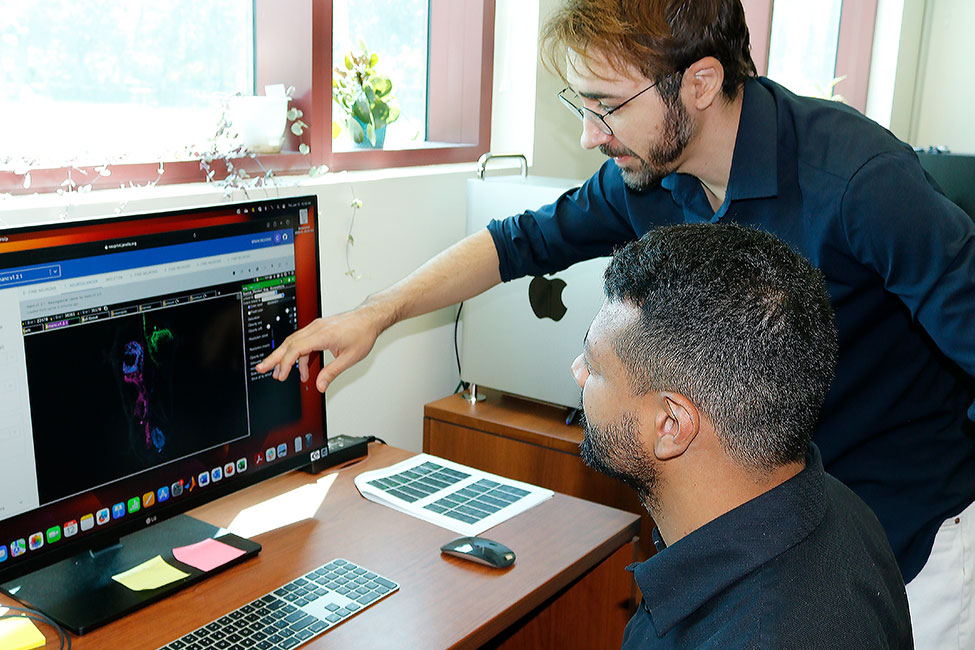
A quick response to impending danger is imperative to many species’ survival. For years, neuroscientists have worked to understand how the nervous system initiates and regulates these split-second reactions. A pair of researchers from Florida Atlantic University recently received a grant from the International Brain Research Organization (IBRO) to help advance their contributions to this worldwide effort.
Rodrigo Pena, Ph.D., assistant professor in the Department of Biological Sciences at FAU’s Charles E. Schmidt College of Science and a member of the Stiles-Nicholson Brain Institute, and Cesar Ceballos, Ph.D., a postdoctoral fellow in Pena’s lab, earned an IBRO Collaborative Research Grant for their project “Axo-Axonic Modulation of the Drosophila Escape Circuit: An Integrative Anatomical, Electrophysiological, and Computational Study.” These grants are designed to encourage collaboration among different research groups (particularly across international lines) by providing funds to cover essential costs of long-distance cooperation. Pena and Ceballos will utilize the funding for travel expenses to support their collaboration with Ricardo Leão, Ph.D., an associate professor at the University of São Paulo in Brazil, who is an expert in electrophysiology.
Reaction times for an organism such as the Drosophila melanogaster fly can be mere milliseconds, which is why neuroscientists have used it as a model for high-speed escape behavior. Researchers know that these reactions happen within a specialized area of the fly’s nervous system called the giant fiber system (GFS). Recent findings have identified a small cluster of nerve connections called the axo-axonic synapses that seem to play an important role in fine-tuning the fly’s escape response.
“Axo-axonic synapses have emerged in numerous systems – from mammals to fish to insects – as potent modulators of neuronal function,” Pena said. “We hypothesize that excitatory and inhibitory axo-axonic synapses selectively modulate the GFS, producing an ultra-fast circuit with highly nuanced control of escape behavior.”
After anatomically mapping the fly’s brain to identify the locations of axo-axonic neurons, the research team will utilize optogenetic (light) stimulation in a collaboration with Rodney Murphey, Ph.D., a professor also in the Department of Biological Sciences. These experiments will target regions to investigate whether activating axo-axonic neurons results in speeding up or slowing down movements that contribute to the fly’s escape response.
The IBRO funding is crucial for this period, as it will allow Leão to travel to FAU to consult on the methodology used in the experiment with Pena and his collaborators at FAU.
A computer model will be built based on the resulting intracellular data to accurately simulate axo-axonic modulation in an ultra-fast escape circuit. Pena and Ceballos plan to disseminate the model through publications and open-source releases of the model code, contributing to the global science community’s knowledge exchange and capacity to build neuroscience.
“Our study addresses a fundamental question in behavioral neuroscience: How do high-speed circuits balance speed and accuracy?” Ceballos said. “We aim to create a tool that accelerates neuroscience discovery by shedding light on universal principals of neuronal control that can be translated to other phyla – including humans.”