Student Research Excellence
by Chelsey Matheson | Tuesday, Dec 09, 2025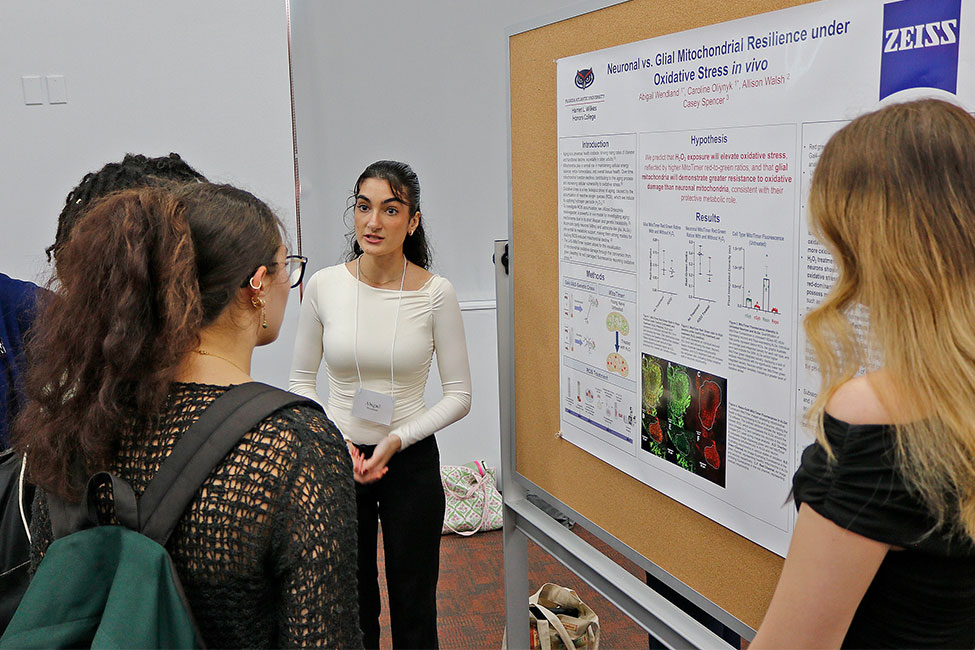
Florida Atlantic University’s John D. MacArthur Campus at Jupiter hosted its annual undergraduate Fall Research Symposium on Nov. 20.
The symposium offered students an opportunity to practice explaining their work to individuals with differing levels of scientific expertise, answer questions and receive feedback on their findings.
Their research covered a range of specialties, including neuroscience, biomedical and psychology. For example, one study investigated the efficacy of a program called “Wilderness Therapy” to help veterans develop coping mechanisms for PTSD. Another tested the use of copper as a viable resource for treating Alzheimer’s disease.
Most students conducted their research in labs throughout the biomedical research hub at the Jupiter campus. They worked under the mentorship of faculty at the Harriet L. Wilkes Honors College (WHC), the Charles E. Schmidt College of Science and FAU Stiles-Nicholson Brain Institute (SNBI), as well as with research partners Zeiss, Max Planck Florida Institute for Neuroscience, and the Herbert Wertheim UF Scripps Institute for Biomedical Innovation and Technology.
For instance, Shyla Grant, a student in the WHC, conducted a study under the mentorship of Tracy Mincer, Ph.D., associate professor of biology and chair of natural sciences and mathematics. Grant is using an AI modeling tool to investigate if a specific type of protein allows bacteria to stick to plastic. Not all species of bacteria adhere to plastic surfaces, so identifying a “sticky” culprit has broad implications, including controlling the spread of health care-associated infections, Grant said. Though more work needs to be done, her most recent results yielded a promising lead.
Abigail Wendland and Caroline Oliynyk completed their experiment as part of an undergraduate course conducted in partnership with Zeiss Microscopy. The pair compared the effect of mitochondrial stress on neurons versus glial cells (non-neuronal brain cells that support neurons) using Drosophila melanogaster – the common fruit fly – as a model. Mitochondria are essential to cells’ energy production. Understanding whether neurons or glial cells exhibit more resilience to mitochondrial stress is significant to the aging brain and the slowing down of energy production in the cells, Wendland said. Though this experiment did not yield a statistically significant difference between neurons and glial cells, Wendland said they have a plan to adjust their methodology that they hope to test in the future. The course was taught by Casey Spencer, Ph.D., assistant professor of neuroscience at WHC and Allison Walsh, a doctoral student at SNBI.
The symposium, which is hosted by the campus’s Office of Academic Affairs, was attended by undergraduate and graduate students, Florida Atlantic faculty and staff, scientists from partner institutions and members of the public.

Shyla Grant, a student at the Harriet L. Wilkes Honors Colleges, presented her project investigating how bacteria sticks to microplastics.
Article Image: Abigail Wendland presented research she completed as part of an undergraduate course conducted in partnership with Zeiss Microscopy.