
FAU Receives $1.3M NOAA Grant to Address Harmful Algal Blooms
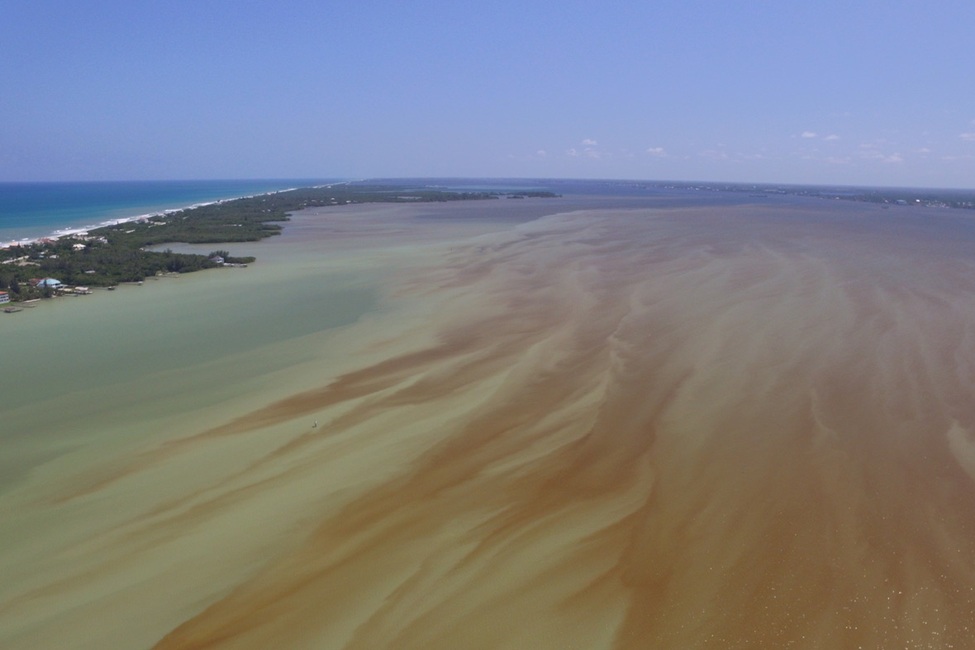
In August 2023, a drone captured a Pyrodinium bahamense bloom near Sebastian Inlet, looking south toward the inlet. This bioluminescent microorganism can produce toxins that pose risks to wildlife and human health.
Grant Snapshot: Florida Atlantic University’s Harbor Branch Oceanographic Institute has received a $1.3 million grant from the National Oceanic and Atmospheric Administration’s National Centers for Coastal Ocean Science to investigate the environmental and biological drivers of recurring and prolonged harmful algal blooms (HABs) in subtropical estuaries. Led by Mingshun Jiang, Ph.D., the interdisciplinary project brings together researchers from FAU, the University of Georgia, and the University of South Florida, to compare HABs dynamics in Florida’s Northern Indian River Lagoon and Georgia’s Skidaway River Estuary.
Researchers will combine field observations, laboratory experiments and computer modeling to determine why blooms persist in the Northern Indian River Lagoon while remaining comparatively short-lived and moderate in the Skidaway River Estuary. The findings will be used to improve predictive models and provide science-based tools to help resource managers evaluate strategies to mitigate HABs, improve estuary health and prepare for potential blooms in other subtropical estuaries across the Southeast.
Harmful algal blooms (HABs) can transform healthy estuaries into environments that threaten water quality, aquatic life and the communities and economies that depend on them. Yet scientists still do not fully understand why some subtropical estuaries experience recurring, prolonged blooms while others with similar environmental conditions do not.
A new $1.3 million grant from the National Oceanic and Atmospheric Administration’s National Centers for Coastal Ocean Science will enable researchers at Florida Atlantic University’s Harbor Branch Oceanographic Institute to investigate the environmental and biological mechanisms that drive HABs in subtropical estuaries. The project, funded through NOAA’s Fiscal Year 2026 Harmful Algal Bloom Program, will focus on why intense HABs persist in Florida’s Northern Indian River Lagoon while remaining comparatively short-lived and more moderate in Georgia’s Skidaway River Estuary.
Led by principal investigator Mingshun Jiang, Ph.D., associate research professor at FAU Harbor Branch, the project brings together researchers from FAU, the University of Georgia, and the University of South Florida.
“The Northern Indian River Lagoon and the Skidaway River Estuary provide two unique natural systems for understanding why harmful algal blooms become persistent in some systems but not in others,” said Jiang. “By bringing together expertise in physical oceanography, biogeochemistry, plankton ecology and environmental management, we can examine the problem from multiple perspectives and connect what we observe in the environment with the biological processes that allow certain algal species to thrive and dominate. This knowledge is essential for improving our ability to predict and manage harmful algal blooms.”
The Northern Indian River Lagoon is an “Estuary of National Significance” that supports an estimated $28.3 billion in annual economic benefits. Yet, the lagoon experiences frequent and persistent HABs that can degrade water quality, contribute to extensive loss of seagrass, and cause major mortality events for fish, with significant ecological and economic consequences. In contrast, the Skidaway River Estuary, a similarly shallow and warm subtropical system in Georgia, does not experience the same prolonged blooms. Its stronger tidal flushing and shorter water residence time create a fundamentally different environment.
This contrast provides a unique opportunity to investigate why HABs develop and persist in some subtropical estuaries but not others. Researchers will examine how water residence time, nutrient availability, temperature, organic matter, sediment processes and biological interactions influence bloom dynamics and which algal species thrive. The team will use these findings to refine predictive models that can help resource managers evaluate mitigation strategies and provide early warnings of HABs in other subtropical estuaries across the Southeast.
The project will combine field observations, laboratory and in-water experiments, and computer modeling to examine how environmental conditions influence HABs in the two estuaries. Researchers will track temperature, salinity, nutrients, organic matter, bloom abundance and species composition through extensive field work at both estuaries. Led by co-principal investigator Natalie Cohen, Ph.D., assistant professor in the Department of Marine Sciences in the Franklin College of Arts and Sciences at the University of Georgia, the team will conduct in situ and laboratory experiments to examine how algal communities and three representative bloom-forming species: Akashiwo sanguinea, Aureoumbra lagunensis and Pyrodinium bahamense, respond to changes in nutrients. Led by co-principal investigator Jordon Beckler, Ph.D., associate research professor at FAU Harbor Branch, the team will also collect sediment samples and associated biogeochemistry information to understand the nutrient fluxes from the sediment, believed to be a key source for sustained phytoplankton blooms in these systems.
The team will use these findings to further develop an existing physical-biogeochemical model of the Northern Indian River Lagoon and adapt it to the Skidaway River Estuary. Comparing the two systems will help researchers determine why blooms persist in the Northern Indian River Lagoon while remaining comparatively short-lived in Georgia.
The project is further supported by approximately $200,000 in new funding from the Harbor Branch Oceanographic Institute Foundation, Inc., to Jiang, Beckler, and Malcolm McFarland, Ph.D., an assistant professor at FAU Harbor Branch, which includes research on the P. bahamense life cycle.
Co-principal investigator is Charles Jacoby, Ph.D., co-director of the Center for Environmental Analysis, Synthesis, and Application at the University of South Florida.
“This grant recognizes the importance of bringing together scientists with different areas of expertise to address a complex environmental challenge that no single discipline can solve alone,” said Jason Hallstrom, Ph.D., interim executive director of FAU Harbor Branch. “The knowledge generated through this work has immediate relevance to the Northern Indian River Lagoon and the communities that depend on it, but its value extends well beyond our region. Understanding why harmful algal blooms persist in some subtropical estuaries and not others can help scientists and resource managers anticipate emerging threats and make more informed decisions to protect estuarine ecosystems throughout the Southeast.”
-FAU-