FAU Completes Successful First Offering of Hacking for Defense
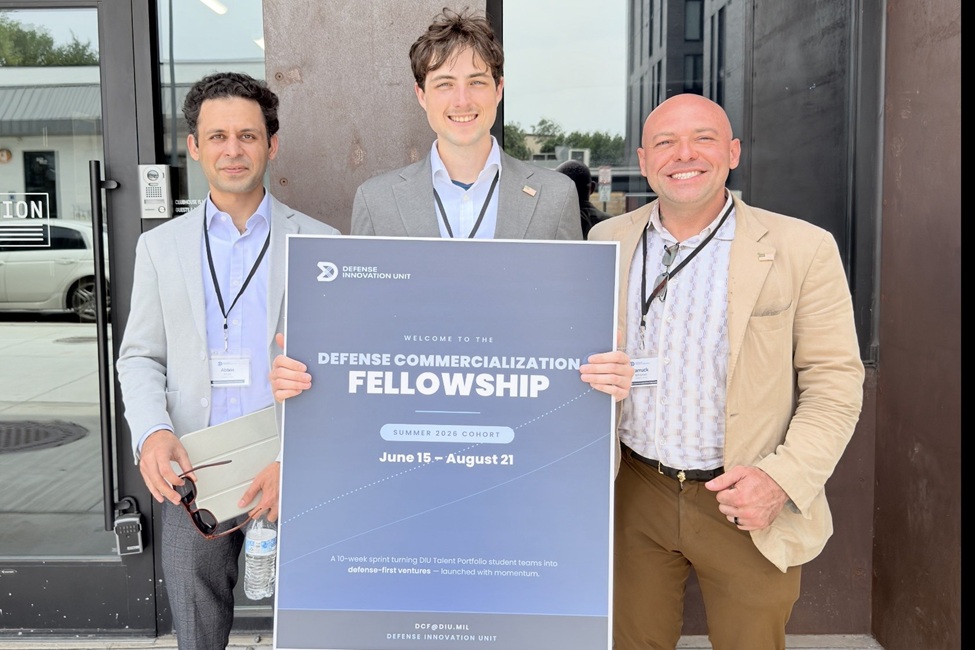
From left, Abbas Khan, Juan Merlos, Ph.D. students, and Tarruck Wheeler, a masters student, all within FAU’s Department of Electrical Engineering and Computer Science.
Program Snapshot: Florida Atlantic University recently completed its inaugural Hacking for Defense course, a national innovation program that connects students with real-world challenges from the U.S. Department of Defense and Intelligence Community. Offered through FAU’s College of Engineering and Computer Science and sponsored by the Defense Innovation Unit, the semester-long course engaged student teams in developing prototype solutions for military and national security partners using Lean Startup methodology and customer discovery practices.
Florida Atlantic University has announced the successful completion of its first Hacking for Defense (H4D) offering, a credit-bearing course that originated at Stanford University in 2016 and is now offered through FAU’s College of Engineering and Computer Science . The course places student teams on real problems submitted by the U.S. Department of War and the Intelligence Community, applying Lean Startup methodology to deliver working minimum viable products (MVPs) inside a single semester.
H4D at FAU is led by Hari Kalva, Ph.D., professor and chair of FAU’s Department of Electrical Engineering and Computer Science, whose collaboration with the Defense Innovation Unit (DIU) beginning in 2020 has expanded FAU’s long-standing defense research portfolio into a structured, credit-bearing classroom experience. H4D is one pathway within DIU’s Innovation with Academia programming, a broader effort to mobilize university talent, research, industry, and entrepreneurial capacity against validated national security problems. Through this work, DIU connects real mission demand to students, faculty, researchers and partners, and helps carry the strongest projects toward prototypes, transition pathways, and capabilities the department can use. Over the past five years, that partnership has produced more than 40 DoW-sponsored capstone projects, engaging more than 200 FAU students with more than 25 DoW and Intelligence Community agencies.
Four student teams completed projects in the inaugural cohort. Project Firefly partnered with the U.S. Army Corps of Engineers Engineer Research and Development Center on real-time multi-sensor fusion that transforms commercial drones into autonomous aerial robotic systems. A second team, Team Echo, developed a continuous cognitive-monitoring system for the U.S. Army Aeromedical Research Laboratory to detect overload in aviators before performance degrades. A third, Team Phantom, built nano- and micro-electromechanical haptic systems for combat lifesaver training under the U.S. Army Combat Capabilities Development Command Soldier Center. The fourth team, Team Agoge, partnered with the 2nd Cavalry Regiment in Germany to build an AI-assisted application that adapts soldier physical training programs to changing operational conditions. Across all four projects, teams conducted more than 80 interviews each with operators and stakeholders inside the sponsoring commands, listening directly to warfighter feedback and refining their approaches as new information emerged.
FAU students engaged with their sponsoring DoW organizations rather than work from secondhand descriptions of the problem. Students traveled to the U.S. Army Aeromedical Research Laboratory in Alabama, the Engineer Research and Development Center in Mississippi, the Soldier Center site in Orlando, and the 2nd Cavalry Regiment in Germany, attended national defense innovation conferences, and received funding to build and refine working prototypes that the sponsors evaluated directly. Each team conducted more than 80 interviews with stakeholders inside the sponsoring commands across the course of the semester.
“FAU has a long-standing and substantial research relationship with the Department of War, supported by major DoW-funded research projects that have involved faculty, graduate students and undergraduate students for many years,” said Kalva. “What Hacking for Defense adds is a new classroom-based pathway that brings mission-driven problem solving, customer discovery and business development training directly into undergraduate project work. Our students are not just solving textbook problems. They are working with operational sponsors, interviewing the people closest to the mission, and building prototypes that can be evaluated by DoW partners. This is an important extension of FAU’s broader national defense research enterprise and a powerful way to prepare mission-minded engineering and computer science talent.”
Following the semester, Project Firefly was selected for the DIU Commercialization Fellowship, a 10-week summer program that helps student-led teams from DIU’s Innovation with Academia portfolio advance validated technologies toward defense commercialization and transition. Through Lean Startup principles, agile engineering, and defense go-to-market support, the fellowship helps young founders refine their products, engage potential users and customers, and build credible pathways from student prototypes to mission-relevant startups.
“FAU is an important academic partner for DIU because it shows how Innovation with Academia is meant to work: validated Department of War problems moving through multiple university pathways, from Hacking for Defense to Capstone projects and, when ready, into follow-on commercialization support. By combining FAU’s engineering talent and faculty expertise with direct engagement from mission partners, we are giving students a clearer path to build against real operational needs while giving the department earlier access to emerging ideas, prototypes, and talent,” said Ngoc Lund, director of DIU’s Innovation with Academia.
Hacking for Defense builds on FAU’s long-standing defense research enterprise by bringing an additional dimension into the student experience: mission-driven innovation, customer discovery and business development training connected directly to undergraduate project work.
“Our college has deep experience working on DoW-funded research that engages faculty and students in areas of national importance. This course extends that strength into the classroom in a structured way. Students gain experience that transcripts alone cannot convey, faculty and students deepen their engagement with DoW problem owners, and FAU further strengthens its role as a contributor to the national security innovation and workforce pipeline,” said Stella Batalama, Ph.D., dean of the College of Engineering and Computer Science.
-FAU-
Tags: students | research | AI | faculty and staff | engineering | military | technology