FAU Leaders Spotlight Climate Innovation and Ocean Economy at Regional Summit
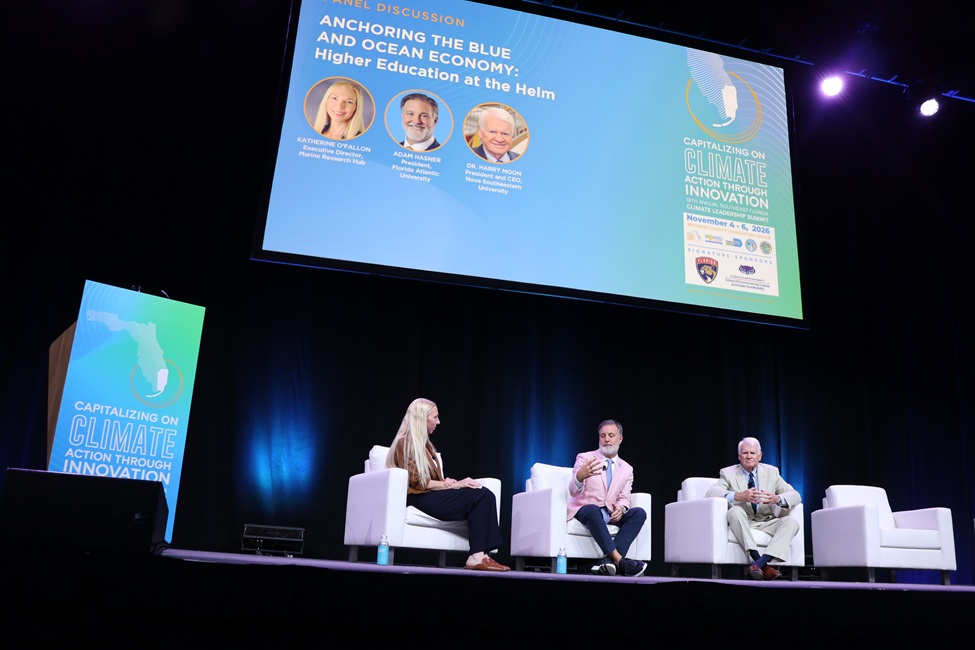
Florida Atlantic University recently brought its research expertise and institutional leadership to the 18th annual Southeast Florida Climate Leadership Summit at the Broward County Convention Center in Fort Lauderdale. As a signature sponsor through its School of Environmental, Coastal, and Ocean Sustainability (ECOS), FAU participated in discussions spanning climate technology, artificial intelligence, infrastructure resilience, public-sector decision-making, and the rapidly growing blue and ocean economy.
This year’s theme, “Capitalizing on Climate: Action Through Innovation,” emphasized how scientific discovery, emerging technologies and strategic investment can advance climate solutions while creating economic opportunities and strengthening communities. The summit brought together leaders from government, business, academia and nonprofit organizations to advance regional resilience strategies.
A highlight of the program was “Anchoring the Blue and Ocean Economy: Higher Education at the Helm,” featuring Florida Atlantic President Adam Hasner and Nova Southeastern University President and CEO Harry Moon, M.D. The discussion examined how universities can accelerate technological development, move discoveries toward commercial applications, prepare specialized talent and strengthen Southeast Florida’s position as a hub for ocean innovation.
“Higher education is one of the greatest assets to the ocean economy,” said Hasner. “At Florida Atlantic, we prepare the talent, drive the discoveries and help launch the businesses that will shape this growing industry. Our responsibility extends beyond educating students and conducting research. We also must create pathways for discoveries to reach the marketplace, connect students with industry leaders and help businesses access the talent and innovation they need to grow. When universities, industry and government work together, public investment in higher education strengthens the entire ocean economy, from the laboratory to the marketplace.”
The summit’s program extended beyond the blue economy to explore how research and innovation can inform climate action across Southeast Florida. Steven Vollmer, Ph.D., director of ECOS within FAU’s Charles E. Schmidt College of Science, delivered the summit’s welcoming remarks as well as moderated a panel examining the practical and financial challenges of regional resilience.
“Just as ECOS is FAU’s hub for solution-based environmental research and community engagement, Southeast Florida is a global hub for climate and resilience leadership,” said Vollmer. “We are excited to support the Climate Leadership Summit. It is a great opportunity to bring our scientific expertise together with the practitioners, policymakers and community leaders advancing solutions on the ground. By connecting research with real-world needs, we can help accelerate action today while preparing the next generation of leaders and practitioners to build a more resilient future for all.”
Vollmer moderated “Managing the Frontlines while Balancing the Ledger,” a discussion with county administrators from Broward, Miami-Dade and Palm Beach counties. The panel addressed the competing fiscal, infrastructure, housing, community and climate priorities confronting local governments, as well as the value of regional collaboration and opportunities to advance resilience over the coming years.
FAU also participated during Innovation Day, with faculty members examining how emerging technologies can support more efficient and resilient communities. Sudhagar Nagarajan, Ph.D., associate professor and associate chair in FAU’s Department of Civil, Environmental and Geomatics Engineering, joined “The Eyes and Ears of Tomorrow,” a panel exploring how sensors, robots and drones are being used to improve cities and strengthen resilience. George Sklivanitis, Ph.D., the Charles E. Schmidt Research Associate Professor and associate director of the Center for Connected Autonomy and Artificial Intelligence in FAU’s College of Engineering and Computer Science, participated in “Thinking Beyond the Now,” a discussion of how AI can support government missions, infrastructure and broader resilience efforts.
Together, these sessions reflected FAU’s role in connecting research, technology and regional priorities. Across its environmental, coastal and ocean programs, the university is working to better understand climate risks, develop tools for decision-makers and translate research into approaches that communities can use.
In addition, at the ECOS booth, visitors experienced an immersive virtual reality simulation developed by FAU’s Center for Urban and Environmental Solutions (CUES), which brings future sea level rise and flooding risks to life in South Florida neighborhoods. Spearheaded by Serena Hoermann, Ph.D., director of CUES, this latest simulation focuses on Fort Lauderdale, allowing users to visualize localized flooding scenarios and see how rising seas could affect their communities, infrastructure and future development.
FAU’s work spans coastal resilience, ocean science and engineering, and emerging technologies. Through ECOS, FAU’s Harbor Branch Oceanographic Institute, SeaTech – The Institute for Ocean and Systems Engineering, and the FAU Marine Laboratory at Gumbo Limbo, researchers study coastal flooding and erosion, develop nature-based solutions and advance technologies in AI, robotics and environmental monitoring.
The university connects research with real-world applications through the Florida Office of Ocean Economy, the Marine Research Hub, industry partnerships and entrepreneurship programs. Student internships and fellowships provide hands-on experience, while collaborations with the U.S. Navy and Blue Ops, a maritime division of Red Cat Holdings, Inc. (Nasdaq: RCAT), expand FAU’s work in maritime security and autonomous systems.
FAU also sponsored 10 undergraduate students to attend the summit, providing opportunities to engage with climate research, innovation and entrepreneurship. Three FAU undergraduates also competed in Innovation Day’s Collegiate Innovation Showcase, presenting ideas developed through their participation in the university’s 2026 Business Pitch Competition.
The summit is the flagship event of the Southeast Florida Regional Climate Change Compact, established in 2009 by Broward, Miami-Dade, Monroe and Palm Beach counties to coordinate climate mitigation and adaptation across the region. Broward County hosted the 2026 summit, with FAU’s ECOS and the Florida Panthers serving as signature sponsors.
To learn more about FAU’s ECOS, visit fau.edu/environment.