FAU Researchers Make Great ‘Strides’ in Gait Analysis Technology
by Gisele Galoustian | Friday, Oct 24, 2025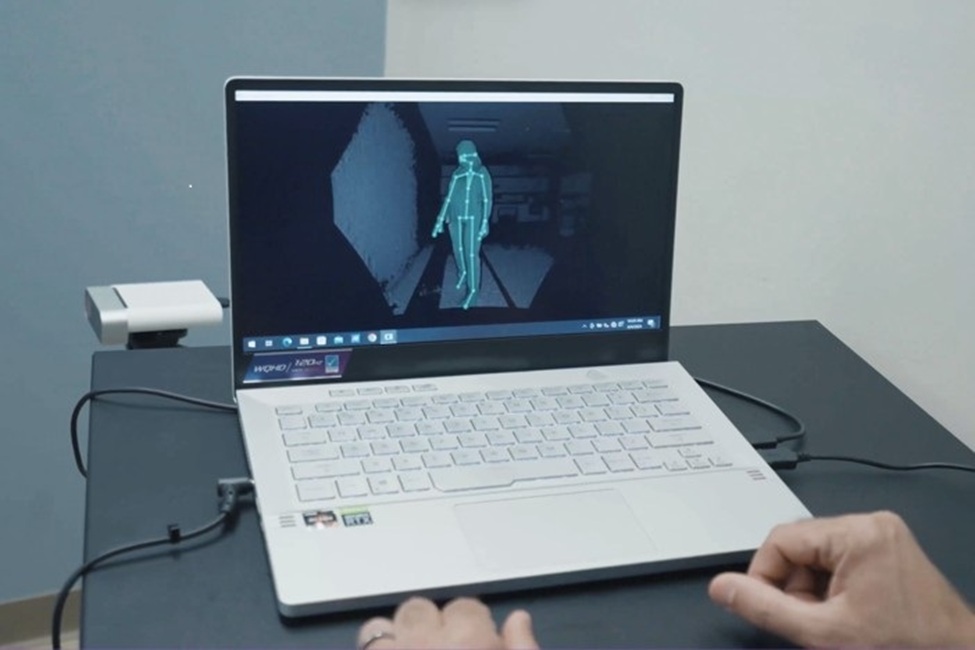
A study from the College of Engineering and Computer Science and the Sensing Institute (I-SENSE) at Florida Atlantic University reveals that foot-mounted wearable sensors and a 3D depth camera can accurately measure how people walk – even in busy clinical environments – offering a powerful and more accessible alternative to traditional gait assessment tools.
Gait, the pattern of how a person walks, is an increasingly important marker of overall health, used in detecting fall risk, monitoring rehabilitation, and identifying early signs of neurodegenerative diseases such as Parkinson’s disease and Alzheimer’s disease. Although electronic walkways like the Zeno™ Walkway have long been considered the gold standard for gait analysis, their high cost, large footprint and limited portability restrict widespread use – especially outside controlled lab settings.
To overcome these barriers, FAU researchers and collaborators conducted the first known study to simultaneously evaluate three different sensing technologies: APDM wearable inertial measurement units (IMUs); Microsoft’s’ Azure Kinect depth camera; and the Zeno™ Walkway – under identical, real-world clinical conditions. The depth-sensing camera captures 3D data, color images, and body movements for use in AI, robotics and motion tracking.
The study findings, published in the journal Sensors, reveal that foot-mounted IMUs and the Azure Kinect not only match the accuracy of traditional tools but also enable scalable, remote and cost-effective gait analysis.
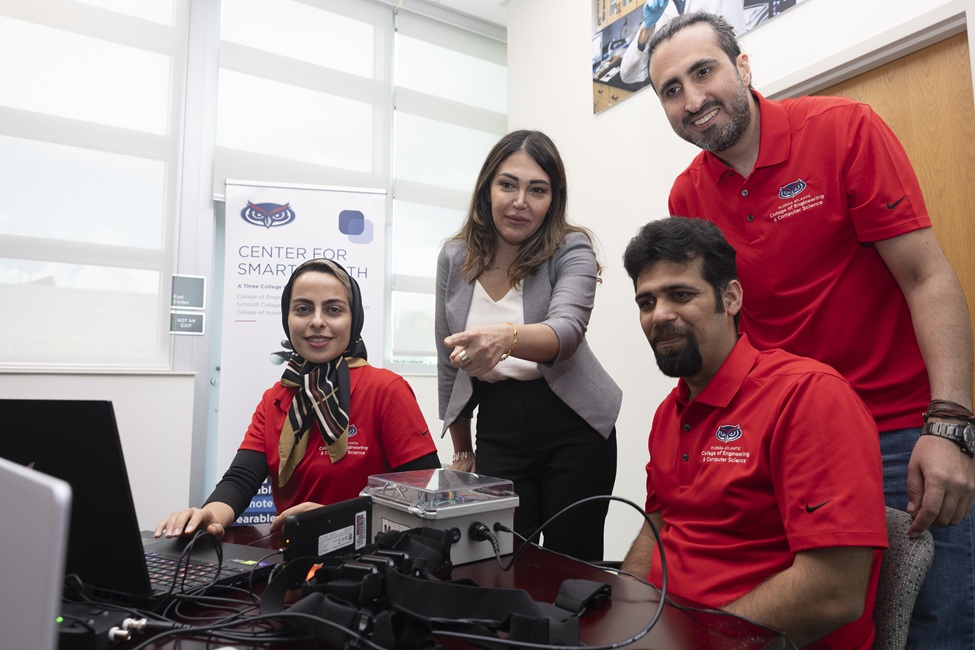
“This is the first time these three technologies have been directly compared side by side in the same clinical setting,” said Behnaz Ghoraani, Ph.D., senior author and an associate professor in the FAU Department of Electrical Engineering and Computer Science and the Department of Biomedical Engineering, and an I-SENSE fellow. “We wanted to answer a question the field has been asking for a long time: Can more accessible tools like wearables and markerless cameras reliably match the clinical standard for detailed gait analysis? The answer is yes – especially when it comes to foot-mounted sensors and the Azure Kinect.”
The study recruited 20 adults aged 52 to 82, who completed both single-task and dual-task walking trials – a method often used to mimic real-world walking conditions that require multitasking or divided attention. Each participant’s gait was captured by the three systems at the same time, thanks to a custom-built hardware platform the FAU researchers developed, which precisely synchronized all data sources to the millisecond.
Researchers evaluated 11 different gait markers, including basic metrics like walking speed and step frequency, as well as more detailed indicators such as stride time, support phases and swing time. These markers were analyzed using statistical methods to compare each device’s measurements with those from the Zeno™ Walkway.
The results were clear: foot-mounted sensors showed near-perfect agreement with the walkway across nearly all gait markers. The Azure Kinect also performed impressively, maintaining strong accuracy even in the complex, real-world clinic setting where multiple people, including caregivers and staff, were present in the camera’s field of view. In contrast, lumbar-mounted sensors, which are commonly used in wearable gait studies, demonstrated significantly lower accuracy and consistency, particularly for fine-grained gait cycle events.
Many studies use lower-back sensors because they are easy to mount. However, data from this study shows that they often fail to capture the details clinicians care most about – especially timing-based markers that can reveal early signs of neurological problems.
“By testing these tools in a realistic clinical environment with all the unpredictable visual noise that comes with it, we’ve made great strides toward validating them for everyday use,” said Ghoraani. “This isn’t just a lab experiment. These technologies are ready to meet real-world demands.”
Importantly, the study is the first to benchmark the Azure Kinect against an electronic walkway for micro-temporal gait markers – filling a critical gap in the literature and confirming the device’s potential clinical value.
“The implications of this research are far-reaching,” said Stella Batalama, Ph.D., dean of the FAU College of Engineering and Computer Science. “As health care systems increasingly embrace telehealth and remote monitoring, scalable technologies like wearable foot sensors and depth cameras are emerging as powerful tools. They enable clinicians to track mobility, detect early signs of functional decline, and tailor interventions – without the need for costly, space-intensive equipment.”
Study co-authors are first author Marjan Nassajpour and Mahmoud Seifallahi, both doctoral students in the FAU College of Engineering and Computer Science; and Amie Rosenfeld, a physical therapist researcher and assistant director of education; Magdalena I. Tolea, Ph.D., research assistant professor of neurology and associate director of research; and James E. Galvin, M.D., professor of neurology, chief, Division of Neurology, and director, Comprehensive Center for Brain Health, all with the University of Miami Miller School of Medicine.
This work was supported by a National Science Foundation grant awarded to Ghoraani and a National Institutes of Health grant awarded to Galvin.