FAU Feasibility Study: Queen Conch Aquaculture and Seagrass Impacts
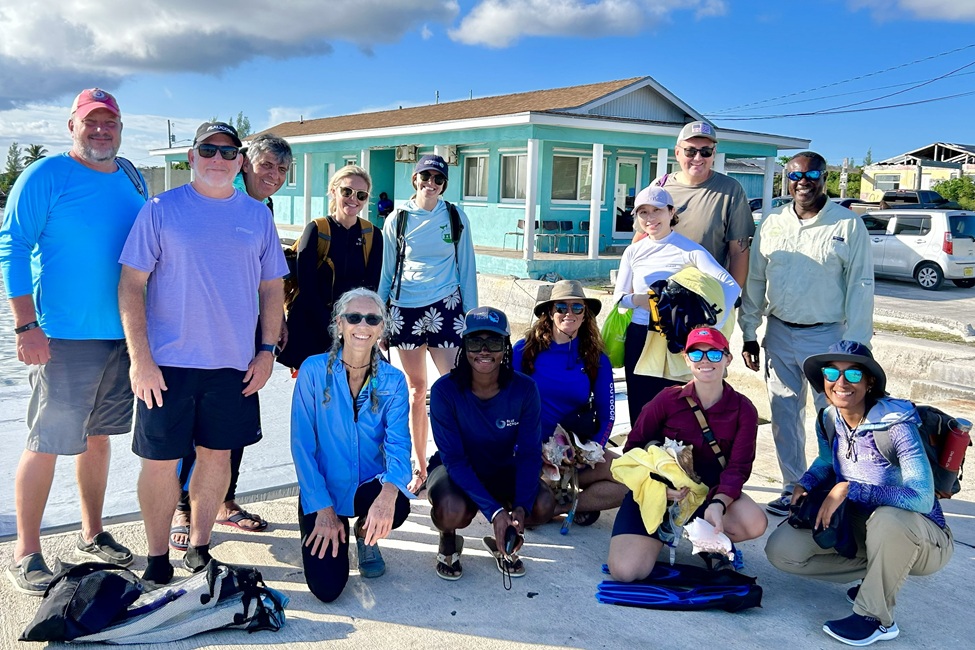
Representatives from FAU, Blue Carbon Plus, Innovasea, and Tidepoint Group conducting a site visit with local partners Blue Action Lab and community members to natural queen conch seagrass nursery areas on Grand Bahama. (Photo credit: FAU Queen Conch Lab)
Study Snapshot: FAU’s Harbor Branch Oceanographic Institute, through its Queen Conch Lab, has launched a 12-month feasibility study to evaluate the commercial and environmental potential of queen conch aquaculture in The Bahamas and other Caribbean regions. Funded by Blue Carbon Plus (BC+), the study will assess optimal hatchery and grow-out systems, identify viable markets for fresh and value-added conch products, and explore how a scalable farming model can produce high-quality conch while supporting animal welfare and economic sustainability.
Titled “Determining the Commercial Viability of Conch Aquaculture and its Seagrass Impact,” the project also examines the environmental co-benefits of aquacultured conch restored to seagrass habitats, including their role in ecosystem health and potential carbon sequestration. The research brings together scientific expertise, industry leadership and innovative farm design, supported by partners such as Tidepoint Group and Innovasea, to generate data that can guide future investments in sustainable aquaculture, marine conservation and community-based economic development.
Florida Atlantic University’s Harbor Branch Oceanographic Institute has been awarded a grant from Blue Carbon Plus (BC+) to explore sustainable, market-driven aquaculture opportunities in The Bahamas and elsewhere. BC+ is a collaboration between Conservation International and The Nature Conservancy. Spearheaded through its Queen Conch Lab, FAU Harbor Branch has launched a 12-month feasibility study, funded by BC+, to assess the commercial viability of queen conch aquaculture.
The project aims to develop a scalable farming model capable of producing high-quality, marketable conch products while simultaneously enhancing the seagrass meadows that sustain this culturally and ecologically important Caribbean species.
The study titled, “Determining the Commercial Viability of Conch Aquaculture and its Seagrass Impact,” will evaluate how science-based aquaculture can strengthen both local economies and marine ecosystems.
Its three core objectives are to determine an optimal farm design and production model that maximizes efficiency and animal welfare across both hatchery and grow-out systems; to identify and assess the market for existing, new and value-added conch products; and to measure and document the environmental co-benefits of aquacultured conch restored to seagrass habitats, including their potential contribution to carbon sequestration.
To advance the market research and strategic planning components, FAU has engaged , principal at Tidepoint Group and a highly-experienced seafood industry executive, to lead the study’s commercialization assessment. Formally CEO of the only open ocean aquaculture farm in the United States, Jones brings decades of experience in global seafood markets, retail and distribution, sustainable aquaculture and community-based business development.
To bring a commercial queen conch facility to life, FAU has also engaged Innovasea, a global aquaculture company known for developing some of the world’s most technologically advanced solutions for sea and land-based fish farming.
FAU Harbor Branch, BC+ and Innovasea conducted a joint site visit in November 2025 to Grand Bahama, the location of the Queen Conch Lab’s partnership project, the Grand Bahama Queen Conch Mariculture Center, where they met with local partners such as Blue Action Lab, conducted interviews with fishery stakeholders, and held strategy sessions to align research, market and environmental priorities.
“This feasibility study represents a critical step toward transforming decades of conch aquaculture research into a viable, scalable industry that benefits both people and the environment,” said Megan Davis, Ph.D., a research professor at FAU Harbor Branch and director of the Queen Conch Lab. “By integrating rigorous science with thoughtful farm design and market analysis, we’re working to ensure that queen conch aquaculture can support economic development while actively restoring the seagrass ecosystems this species depends on.”
FAU Harbor Branch’s Queen Conch Lab has long been recognized as the leader in queen conch aquaculture, restoration and education. Building on its network of mobile hatchery labs deployed across the Caribbean, this new study will provide key data to guide future investments in sustainable aquacultured queen conch and seagrass conservation.
“At Blue Carbon Plus, we are focused on advancing solutions that align commercial success with measurable environmental benefits,” said Christine McClung, BC+ program director. “This project brings together science, industry expertise and local partnerships to explore how aquaculture can generate durable market opportunities while strengthening marine ecosystems and supporting coastal communities in The Bahamas and beyond.”
-FAU-
Tags: research | harbor branch | community | faculty and staff