FAU Mechanical Engineers Earn Third Place at NASA HERC Competition
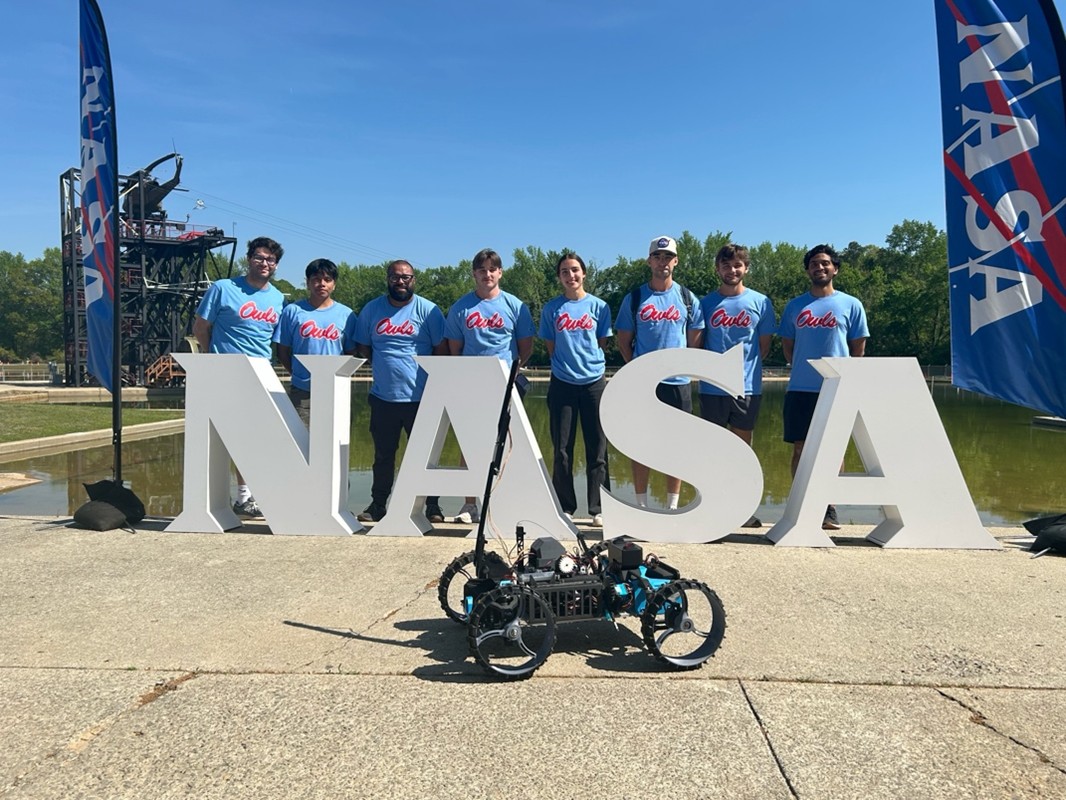
From left, Charles Travert, Fabricio Ochoa, Jose Marte Rosario, Erik White, Ana-Maria Briscan, Lucas Kulon, Daniel Briant and Paul Chazhur. The Astro-Owls rover designed and built by the students is at the center.
A team of Florida Atlantic University mechanical engineering students secured third place in the college remote-controlled division at NASA’s 2026 Human Exploration Rover Challenge (HERC), showcasing innovation, teamwork and technical experience on a national stage.
The FAU team – Daniel Briant, Ana-Maria Briscan, Paul Chazhur, Lucas Kulon, Jose Marte Rosario, Fabricio Ochoa, Charles Travert and Erik White – spent more than nine months designing, building and rigorously testing their rover, dubbed “Astro-Owls.”
The students traveled to Huntsville, Alabama to compete at the Aviation Challenge facility at NASA’s Marshall Space Flight Center outside the U.S. Space & Rocket Center. There, the team’s rover navigated a demanding lunar-inspired obstacle course designed to simulate the rugged terrain and challenges of extraterrestrial exploration.
Competing against 15 teams in the college remote-controlled division, FAU finished third overall, behind The University of Alabama, Huntsville (first place), and South Dakota State University (second place). Other competitors included teams from the University of Florida and West Florida University.
“This achievement highlights the caliber of our students and the strength of the college’s approach to engineering education,” said Stella Batalama, Ph.D., dean of the College of Engineering and Computer Science. “Designing and building a rover capable of performing multiple sensing and measurement tasks in a demanding environment requires not only technical skill, but persistence and teamwork – qualities our students continue to demonstrate on a national stage.”
HERC is one of NASA’s most hands-on student engineering programs, a NASA-conducted engineering design challenge providing resources and experiences for students and faculty. The activity is built around NASA’s mission, providing participants with the opportunity to engage with agency subject matter experts and professionals across aerospace industry.
Since fall 2025, the 44 competing teams – drawn from high schools and universities across the country and internationally – have been designing and building rovers from scratch, walking through the full engineering design cycle: concept, prototype, test and compete.
“As a faculty member, I’m proud of the success of this student team that reflects not only their excellent engineering abilities, but also their determination and teamwork effort during this nine-month challenge,” said Oscar Curet, Ph.D., mentor of the team and an associate professor in the department of Ocean and Mechanical Engineering. “The team went through multiple design iterations, testing and some drawbacks that they were able to overcome. Their perseverance and dedication paid off, demonstrating the quality of our FAU students.”
The FAU team was sponsored by the FAU Office of Undergraduate Research and Inquire (OURI), the Florida Space Grant Consortium and the Ocean and Mechanical Engineering Department.
For more information on the 2026 HERC competition, visit here.-FAU-
Tags: engineering | students