From the Research Lab to Industry — and Back Again
by Nicole G Nussbaum | Thursday, Sep 10, 2026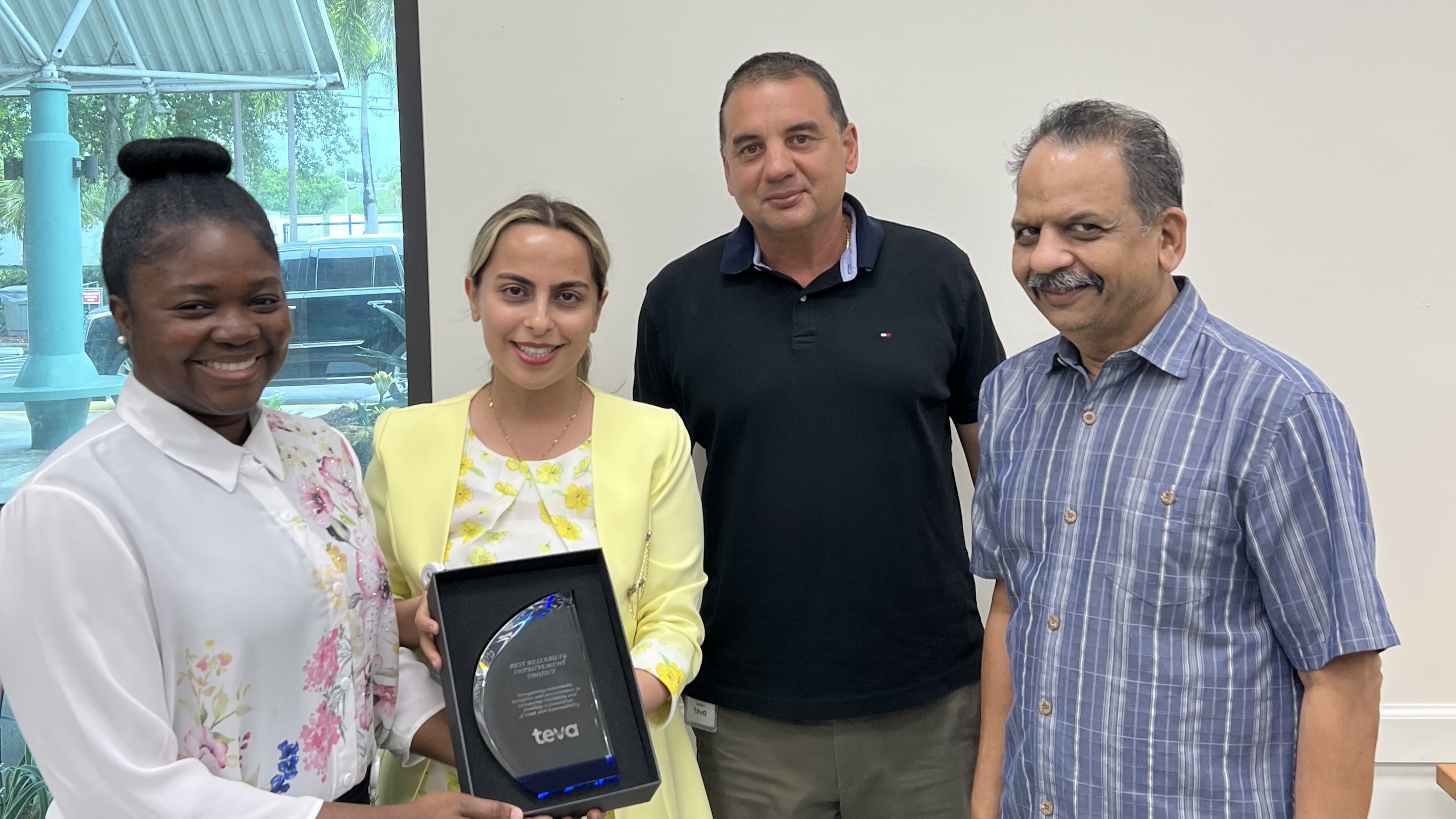
Institute doctoral student Marjan Nassajpour spent a summer away from the research lab, and the experience changed the way she plans to work as she picks up her research this fall.
She worked as a research intern on the AI and Robotics team at Teva Pharmaceuticals in Davie, Florida, arriving with years of experience using artificial intelligence to make sense of complex health data. She returned with a clearer idea of what she wants that research to accomplish — and what it takes to move a promising model beyond the lab.
At the Institute for Smarter Cities, Spaces, and Health, Marjan works under the guidance of Behnaz Ghoraani, Ph.D., on the early detection of Alzheimer’s disease using electroencephalography, or EEG, and wearable sensor data. Her research combines signal processing and machine learning to look for patterns that could indicate cognitive decline before symptoms become clinically apparent.
“Ultimately, I’m hoping this kind of multimodal, noninvasive approach could help clinicians catch Alzheimer’s earlier, when interventions are more likely to help,” Marjan said.
Her projects at Teva took her well beyond Alzheimer’s research, working on anomaly detection for industrial equipment, computer vision for compliance monitoring and sensor-based energy monitoring. She moved through the development process from exploring data and building models to evaluating results and preparing them for deployment and stakeholder review.
The subject matter was new. The problems hidden within the data were not.
“My experience working with noisy signal data and feature engineering transferred more directly than I expected,” Marjan said. “Techniques I use for filtering and extracting meaningful patterns from EEG and wearable sensor data turned out to be just as relevant to the industrial sensor data I worked with at Teva.”
Due in part to these skills she already possessed, Marjan and her teammates received the Best Reliability Improvement Project award for their work on an anomaly detection project.
Individually, Marjan worked on a computer vision detection model that initially performed well using a public baseline dataset. Then she began training it with photographs from the actual site.
The data got messier. False positives emerged. Unexpected edge cases appeared. Each round of retraining brought the model closer to the environment where people would actually rely on it.
“Watching the false positives drop with each retraining cycle and debugging those unusual cases taught me a lot about how messy real-world deployment data can be compared with clean benchmark datasets,” she said.
The experience also introduced a different measure of whether a model was successful. Strong technical performance was only part of the equation. Marjan had to account for limited computing hardware, deployment requirements and timelines while explaining results to people who needed to understand and act on them.
“In the lab, I have more freedom to iterate and explore a problem thoroughly before settling on an approach,” she said. “At Teva, there was more pressure to develop practical, deployable solutions on a timeline. There was also a strong emphasis on interpretability and robustness because the results needed to be trusted and used by people in a pharmaceutical environment where accuracy and compliance carry real weight.”
For a researcher developing AI tools that could one day inform decisions about human health, that lesson followed her home.
“In health care-related research like mine, being able to explain why a model flagged something can matter just as much as the flag itself,” Marjan said.
As she returns to her Alzheimer’s research, Marjan plans to build interpretability into her models earlier and test them with an eye toward how they might perform beyond carefully curated research datasets. She also plans to use visualization techniques she developed at Teva to make complex results clearer and more accessible in her research papers.
“One of the many things we want our doctoral students to develop is the ability to take what they learn through research and apply it to problems we may not have anticipated,” Behnaz said. “Marjan did that at Teva. She came back thinking differently about what happens after you develop a model — how it will perform with real-world data, how someone can understand and trust its results, and what it would take to actually use it outside the lab.”
Marjan’s work at Teva is not finished. This fall, she is continuing her internship part-time, including further development of her computer vision project, while spending the rest of her time at the institute focused on her doctoral research.
“This experience confirmed that I want my career to sit at the intersection of AI and health care,” she said. “It showed me that meaningful applied work in a health care-related industry is exactly the kind of impact I’m looking for, whether that’s in industry research or a role that bridges academia and industry.”
Marjan left the institute for the summer with research skills that proved useful in an entirely different environment. Now, she is moving between the two — bringing her academic training to problems at Teva and an industry perspective back to her research at the Institute for Smarter Cities, Spaces, and Health.
“I’m approaching research with a more application-driven mindset,” Marjan said. “This summer taught me to think beyond developing a good technical solution and consider how it can be implemented, tested and create real-world impact.”