I-SENSE Pathways: From High School Research to an International Stage
by Nicole G Nussbaum | Thursday, Jul 30, 2026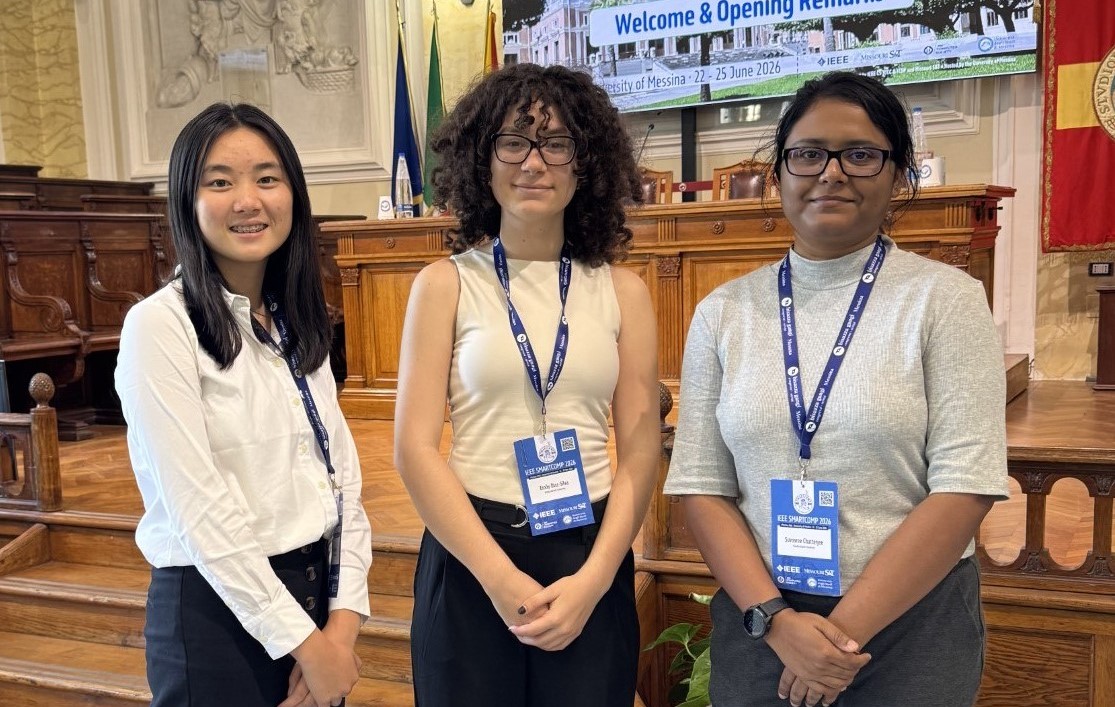
Most summer research programs end with a final presentation, but for Emily Diaz-Silva and Grace Gao, their presentation last summer marked the beginning of their research.
Instead of walking away when the six-week My Summer Streetscape Research Institute led by I-SENSE through the Center for Smart Streetscapes (CS3) ended in August of 2025, the two students continued working in the I-SENSE lab throughout their next year of high school, expanding the project they had started that summer. Their work eventually led to a presentation at IEEE SMARTCOMP 2026 in Messina, Italy, before they returned this summer as undergraduate researchers in I-SENSE's Research Experiences for Undergraduates (REU) program.
Their experience reflects the kind of long-term engagement I-SENSE hopes to foster by creating opportunities for students to continue building on their research beyond a single summer.
"One of the many goals of our summer programs is to give students an authentic research experience and show them what's possible beyond the classroom," Jason Hallstrom, Ph.D., executive director of I-SENSE said. "Emily and Grace didn't see the end of that first summer as the end of their project. They continued asking questions, building on their work and taking advantage of the resources I-SENSE has to offer."
The My Summer Streetscapes Research Institute program introduces students to community-engaged engineering research by pairing them with faculty members, graduate students and mentors working on projects that address real challenges facing South Florida communities.
Emily entered the program with experience in competitive underwater robotics and was looking for opportunities to apply her programming skills outside of structured competitions.
"Robotics competitions are designed to mirror real-world problems, but everything happens in a controlled environment with well-defined missions," Emily said. "What drew me to this experience was the chance to apply those same skills to real systems in local communities, where the challenges are much more unpredictable and the work can have a direct impact."
Grace was drawn by that same connection between engineering and community impact.
"I was interested in how technology and research could be used to address real-world challenges in local communities," she said. "That felt unique for a high school research experience."
Working with I-SENSE researchers, the pair developed LitterNET, a computer vision system that uses video analysis to detect litter in public spaces — contributing to I-SENSE's Smarter Cities research focus by exploring how artificial intelligence can help communities better understand and care for shared public spaces.
Throughout the academic year, they continued refining LitterNET, exploring new research questions and preparing the project for publication and presentation.
"By the end of that first summer, I realized our work had only just begun," Emily said. "Research is never truly finished — every answer led to new questions, and we wanted to keep exploring them."
As the project evolved, so did the students' understanding of research.
Emily expanded her work into areas including litter characterization, wind velocity detection, video summarization and search, while Grace gained a new perspective on the role research can play in addressing community challenges.
"I used to think research was mostly complicated numbers and technical language," Grace said. "Working on LitterNET helped me realize it plays an important role in solving real-world problems."
Emily said the experience also changed how she approached engineering.
"Research is open-ended," she said. "You're constantly asking new questions, testing ideas and discovering where they lead."
After the additional year of working on LitterNET, Emily and Grace traveled to Messina, Italy, with Hallstrom to present at IEEE SMARTCOMP 2026, one of the world's leading conferences on smart computing. Their poster demonstrated how computer vision can help researchers better understand litter accumulation in public spaces, connecting research rooted in local communities with an international audience.
For Emily, presenting the work was rewarding because of everything that came before it.
"The conference was definitely a highlight," she said. "But what had the biggest impact were the months leading up to it. The late nights coding, writing the paper and working alongside such a great team were what made presenting our work feel earned."
The experience also reinforced the importance of collaboration.
"Working on the paper together taught me so much about teamwork," Grace said. "We grew together throughout the process, and I couldn't have asked for a better research partner."
When Emily and Grace returned to I-SENSE this summer through the REU program, they arrived with a year of research experience already behind them.
"Coming back, I already understood the research process and the lab environment," Emily said. "That foundation allowed me to contribute more independently and take on more challenging problems from day one."
After a second summer refining their research skills, both students plan to continue pursuing research throughout their academic careers. Emily hopes to explore artificial intelligence, computer vision and other areas of computer engineering while contributing to projects with meaningful impact. Grace plans to continue working on engineering research that addresses important societal challenges and serves communities.
A year after joining the My Summer Streetscapes Research Institute and I-SENSE, Emily and Grace have completed two summer research experiences, presented at an international conference and gained a clearer picture of where engineering research can take them next.