The IDEAL Master’s and Specialist Degree in Educational Leadership for School Leaders
The IDEAL Program Educational Philosophy and Practice
In keeping with the transformative principles of adult learning (Knowles, Holton III, & Swanson, 2015) 1, the IDEAL Program has been designed to meet the needs and aspirations of emerging school leaders who work full-time while they manage multiple personal commitments. In addition, the curriculum’s delivery model is designed for both local and distant learners and is therefore offered in a synchronous distributed eLearning format. This means that students attend a pre-determined class schedule over six semesters as a cohort and with their instructor in real time (on Saturday mornings, and Tuesday and Thursday evenings) but do so from wherever they may be. All classes are conducted remotely via Zoom.
1 Knowles, M., Holton III, E., & Swanson, R. (2015). The Adult Learner: The definitive classic in adult education and human resource development. New York: Routledge.


A Synchronous Distributed eLearning Program
Overview
The Florida Atlantic University (FAU) College of Education’s (COE) Department of Educational Leadership and Research Methodology (ELRM) has as its mission to contribute to the personal and professional growth of current and potential leaders who serve educational agencies or individuals in a variety of settings. The Master’s Degree in Educational Leadership, which we have called IDEAL (for Integral Development of Educational Administrators and Leaders) has been designed to provide aspiring school leaders with the rigorous, research-based, and job-embedded preparation required of instructional and transformational leaders of public, charter, private, religious, and international schools. The IDEAL Program seeks also to develop and sustain a commitment to positive social change; excellence in both understanding the need for, and implementing, the expert decision making and people skills associated with leadership in education; a belief in the power of lifelong learning, inclusion and human dignity; and exemplary standards of ethical and professional behavior.
 Completion of this degree, and passing the Florida Educational Leadership Exam (FELE), leads to Florida Educational Leadership Certification (Level I), which qualifies an individual to serve as a public school assistant principal, intern assistant principal, intern principal, or interim principal.
In addition to the leadership domains of knowledge and experiential learning considered as world class by the profession, the IDEAL Program includes learning the Florida Educational Leadership Standards (FELS) which are measured through the FELE, and the Professional Standards for Educational Leaders (PSEL). It also complies with the program reaccreditation requirements specified by the Council for the Accreditation of Educator Preparation (CAEP).
Our faculty are dedicated to the success of each and every student by building strong relationships through personalized advising, coaching, and mentoring. They comprise full-time, qualified, experienced higher education professors, researchers, and top school administrators with a background in public and private education. We also require that each student be supported and mentored by a school administrator at their school for the duration of the program.
 Special Dispensation for IDEAL Program Graduates for the Aspiring Assistant Principals Program (AAPP) by the School District of Palm Beach County (SDPBC)
As of 2024, IDEAL Program graduates are guaranteed a place in the AAPP if they meet the district’s requirements. IDEAL Program graduates interested in this opportunity should contact janet.d.butts@palmbeachschools.org.
For more information, visit https://www.palmbeachschools.org/Page/2095
For more information on the program and applications process, please contact Dr. John Hardman, IDEAL Program Director, at whardma1@fau.edu. or fill out our contact form at the top of the page.
Masters Program Description
The IDEAL School Leaders Masters Program is built on the four major domains that the ELRM requires for leadership learning; Leadership Foundations, Research Foundations, Professional Knowledge, and Experiential Learning. It is centered on providing effective leadership in areas of research, service and teaching at the local, state, national and international levels.
The IDEAL curriculum combines rigorous coursework with job-embedded clinical practice conducted at the student’s school throughout the program. Course content includes topics such as adult learning, systems thinking, instructional leadership, leadership for social justice, family and community engagement, school operations management, educational governance, law and policy, research methods, and many more. To ensure the effective completion of the school-based tasks included in the program’s three-semester internship, students are required to establish a strong working relationship with their Principal or other school administrator, who must agree to act as their mentor for the duration of the program*. Students in Florida graduate after completing state licensure requirements by taking the Florida Educational Leadership Examination (FELE). Students elsewhere should become informed as to the licensure requirements in their state.
* Administrator mentors are required to complete mentor training provided by the Department.
Students successfully completing the Masters Degree will have mastered the subject matter needed for the profession and understand the need to engage in lifelong learning to maintain effectiveness in a changing environment.
The first domain, Leadership Foundations, provides the student with learning specifically about leadership. Leadership is a relationship between leaders and followers who work together toward common goals to effect change in an ethical way. Leaders continually organize to ensure that goals are accomplished. They (a) set and seek to achieve goals, (b) find resources, (c) adapt to their environment, (d) maintain cohesiveness within the system, and (e) preserve a unique system of values and work flow. Leaders must develop their own minds in systems terms and see their organizations holistically, so they may transfer knowledge from one setting to another. They must develop skills and a capacity to envision the future and be able to find opportunities within and without their organizations. Informed reflective decision-makers need leadership foundational knowledge. The theory, learning, and application of leadership are provided through the three core courses that are required for all EDL programs.
The remaining three domains are Research Foundations, Professional Knowledge, and Experiential Learning. These domains have a core group of courses that provide the student with the opportunity to learn the most important elements contained within each.
Research Foundations. School leaders today must be adept at using current research methods and tools, as well as be able to interpret findings and analyze data thereby revealing answers to questions and problems encountered in practice. In the era of accountability, data-based decision making, and scientifically-based educational programs and practices, school leaders’ learning and knowledge in this area is critical to professional success.
Professional Knowledge. Ethical reflective decision-makers understand why they are given discretion in their roles and use that ability only for the student’s or client’s benefit. Students learn about specialized fields of school leadership including school operations and management, governance, law, instructional leadership, and school community in the component courses of this domain.
Experiential Learning. This domain implies the concept that elements of a professional’s education will be gained from a practical approach in a real-world situation. It is based on the belief that insights gained through a job, internship, volunteer work, or course field work will enhance academic studies and the professional’s critical reflection skills in thinking and acting upon his/her talents, aspirations, and the needs of the work setting. This domain also helps the professional in setting academic, career and personal goals. In Experiential Learning, students take internship courses with curricula that are built to practice assistant principal-level activities. These internships are semester-specific (Fall, Spring, and Summer). Each internship course presents different knowledge and skills applications. The curriculum of each internship is centered on the activities occurring during each of the Fall, Spring, and Summer school administrative calendar time frames.
Leadership Standards
The IDEAL Program is aligned with the Florida Educational Leadership Standards (FELS). The purpose of these standards is to establish Florida’s expectations for effective school administrators. These evidence-based standards form the foundation for school leadership preparation programs, educator certification requirements, professional learning for school administrators, and school administrator evaluation systems. The Standards reflect interdependent domains, qualities and values of leadership work that research and practice suggest are integral to student success:
Standard 1. Professional and Ethical Norms.
Standard 2. Vision and Mission.
Standard 3. School Operations, Management, and Safety.
Standard 4. Student Learning and Continuous School Improvement.
Standard 5. Learning Environment.
Standard 6. Recruitment and Professional Learning.
Standard 7. Building Leadership Expertise.
Standard 8. Meaningful Parent, Family, and Community Engagement.
IDEAL Program Core Values and Beliefs
The program is guided by the following foundational statement of intent and core values and beliefs.
Vision
We will be widely recognized as a leading school leadership professional learning program locally, nationally, and internationally, developing the strongest school leaders and leadership teams to lead and transform schools into model learning organizations.
The IDEAL School Leader Profile
The program is grounded in five core values and beliefs about educational leadership, expressed as the IDEAL School Leader Profile:
Leader of Leaders and Learning
School leaders who are committed to a vision of leadership that is instructional, collaborative, distributive, data-informed, research-based, ethical, developmental, innovative, and courageous. They understand that leadership is most effective when it is shared and focused on developing leadership capacity within schools and school systems. They are lead learners whose leadership requires the ability to use pedagogy and andragogy in facilitating the learning of everyone in the school and its community.
Reflective Practitioners
School leaders who are reflective practitioners with a world view to create dynamic learning environments. They are strategic thinkers who develop organizational and operational systems to promote ongoing reflective and critical inquiry to inform action. They welcome critical feedback to develop the personal insight necessary to increase their leadership attributes and skills.
Transformative Decision-Makers
School leaders who recognize that their leadership is a transformative and political process to bring about positive change in the pursuit of a better society and world. They understand and demonstrate the capability to evaluate the moral and legal consequences of decisions and make their choices based on the goal of maximizing student learning and fostering a democratic community. They are strategic and systems thinkers with a growth mindset.
Relationship Builders
School leaders who are adept at building positive relationships that support the wellbeing of all members of the school community. They are culturally aware leaders who treat each individual with civility, empathy, respect, and forthrightness while holding high expectations for everyone who contributes to the learning organization. They build external relationships with families, community members, and community organizations to strengthen the school programs they lead.
Visionaries with High Expectations
School leaders who communicate and create a shared vision that inspires high expectations for their own performance, as well as for the performance of all others in the school. They embrace accountability and give feedback as tools for continuous improvement while remaining focused on student learning as a priority. They are passionate leaders who persevere and challenge the status quo.
Plan of Study
The IDEAL Program Plan of Study comprises 15 courses, including three internships that are conducted at the student’s school with the guidance of their instructor and the support of their school administrator mentor. The program is mandated in terms of coursework – you don’t have elective classes, and courses are scheduled on a pre-established rotation. The following table lists the coursework that you need to take for your degree:
| PREFIX | NO. | Title | CREDITS |
|---|---|---|---|
| Leadership Foundations Coursework | |||
| ADE | 6381 | Leadership 1 - Adult Learning & Assessment | 3 |
| EDS | 6100 | Leadership 2 - Theory & Assessment | 3 |
| EDA | 6103 | Leadership 3 - Administrative Processes | 3 |
|
Education Foundations Coursework
|
|||
|---|---|---|---|
| STA | 6113 | Statistical Methods in Education | 3 |
| EDF | 6481 | Educational Research Methods (pre- or co-requisite: Stat. Methods) | 3 |
|
Professional Knowledge Coursework
|
|||
|---|---|---|---|
| EDA | 6207 | School Operations | 3 |
| EDA | 6232 | Law and Policy | 3 |
| EDS | 6050 | Instructional Leadership 1 | 3 |
| EDS | 6052 | Instructional Leadership 2 (prerequisite: Instructional Leadership 1) | 3 |
| EDA | 6300 | Systems and Community | 3 |
| EDA | 6933 | Contemporary Trends in Education | 3 |
| Experiential Coursework | |||
|---|---|---|---|
| EDA | 6945 | Fall Internship | 3 |
| EDA | 6946 | Spring Internship | 3 |
| EDA | 6947 | Summer Internship | 3 |
| TOTAL | 42 | ||
Important: Additional Graduation Requirements
- ESOL Endorsement -- Candidates in public schools who have not met their ESOL/ELL requirement of sixty (60) hours of ESOL district in-service points, or three (3) credit hours in a survey type ESOL course, must take TSL 4324 ESOL Strategies for Content Area Teachers prior to program completion. All other candidates must provide proof of ESOL Endorsement or Certification or may opt to take TSL 4324 ESOL Strategies for Content Area Teachers.
- There is no thesis requirement for this program.
All candidates must provide evidence to the Department of Educational Leadership that these requirements have been satisfied.
Admission Requirements
The IDEAL Program has been designed for the self-motivated teacher leader seeking to strengthen their leadership effectiveness, whether as a grade level team leader, department chair, assistant principal, principal, or district official. While we welcome applicants with this profile, we require that they be endorsed by their current principal or other supervisor within their organization. One of the core principles of the IDEAL program is that mentorship is a key component in developing leaders. For that reason, the initial step in the admissions process is for candidates to ensure they will be endorsed by the school principal based on their demonstrated leadership characteristics. The specific requirements for admission are processed by the Graduate College and the Department of Educational Leadership and Research Methodology.
General Requirements
Applicants must hold a Bachelor’s Degree from an accredited college or university. Additional program requirements can be found at the Graduate College site page .
- Undergraduate GPA of 2.5 in upper division coursework*
- Three years’ teaching experience by program start
- Resume
- Letter of application with a statement of personal goals
- Two letters of recommendation (one of these must be by the school administrator/mentor)
- School Administrator Sponsor Commitment Letter – School Leaders
*GRE not required
Additional Application Requirements
Applicants who satisfy the requirements listed above will be invited to complete the admissions process by participating in the following:
- Application Essay (One-week turnaround)
- Interview: Acceptance to the program is not final until a formal interview has been conducted in person or by video-conference.
While the University holds a September 15 deadline for applications for the Spring semester as a general rule, the IDEAL program reviews candidates throughout the year. You should contact Dr. John Hardman at whardma1@fau.edu to enquire about available places for the next IDEAL Cohort even if the official deadline has passed.
Proof of Residency and Immunization
To qualify for in-state tuition, you must provide proof that you have been a Florida resident for the past 12 months. Check the Registrar’s Office for information on the required documentation.
As an FAU student, you are required to submit proof of immunization before beginning your program. Feel free to contact Student Health Services. If you are requesting an exemption from immunizations, the process is detailed under the link as well.
Program costs: For information on tuition costs and financial aid please click on the links below.
Program Schedule
As described previously, both in-person and remote students will be attending classes following the schedule indicated below. The real-time classes are complemented by online readings, resources, assignments, and assessments.
Schedule of all courses:
Six-week fast-track courses (2 per semester):
- Saturdays 8:30 am – 12:30 pm
- Tuesdays 4:20 pm – 7:00 pm
Semester long courses, including the three-semester internship:
- Thursdays 4:20 pm – 7:00 pm
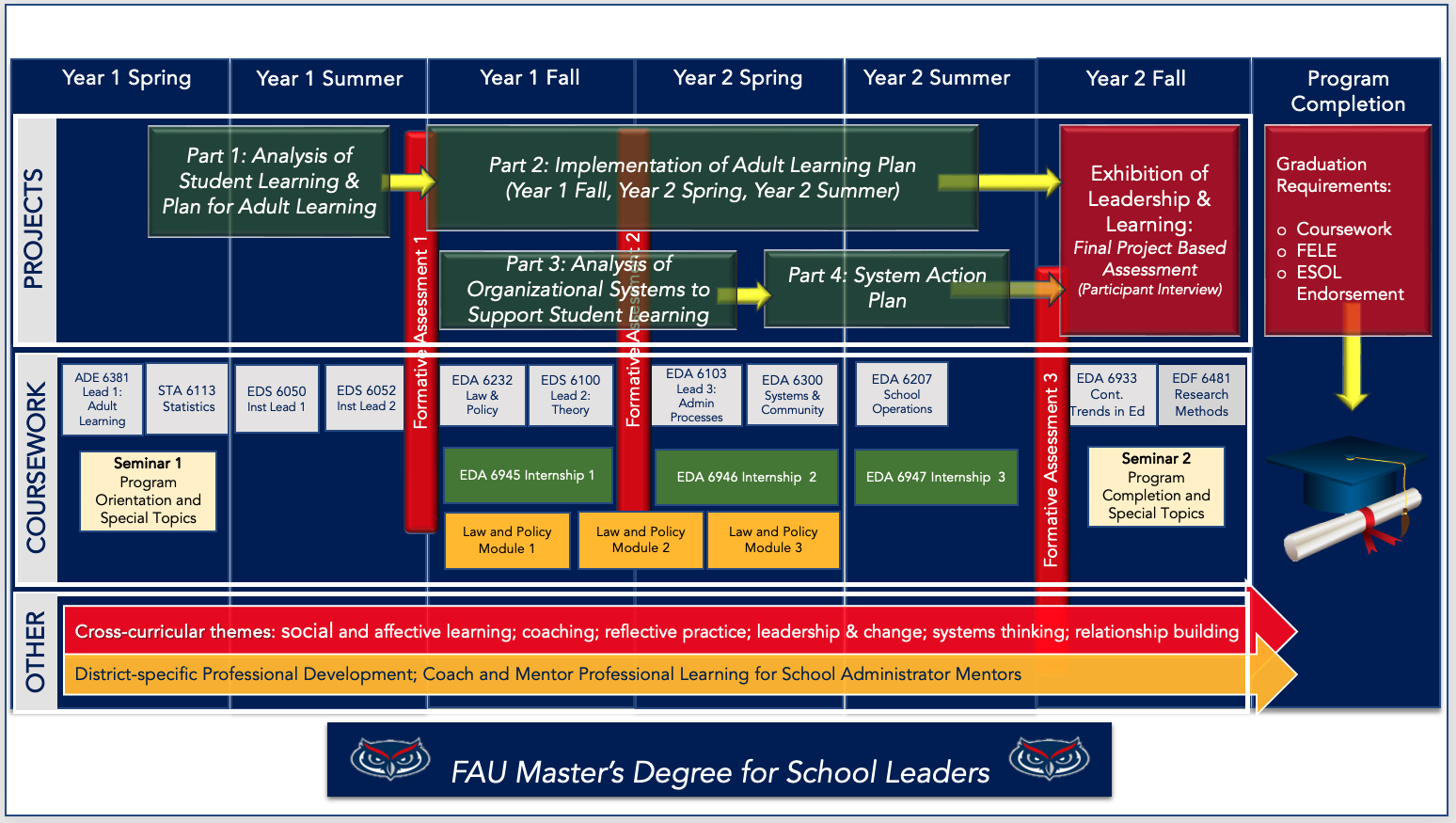
IDEAL Curriculum Schedule
As mentioned, coursework is complemented asynchronously through online readings, journals, and assignments. The latter consist of directed research and tasks students conduct at their place of work. Using this rotation, students can complete the program in six semesters (see IDEAL Curriculum Schedule above). Please note that the program requires full-time attendance. Exceptions due to major life circumstances will be considered on a case-by-case basis.