Active Shooter Procedures
Violent incidents, including but not limited to: acts of terrorism, an active shooter, assaults, or other incidents of workplace violence, can occur on the University grounds or in close proximity with little or no warning. An active shooter is considered to be a suspect or assailant whose activity is immediately causing serious injury or death and has not been contained.
The Florida Atlantic University Police Department has adopted nationally accredited law enforcement response procedures to contain and terminate such threats as quickly as possible. The following information regarding law enforcement response will enable you to take appropriate protective actions for yourself. Try to remain calm as your actions will influence others. The following instructions are intended for incidents that are of an emergent nature (i.e. imminent, or in progress).
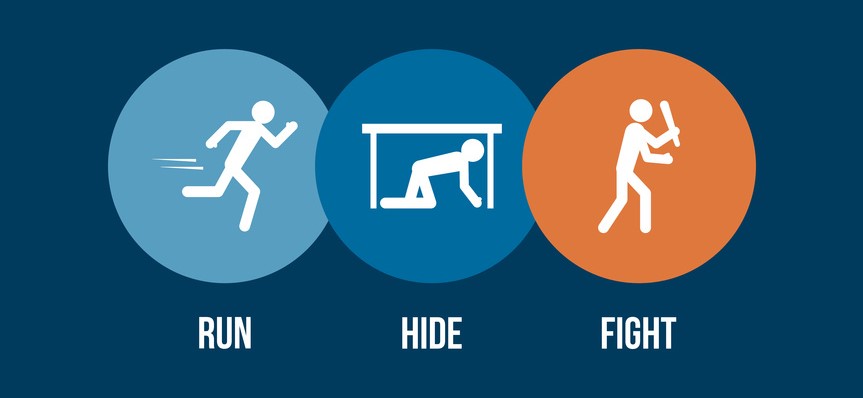
The awareness and preparedness of members of our community is equally important. We present this information for your use and distribution.
Additionally, the Florida Atlantic University Police Department offers workshops in safety and crime prevention.
Learn information about crime prevention.
Below are links to guides provided by the United States Department of Homeland Security. They are guidelines for action should you find yourself in an active shooter situation. Please feel free to print them for your personal reference or share them with other students, faculty, staff members, or anyone you think may benefit from having this information.
http://www.dhs.gov/xlibrary/assets/active_shooter_pocket_card.pdf
http://www.dhs.gov/xlibrary/assets/active_shooter_poster.pdf
If you find yourself involved in an active shooter situation, try to remain calm and call 9-1-1 or the University Police at (561) 297-3500, as soon as possible.
1. Run.
If there is an accessible escape path, attempt to evacuate the premises. Be sure to:
• Have an escape route and plan in mind.
• Evacuate regardless of whether others agree to follow.
• Leave your belongings behind.
• Help others escape, if possible.
• Prevent individuals from entering an area where the active shooter may be.
• Keep your hands visible.
• Follow the instructions of any police officers.
• Do not attempt to move wounded people.
• Call 9-1-1 when you are safe.
2. Hide.
If evacuation is not possible, find a place to hide where the active shooter is less likely to find you. Your hiding place should:
• Be out of the active shooter’s view.
• Provide protection if shots are fired in your direction (i.e., an office with a closed and locked door).
• Not trap you or restrict your options for movement.
To prevent an active shooter from entering your hiding place:
• Lock the door.
• Blockade the door with heavy furniture.
If the active shooter is nearby:
• Lock the door.
• Silence your cell phone and/or pager.
• Turn off any source of noise (i.e., radios, televisions).
• Hide behind large items (i.e., cabinets, desks).
• Remain quiet.
If evacuation and hiding out are not possible:
• Remain calm.
• Dial 9-1-1, if possible, to alert police to the active shooter’s location.
• If you cannot speak, leave the line open and allow the dispatcher to listen.
3. Fight.
Take action against the active shooter as a last resort, and only when your life is in imminent danger, attempt to disrupt and/or incapacitate the active shooter by:
• Acting as aggressively as possible against him/her.
• Throwing items and improvising weapons.
• Yelling.
• Committing to your actions.
• If you observed any victims, give a description of the location and number of victims.
• If you observed any suspicious devices (improvised explosive devices), provide the location seen and a description, if possible.
• If you heard any explosions provide a description and location.
• Attempts to rescue people should only be attempted if they can be accomplished without further endangering the persons inside a secured area.
• Depending on circumstances, consideration may also be given to exiting ground floor windows as safely and quietly as possible.
• Officers usually arrive in teams of more than one officer.
• Officers may wear regular patrol uniforms or external bulletproof vests, Kevlar helmets, and other tactical equipment.
• Officers may be armed with rifles, shotguns, and handguns.
• Officers may use pepper spray or tear gas to help control the situation.
• Officers may speak sternly, shout commands, and may push individuals to the ground for their safety.
• Put down any items in your hands (i.e., bags, jackets).
• Immediately raise hands and spread fingers.
• Keep hands visible at all times.
• Avoid making quick movements toward officers such as holding on to them for safety.
• Avoid pointing, screaming, and/or yelling.
• Do not stop to ask officers for help or direction when evacuating, just proceed in the direction from which officers are entering the premises.