Artificial Intelligence
Artificial Intelligence
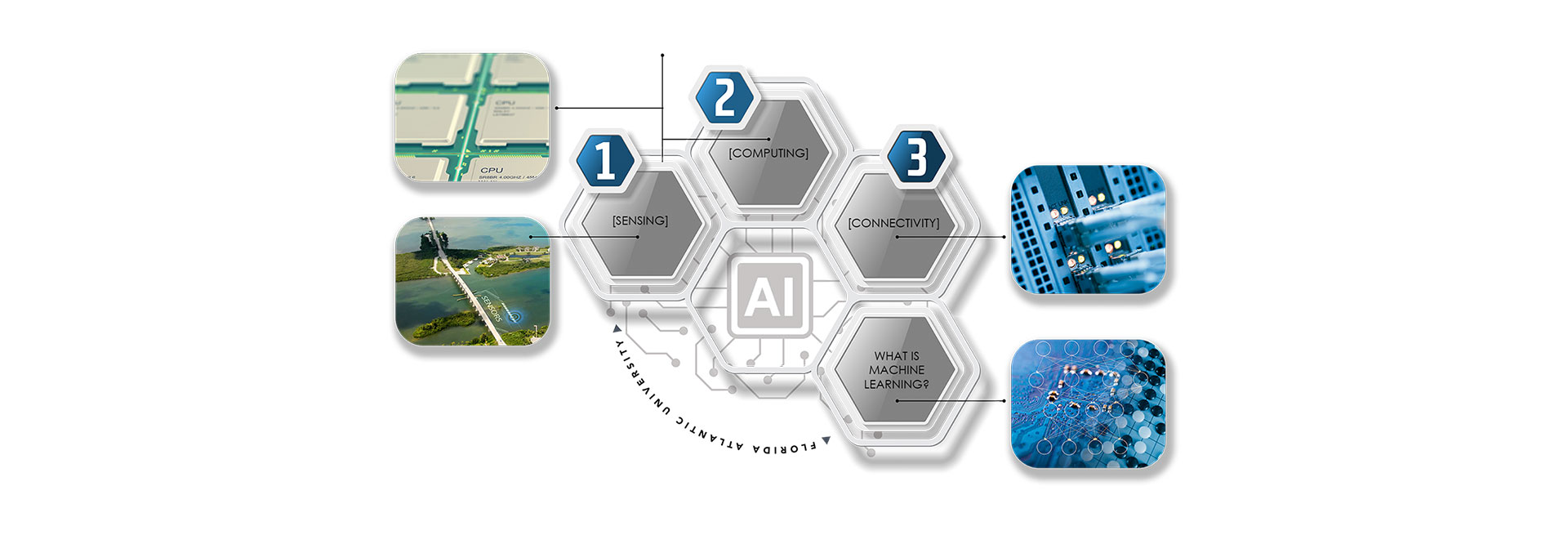
Artificial Intelligence (or AI for short) has three main components, sensing, computing and connectivity. FAU is incorporating all of these into engineering, medical and other areas of research and education.
[Sensing]
Sensors measure information about physical and sometimes virtual environments.
[Computing]
Computing leverages advancements in hardware, software, and algorithm design to solve increasingly complex tasks.
[Connectivity]
Connectivity aggregates the power of individual devices to create a whole greater than the sum of its parts.
What is Machine Learning?
Machine learning algorithms identify patterns, trends, and rules that are too complex for humans to see. But since machines do not learn like humans, these algorithms require a large amount of data to use as learning examples. Sensor systems are among the most useful data sources in constructing these examples.
What is AI?
Artificial intelligence mimics aspects of human intelligence, like learning. It is generated by giving computers step-by-step instructions known as algorithms. AI can take a digital form, like a chatbot, or engineers can combine it with robotics, sensors and wireless communication to create things like self-driving cars or package-delivering drones.
FAU already has significant expertise in place. Research at the Institute for Sensing and Embedded Network Systems Engineering (I-SENSE), for example, focuses on sensing the environment and interpreting that data with AI — the sort of technology that could enable self-driving cars to detect road conditions and navigate safely. Meanwhile, researchers in the college and across the university are developing and applying AI in many ways, even exploring its ethical implications.
The university is implementing new degree options for students, including a Master of Science with a major in AI, the first such degree in the state; a multidisciplinary Master of Science in Data Science and Analytics; and a joint degree that funnels students from the Harriet L. Wilkes Honors College to a Master of Science in Data Science.
Compared to its inspiration, the human brain, state-of-the-art AI’s capabilities are limited. The technology’s greatest potential arises when used within autonomous machines that work together — like self-driving cars optimizing traffic flow, or a swarm of drones re-establishing a wireless network after a disaster.
In addition, FAU’s Wimberly Library will soon be home to The Rubin and Cindy Gruber Sandbox, a 3,400 square-foot state-of-the-art artificial intelligence lab.
How will AI affect me?
AI is being referred to as the fourth industrial revolution because of the impact it will have on our daily lives ranging from medical to defense, communication and traffic. Examples include sensors that determine when your lawn needs water or fertilizer, thus helping conserve a dwindling fresh water supply. Traffic light sensors will communicate with cars … and cars will communicate with other cars, resulting in fewer accidents and less traffic congestion that improves your daily commute. You will soon be able to communicate from anywhere including underwater, underground and even in space.
Questions about AI
Will AI cost people their jobs?
While some jobs will be replaced by technology, others will be created. AI is most beneficial as an augment to existing jobs vs a replacement to human beings.
Where is AI being used most?
AI is being used in navigation apps like Google Maps, as well as in digital assistants like Apple’s SIRI and Amazon’s ALEXA. The AI is programmed with a database then “learns” as it is used.
What are the advantages of AI?
AI devices make fewer errors than humans. In some cases, where the task is repetitive, the error rate is exceptionally low. AI takes less time to search billions of options (seconds or minutes compared to years or not possible).
Environment


-
Curet was awarded $500,000 from the National Science Foundation for the Bio-Inspired Underwater Vessels for Coastal Monitoring, Inspection and Station Keeping project.
Secure Communication

-
-

-
Intelligent Transportation


-
Cyberphysical Systems and Energy

-

-
Nojoumian was awarded $300,135 from the Army for his work with the Incentivizing Blockchain Miners to Avoid Dishonest Mining Strategies by a Reputation-Based Paradigm.
-

-
Nurgun Erdol, Ph.D., developed an automated classification algorithm – Fish Acoustic detection Algorithm Research (FADAR), capable of identifying species of groupers in their natural environment with a classification accuracy. Erdol is a professor and Department Chair in the Computer and Electrical Engineering and Computer Science.
Emergency Planning and Resilience
-
Active Projects:
Emergency Planning and Resilience Projects
Cybersecurity
- Detecting deep fake speech (in partnership with Los Alamos National Laboratory)
Mobile Phone Security
- Kristen Crawford, Logan Arrandale, and William Hahn. All Ears: Can Ear Recognition Software be a Solution for Mobile Phone Security? 2019 First Place Cross-Disciplinary FAU Wave Undergraduate Research Award
Human Pose Analysis
- Classifying criminal human behavior from skeletal key points with deep neural network
Healthcare Diagnostics and IT

-
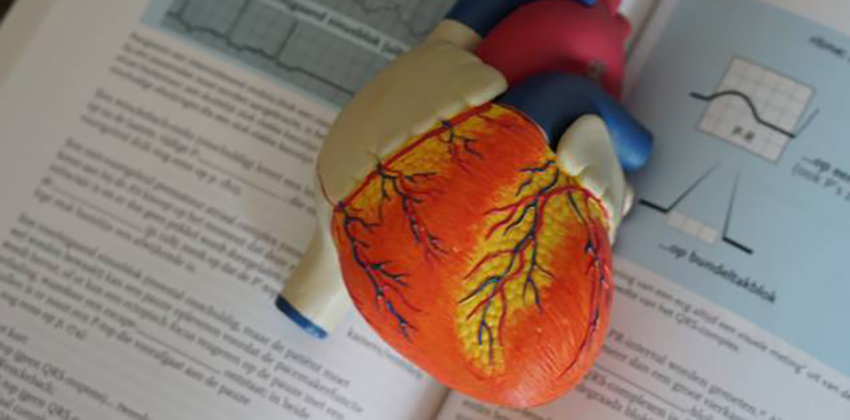
In addition, Ghoraani and other researchers, developed the first algorithm that can locate patient-specific ablation targets within the atria that does not require specialized catheters or 3D electro-anatomic maps of the heart. The new algorithm – the iterative catheter navigation (ICAN) – is fundamentally different from existing approaches.
Ghoranni was funded $259,426 from the National Institutes of Health for her work on the Catheter Guidance Algorithm for Identification of Atrial Fibrillation Ablation Targets.
-
-
Batalama received a $500,000 grant from the National Science Foundation for the Cognitive Networking of the Oceans: Localization and Tracking Fundamentals project.

-
-
Active Projects:
Machine Olfaction (Emily Stark)
- Melanoma detection from non-invasive gas sampling (in partnership with University of Warwick)
- Deep-learning based classification for small datasets of high resolution data
- Deep-learning investigation of VOC patterns as biomarkers of respiratory infections (in partnership with IMSPEX Corporation)
- Autonomous broiler house monitoring for commercial growers (in partnership with Auburn University and Kansas State University)
Computational Biology (Paul Morris, Danny DaSilva, Rachael St. Clair)
- Convolutional neural networks for predicting molecular binding affinity to HIV-1 proteins
- Suppressing and modeling autoimmune disorders via primary protein sequences
- A deep learning approach to virtual high throughput screening (vHTS) for drug discovery
- Predicting neuronal orphan receptor ligand binding
- Automatic tracking and analysis of C. elegans during high throughput seizure assays
Human Pose Analysis
- Detecting drug impairment with deep learning (collaboration with Banyan Detox Facility)
- AI-based feedback for prevention of body-focused repetitive behaviors
- Predicting therapy interaction success (in collaboration with Paul Peluso)
- Using gait estimation for early detection of dementia
- Good posture application: feedback for postural improvement
Prevention of Body-focused Repetitive Behaviors
- Stefani Moccia, Elan Barenholtz, and William Hahn. AI-based Feedback for Prevention of Body-focused Repetitive Behaviors 2019 Second Place Behavioral, Educational & Social Science FAU Wave Undergraduate Research Award
deep learning and their applied utility toward chemical informatics
- Evan Clark, Rachel St Clair, Mike Teti, Elan Barenholtz and William Hahn. Advances in deep learning and their applied utility toward chemical informatics and drug discovery. ACS Conference 2019 Accepted with Talk.
Virtual high-throughput screening
- Paul Morris, Rachel St Clair, Mike Teti, Elan Barenholtz and William Hahn. Virtual high-throughput screening; A combined deep-learning approach. ACS Conference 2019 Accepted with Talk.
Predicting Molecular Binding Affinity to HIV-1 Proteins
- Morris, Paul & DaSilva, Yahchayil & Clark, Evan & Hahn, William & Barenholtz, Elan. (2018). Convolutional Neural Networks for Predicting Molecular Binding Affinity to HIV-1 Proteins. Proceedings of the 2018 ACM International Conference on Bioinformatics, Computational Biology, and Health Informatics. ACM, 2018.
Transcriptome Sequence Analysis of Primary Tumors
- Wilson, Kelsey & Augustin, Regynald & Morris, Paul & Clark, Evan & Hahn, William & Barenholtz, Elan. (2018). Deep Learning Guided Transcriptome Sequence Analysis of Primary Tumors for Differentiation and Diagnosis of Multiple Cancers. GPU Technology Conference, DOI:10.13140/RG.2.2.26273.71521
Prediction for Synthetic Biology and Genetic Engineering
- Teti, Michael, Rachel St Clair, Abrian Miller and William Edward Hahn. Deep Learning Sequence Prediction for Synthetic Biology and Genetic Engineering. iGem 2017 Accepted with Talk.
Emotion Recognition from Photographs
- Geela Ramos, Fabio Ibanez, and William Hahn. Deep Learning Emotion Recognition from Photographs. 2018 1st Place Broward County Regional Science and Engineering Fair and 2nd Place Florida State County Science Fair
Mood Disorder Classification Using Eye Movements
- Developing a Model for Mood Disorder Classification Using Eye Movements. Michael Kleiman, Evita Conway, Elan Barenholtz and William Hahn. 2018 FAU Wave Competition. (First Place)
Machine Olfaction
- Machine Olfaction Using Deep Learning Artificial Neural Networks, Stephen Hoover, Biomedical engineering oral presentation presented the National Council on Undergraduate Research, April 2
Connected Autonomy and Robotics
-
Curet was awarded $500,000 from the National Science Foundation for the Bio-Inspired Underwater Vessels for Coastal Monitoring, Inspection and Station Keeping project.
Active Projects:
Connected Autonomy & Robotics Projects
Autonomous Navigation
- Autonomous wheelchair, Autonomous navigation and voice control (Matt Trask)
- Autonomous golf cart, add autonomous navigation and control (Matt Trask)
- Autonomous ocean trash collection robot (with Department of Mechanical Engineering)
- Evaluation of deep neural networks in an autonomous robot (Mike Teti)
Machine Olfaction
- Autonomous broiler house monitoring for commercial growers (in partnership with Auburn University and Kansas State University)
Sparse Coding and Compressed Sensing
- Learning attention through unsupervised sparse coding in an autonomous robot
Q-Learning
- Utilizing OpenCV for Q-Learning State Space Reduction in Re-Purposed Off-The-Shelf FPV Rovers” Paul Morris, Marcus McGuire, Shawn Martin, Nicolas Tutuianu, Washington Garcia, William Hahn and Elan Barenholtz. FAU Undergraduate Research Symposium, 2017. (First Place)
Air Gapped Video Steam
- Rodrigo Castellon, and William Hahn. End-to-end Vehicle Control from Air Gapped Video Steam. 2018 1st Place Broward County Regional Science and Engineering Fair, 3rd Place Florida State Science and Engineering Fair, and NASA Special Recognition Award
Deep Learning Architectures in an Autonomous-Vehicle
- Teti, Michael, Elan Barenholtz and William Hahn. A Systematic Comparison of Deep Learning Architectures in an Autonomous-Vehicle. GTC 2018. Accepted with Talk.
Social Science


-
Active Projects:
Social Science Projects
Human Pose Analysis
- Assessing level of interest and engagement during video viewing (Nicole Perez)
- Classifying criminal human behavior from skeletal key points with deep neural networks
The Ethics of Robotic Olfaction
- Stark, Emily & Pitt, Jeremy & Nur Wicaksono, Alfian & Milanovic, Kristina & Lush, Victoria & Hoover, Stephen. (2018). Odorveillance and the Ethics of Robotic Olfaction [Opinion]. IEEE Technology and Society Magazine