
Professional Master of Science in Supply Chain Management (MSSCM)
Professional Master’s in Supply Chain Management
The Professional Master of Science in Supply Chain Management (MSSCM) is a 30-credit program catered to working professional students. Supply Chains are essential for the trade, retail, manufacturing, and service industries and are expanding geographically and in scope. Continued globalization, advancements in digital technologies, and the more recent emphasis on Blockchain have resulted in an increased focus on supply chain and its risks.
FAU's Master of Science in Supply Chain Management program offers (1) a strong curriculum, delivering the foundations and principles of Supply Chain Management, Operations Management, Procurement, and Sourcing, integrated with major subfields such as Artificial Intelligence, Big Data Analytics, and Blockchain; (2) high-quality applied industry projects supervised by experts in the field; and (3) software and simulation systems that students can apply to real world situations and problem solving.
Graduates earning the Master in Supply Chain Management are equipped to meet market demands for highly skilled individuals able to manage a wide range of supply chain management functions including data and analytics skills, as well as to analyze, interpret, and make data-based business decisions.
FAU’s Graduate Business programs –already ranked among prominent universities in U.S. News & World Report national rankings—are expanding to offer the Professional Master of Science in Supply Chain Management (MSSCM) for aspiring leaders.
Earning a Professional Master's in Supply Chain Management provides graduates with a comprehensive understanding of the complexities of international commerce and how to tackle the unique challenges of organizations and communities operating in a fast-paced global business landscape through a variety of career options. Students will be challenged to think critically in and will be equipped to lead in multi-national roles.
Apply For On-Campus Spring 2027 Apply For Online Spring 2027 Request Information Information Sessions And Events Get In Touch
Why Supply Chain Management?
Supply Chain is a crucial element of the trade, retail, manufacturing, and service industries. Global trade and shipping are key aspects of the South Florida economy. Globalization and advancements in digital technologies, along with the most recent emphasis on Blockchain, have resulted in an increased focus on supply chain and its risks. Supply chains are expanding geographically and in scope leading to an increasing demand for supply chain management professionals locally and nationwide.
Learning Objectives:
- Develop a global business operations perspective
- Identify management issues, risks and opportunities in emerging environments
- Gain skills and knowledge to be competitive in Supply Chain and Logistics Management
- Understand successful management of global supply chain network processes: sourcing, operations, and distribution
Employment opportunities for Supply Chain Management Professionals are expected to grow by 30% from 2020 to 2030, much faster than the average for all professions (US Bureau of Labor Statistics). Graduates with a Master's in Supply Chain Management earn an average base salary of $78,000 a year (Payscale).
Sample of Career Roles:
- Purchasing agent
- Operations manager
- Logistics analyst
- Purchasing manager
- Supply chain manager
- Logistician
- Logistics manager
- Production, planning and expediting clerk
- Storage and distribution manager
Learning Methodology
A variety of learning methods are employed throughout the program. Case studies, computer simulations of challenging, competitive business situations, problem-solving discussions, team presentations, individual study, lectures, visual presentations, guest speakers, and assigned readings are regularly used. Students also complete research and analytical studies to develop strategic thinking abilities.
Program Features
- 10 courses/ 30 credits
- 8-week terms
- In-person on the Boca Raton campus:
- Monday & Wednesday Evenings, 6:30 PM - 9:30 PM
- Students may attend live virtual during class hours
- $27,000
- $900 per credit hour
- Program Fees Include: Tuition, e-books and materials, software, student ID with access to facilities and library resources, parking e-permit, review classes and recorded classes, professional development training, graduation cap and gown, and banquet
- Fees are the same for Florida Residents, Out-of-State Residents & International Students
- Financial aid, tuition reimbursement, self-pay, and veterans' benefits are all accepted
- Globally recognized AACSB-accredited College of Business
- Program starts every Spring (January) and Fall (August) of each year
- Courses taught by world-class faculty
- Exclusive access to state-of-the-art classrooms, study rooms, and facilities
- 10 courses/ 30 credits
- 8-week terms, Completely Online
- $27,000
- $900 per credit hour
- Program Fees Include: Tuition, e-books and materials, software, student ID with access to facilities and library resources, parking e-permit, review classes and recorded classes, professional development training, graduation cap and gown, and banquet
- Fees are the same for Florida Residents, Out-of-State Residents & International Students
- Financial aid, tuition reimbursement, self-pay, and veterans benefits are all accepted
- Globally-recognized AACSB accredited College of Business
- Program starts every Spring (January) and Fall (August) of each year
- Courses taught by world-class faculty
- Exclusive access to state-of-the-art classrooms, study rooms, and facilities
Program Calendar
The Office of Executive Education reviews candidate applications on an individual basis looking at aspects of an applicant's professional and academic background. Spring 2027 Online: Click HERE to access/return to the Departmental Application Spring 2027 On-Campus: Click HERE to access/return to the Departmental Application Item 2: Submit Unofficial Transcript(s) or Unofficial Transcript Evaluation Item 3: Submit Letters of Recommendation Non-native speakers of English must provide evidence of proficiency in English from: Test of English as a Foreign Language (TOEFL), International English Language Testing System (IELTS), or Duolingo. Please note, applicants are responsible for making arrangements to schedule the test(s). The minimum College of Business requirements Here is the official FAU regulation on English Language Proficiency Regulation 4.009. Non-Native speakers of English are not required to submit proof of English language proficiency if they meet one of the following:Admission & Application Process
Item 1: Submit Current Resume
Current resume with three academic or professional references on last page including: reference name, title, company, contact information.
Upload your unofficial transcript(s) from your bachelor’s program or transcript evaluation (this step is NOT required for FAU graduates). If you only have an official copy of your transcripts or evaluation, please mail them to our office (listed below). Graduates of a foreign college who have completed an academic program equivalent to a U.S. bachelor's degree are required to submit a course-by-course and GPA evaluation from a foreign credentials evaluation service that is a member of NACES.
The supplemental application includes a "Recommendations" tab with space to enter email addresses corresponding to your recommenders (two letters recommended). If email addresses are entered, please notify your recommenders that they can expect a request from you - via email - containing a link to our database. Alternatively, upload scanned letters of recommendation. Recommenders should be academic (professor, instructor) or professional (colleague, manager, associate) and can be a subset of your references. The letter should address your work ethic, preparedness for graduate studies, how the degree would help you advance your profession, etc. A one-page document composed of 2-3 paragraphs will suffice for this requirement for each letter.
Curriculum
The Professional Master of Science in Supply Chain Management (MSSCM) is a 30-credit program consisting of coursework centered on supply chain management. Courses focus on shipping, trade and port management, and technology and business analytics, which are important for the local and national economies, especially those connected to the global trade community. *Software/tools used in courses (subject to change).
Core Curriculum - 9 courses (27 credits) Introduces the major managerial problems and decision processes of operations management. Includes design of operations: planning, scheduling, quality management, systems analysis and evaluation, resource allocation, and inventory management. Integration of operations management with other functional areas. *Microsoft Excel, Solver Add-in Provides an understanding of key issues, mechanics, and developments in sourcing and supply chain management. Explores the connection of supply chain network to all of the value activities that plan, control, and supply interim and finished product services to customers. *Microsoft Excel, Solver Add-in Solve research and business problems by leveraging the most powerful productivity tool, Excel. Curation, management, analysis, and visualization of information and data are covered by using PowerView, Vlookup, charts, pivot tables, scenarios, functions, macro programming etc. *Microsoft ExcelSupply Chain Management Core Curriculum Courses
(3 credits)
(3 credits)
(3 credits)
(3 credits)
(3 credits)
(3 credits)
(3 credits)
(3 credits)
(3 credits)
Elective - 1 course (3 credits). Select (1) of the following Elective courses: Introduces the core concepts of data mining (DM) and its techniques, implementation and benefits. Identifies industry branches that most benefit from DM, such as retail, target marketing, fraud protection, health care and science, and web and e-commerce. Detailed case studies and using leading mining tools on real data are presented. *Analytical Solver Platform (XLMiner) & Rapid Miner Provides an understanding of the business intelligence and business analytics processes and techniques used in transforming data to knowledge and value in organizations. Students also develop skills in analyzing data using generally available tools (e.g. Excel). *Microsoft Excel & Tableau An in-depth examination of business analytics methods of visualization, data mining, text mining and web mining, using various analytical tools. In a laboratory setting, investigates applications for smaller firms. *Python, R & MySQL Workbench Provides a business perspective of artificial intelligence (AI) and other emerging technologies as drivers of innovation in businesses. Students learn how AI is used in practice across organizations and industries, how to plan, manage and maintain AI projects, and how to address the AI challenges and implications for the organization and society. *IBM Watson Studio; IBM Cloud Develops skills for launching and managing web-based businesses. Students complete a business plan for starting an online business of their choice. Additional topics include evaluating current web-based business opportunities, online entrepreneurship, web-based venture financing and e-business operations. Covers concepts and techniques for retrieving, exploring, visualizing and analyzing social network and social media data, website usage and clickstream data. Learn to use key metrics to assess goals and return on investment and perform social network analysis to identify important social actors, subgroups, and network properties in social media. *Google Analytics, Similarweb, OpenTracker, Facebook InsightsSupply Chain Management Core Elective Courses
(3 credits)
(3 credits)
(3 credits)
(3 credits)
(3 credits)
(3 credits)
(3 credits)
(3 credits)
(3 credits)
Educational Objectives & Student Outcomes
2. Integrate advanced topics such as AI, big data analytics, and blockchain into supply chain practice.
3. Apply industry-standard software and simulation tools to real-world business challenges.
4. Prepare for leadership roles in a variety of sectors, including trade, retail, manufacturing, and services.
2. Manage procurement, sourcing, and logistics functions effectively.
3. Leverage technology to solve complex supply chain problems.
4. Communicate solutions and strategies clearly to diverse audiences.
5. Demonstrate ethical and professional standards in global supply chain environments.
FAU College of Business Faculty
One of the strongest attributes of the Florida Atlantic University College of Business is the highly esteemed and experienced faculty. Classes are taught using a balanced blend of case studies, real-world examples and strong academic theories, making the crucial real-time link between the classroom and industry.
The faculty members in the Master's in Supply Chain Management program are selected from the nearly 90 full-time faculty in the College of Business. Selection criteria include excellence in teaching, consulting, research, and publication.
Faculty teach in the Master's in Supply Chain Management program because they are interested in the practical world of international business and appreciate the emerging opportunities and difficulties. Additionally, the expertise of your professors is demonstrated by their scholarship, industry experience, and research prowess:
- Earned doctoral degrees from the nation's most prestigious AACSB-accredited universities, such as Harvard, Wharton School, Northwestern, MIT, Columbia, Chicago, NYU, and Michigan.
- Consulted with Fortune 500 firms, small businesses, and government; published numerous texts and articles.
- Published articles in leading academic business journals:
- Accounting Review, Auditing: A Journal of Practice & Theory, Accounting Horizons, Journal of Accounting Research, Financial Review, Financial Management, Journal of Financial Research, Journal of Marketing, Journal of Marketing Research, Journal of Retailing, Journal of Consumer Marketing, International Marketing Review, Journal of Business Research, Public Opinion Quarterly, Columbia Journal of World Business, International Business Studies.
- Published articles in the most widely recognized practitioner-oriented business and trade journals:
- Harvard Business Review, Journal of Accountancy, Business Horizons, Long Range Planning, Marketing News, American Demographics, The CPA Journal, Journal of Taxation, Financial Executive, Banker's Magazine, Bank Marketing, Productions and Inventory Management, The Financial Planner, The Personnel Administrator, The Development Journal.
Guest speakers from industry and government may also be invited to lecture.
Tuition & Payment Options
Professional Master's in Supply Chain Management Program Fees
| Program Type | Per Credit Hour | Total Number of Credits | Total Program Cost |
| Online / On-Campus | $900 | 30 credits total | $27,000 |
Program Fees are the same for Florida residents, out-of-state residents, and international students.
Online & On-Campus Program Fees include:
- Instructional materials, eBooks, and software
- Refreshments and snacks for in-person attendees during class sessions (on-campus only)
- Recordings of all course lectures
- Digital parking permit
- Student ID card
- Dedicated Advisor and guaranteed schedule for the entire program
- Access to workshops and seminars
- Business Career Specialist
- Full support: advising, tech support, financial services, career guidance
- Lifetime discounted rates on professional development certificate courses
- 24/7 access to dedicated group study rooms
- Microsoft Office products
- Tutoring and writing services
- Graduation regalia
- Graduation banquet
Financial Information
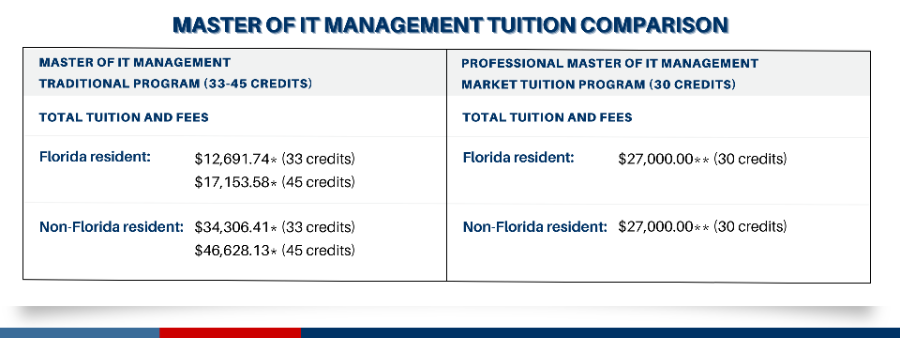
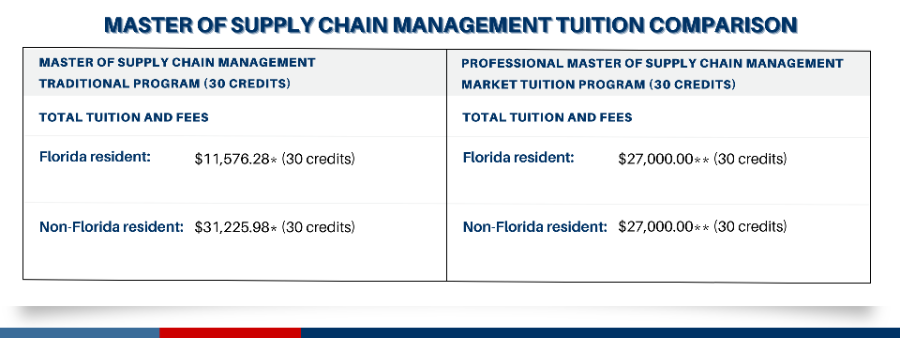
*The total tuition and fees include per credit hour fees, non-resident fee if applicable, tuition differential, capital improvement fee, financial aid fee, activity and service fee, athletic fee, health fee, technology fee, transportation access, for two years, student ID card, and graduate orientation fee.
**The total tuition and fees include per credit hour fees, non-resident fee if applicable, tuition differential, capital improvement fee, financial aid fee, activity and service fee, athletic fee, health fee, technology fee, transportation access, for two years, student ID card, graduate orientation fee, textbooks and materials, graduation regalia, and graduation banquet.
For more information regarding the traditional tuition and fees, please visit: Tuition Breakdown
For information on financial assistance, please visit: Financial Aid
For obligations for repayment of Federal Student Aid, please visit: https://studentaid.gov/manage-loans/repayment/plans
Additional Financial Information
Upcoming Events
Join us for a variety of events and information sessions.
Executive Education Admissions
777 Glades Road, Boca Raton, FL 33431
phone:
(561) 297-6000
fax:
(561) 297-2179
email:
MSSCM@fau.edu
map:
Bldg. 103, SF 129
Accreditation & Rankings
Executive Education Professional Development Programs
Best MBA in Sport Management
AACSB Accreditation
Best Business Programs
Best National Universities

R1 Distinction
Best Online Bachelor's Program
Best Online MBA Program in Business
Best Online Graduate Schools in Business
Best Online Veteran Bachelor's Program
Best Online Bachelor's in Business
Top 50 in Undergrad Entrepreneurship
Top 50 in Graduate Entrepreneurship
Best Graduate Business Schools in Accounting
Best Graduate Business Schools in Entrepreneurship
Best Graduate Business Schools in Finance
Best Graduate Schools in International Business