News of FAU Observatory
Section updated: November 2nd 2026.
The month of November 2026 will be filled with astronomical and Observatory events.
Sunday, November 1st: 🌗 3 rd Quarter Moon
Tuesday, November 3rd: 🗳️ Election Day
Please make your votes carefully and remember that pro-Science and Health are very important!
Friday, November 6th : 🔭 Public Viewing Session 7 pm - midnight
A rich part of the sky will be available to us for the evening of November 6th.
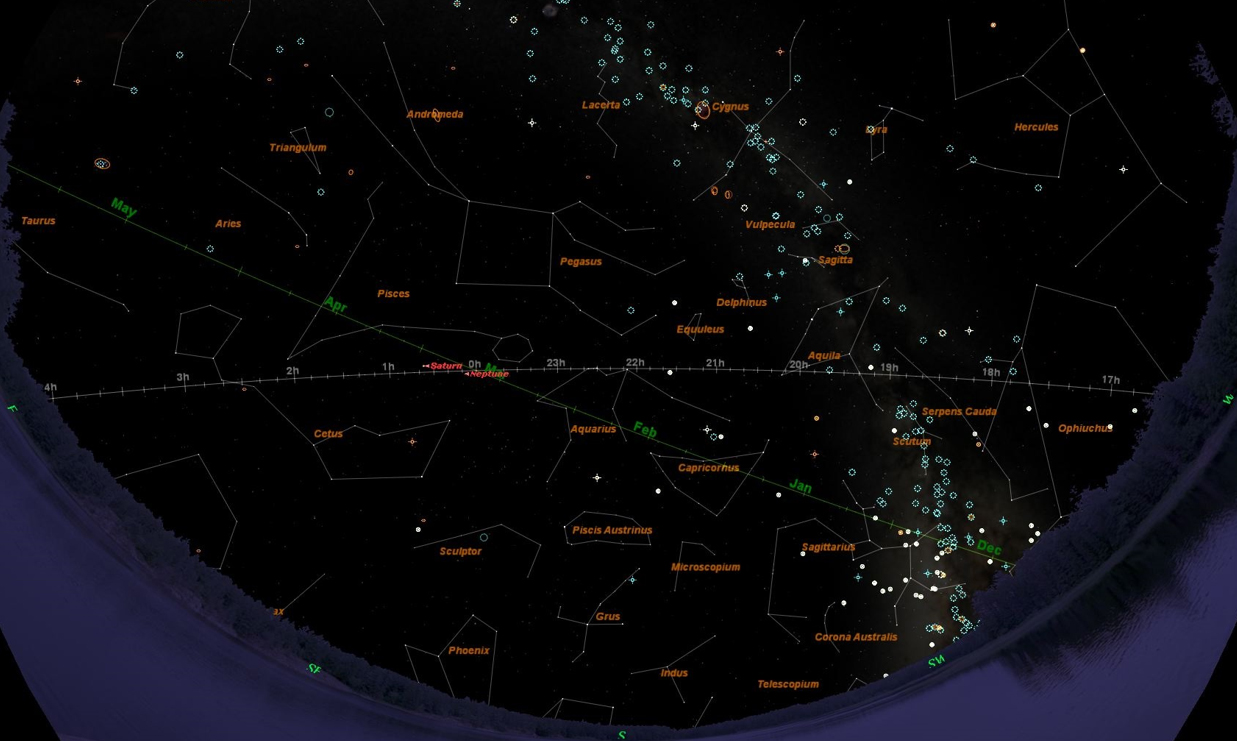
Shown above are the light circles for globular clusters such as M13 & M92 in Hercules, light blue circles are open clusters, and cyan crossed circles are planetary nebula, orange ovals are galaxies, though they are challenged by the light pollution from the surrounding cities. Below the green ecliptic line south of the constellation of Pisces, is where we will find the planets Neptune and the “ Planet of Geometry ” Saturn.
Among the variety of things to explore are the globular clusters M5 in Serpens Caput and M22 in Sagittarius. Open clusters NGC 6802, called Brocchi’s Cluster (a.k.a. the “Coat-hanger cluster”) in Vulpecula the fox, NGC 7662 in Andromeda, The planetary nebula of the “Saturn Nebula” NGC 7009 in Aquarius, M57, the Ring Nebula, in Lyra near the star Vega, and the “blinking planetary nebula” NGC6826 in the constellation of Cygnus the swan. We will also spy on its apparent, binary star called Albeiro, the swan’s beak, which are colored blue and gold, like the Ukrainian flag.
Thursday, November 9th: 🌑 New Moon
Wednesday, November 11th 🎖️🌠 Veteran’s Day, Northern Taurids Meteor Shower
Coming from a radiant near the Pleiades in Taurus, the Earth scoops up particles from the comet 2P Encke. The numbers of its meteors are meager about 5 per hour. The meteors travel at 29 km/s, so are slowish, but brighter than average meteors. Lunar conditions are ideal for viewing them.
As the meteors will appear to travel all across the entire sky, you'll want a dark, clear and unobstructed view of it that you can find. So go far away from city lights to see them. In South Florida, I often advise folks to try the beach, though please be VERY careful during sea turtle season! Use only red LED flashlights as the color also protects your night vision (and of course your nighttime circadian rhythm, too) so that you can see the show. Bring a blanket, use bug spray, get comfortable and enjoy the view!
Tuesday, November 17th : 🌓🌠🔭 1st Qtr Moon, Public Viewing Session, Leonids Meteor Shower
Similar conditions will be found this night as was available on the 6th. However, we’ll also be treated to the first quarter Moon, too.
Coming from the head of Leo the Lion, will be the radiant point of the Leonid Meteor Shower from the comet 55P Tempel-Tuttle. While the numbers of its meteors are only ~15 per hour, they are the fastest traveling at 71 km/s! Expect them to be brighter than average meteors, often with persistent trains. Lunar conditions are great for viewing them.
Saturday, November 21st: Alpha Monocerotids Meteor Shower
Coming near southeast of Procyon will be the radiant point of the α Monocerotids Meteor Shower from an unknown comet. Its numbers are variable ranging between 3 to 400 per hour! They are fast, brighter than average meteors, traveling at 65 km/s. The waxing gibbous Moon shouldn’t be too much of a problem for viewing them.
Tuesday, November 24th: 🌕 Full Moon
Wednesday, November 25th: ☍ Uranus Opposition
Uranus will reach opposition on this night, appearing as a tiny light cyan ball, 18.444 au away from us and a whopping 3.8 arc seconds across! The light from it that one may see will have taken 2.55 hours to reach us.
Wednesday, November 25th - Friday, 27th : 🦃 Closed for Thanksgiving Break
Enjoy the holiday break!
Monday, November 30th : 🌖♃♂*☌ Moon, Jupiter, Mars & Regulus Conjunction
A treat awaits those who are up early. For if they look up, they will see the Moon, the planets Jupiter and Mars, and the star Regulus will appear to join together in the predawn sky. Their conjunction will appear best around 5:30 am.